





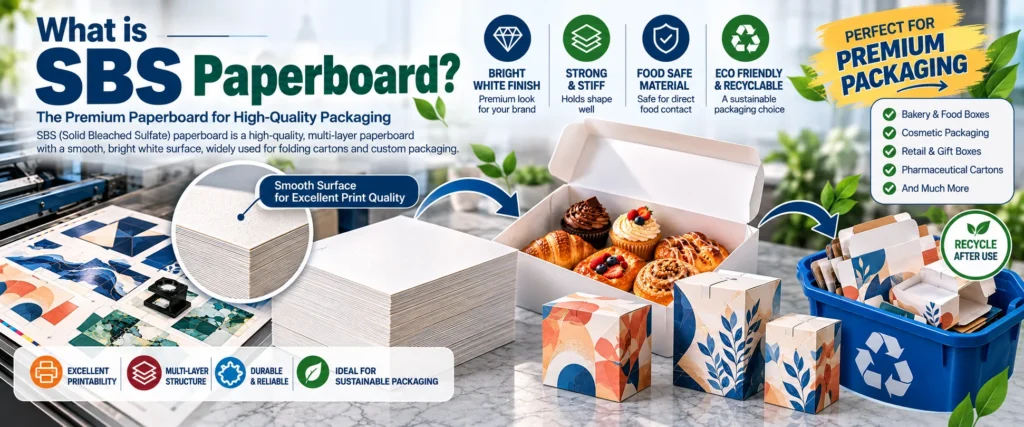
SBS paperboard is the bright white board behind most premium cosmetic cartons, pharmacy boxes and bakery packs on a store shelf. The letters stand for solid bleached sulfate, a name that describes how the board is pulped and bleached rather than how it looks.
Buyers meet the term on a quote and want to know whether it suits their product. This guide answers that question with plain facts on how SBS is made and how thick it runs. It also covers how the board prints and folds and protects what sits inside. It also shows where SBS sits against the other grades a printer might suggest.
You will also find the food contact rules and the recycling facts plus a thickness chart that matches common box types to a caliper. Every section opens with a direct answer so you can jump straight to the part you need today.
Key takeaways
- SBS paperboard is a virgin fiber board made from bleached kraft pulp, so it stays white all the way through the sheet.
- Folding cartons use SBS from about 12 to 24 points, which is roughly 230 to 400 GSM on a typical mill chart.
- A clay coating on one or both sides gives SBS the smooth face that makes photos, small type and foil look sharp.
- SBS is the usual choice for direct food contact when the board and its coatings meet FDA rules such as 21 CFR 176.170 and 176.180.
- Plain SBS cartons go in the paper recycling stream, while full film lamination or plastic windows can limit that claim.
What Is SBS Paperboard?
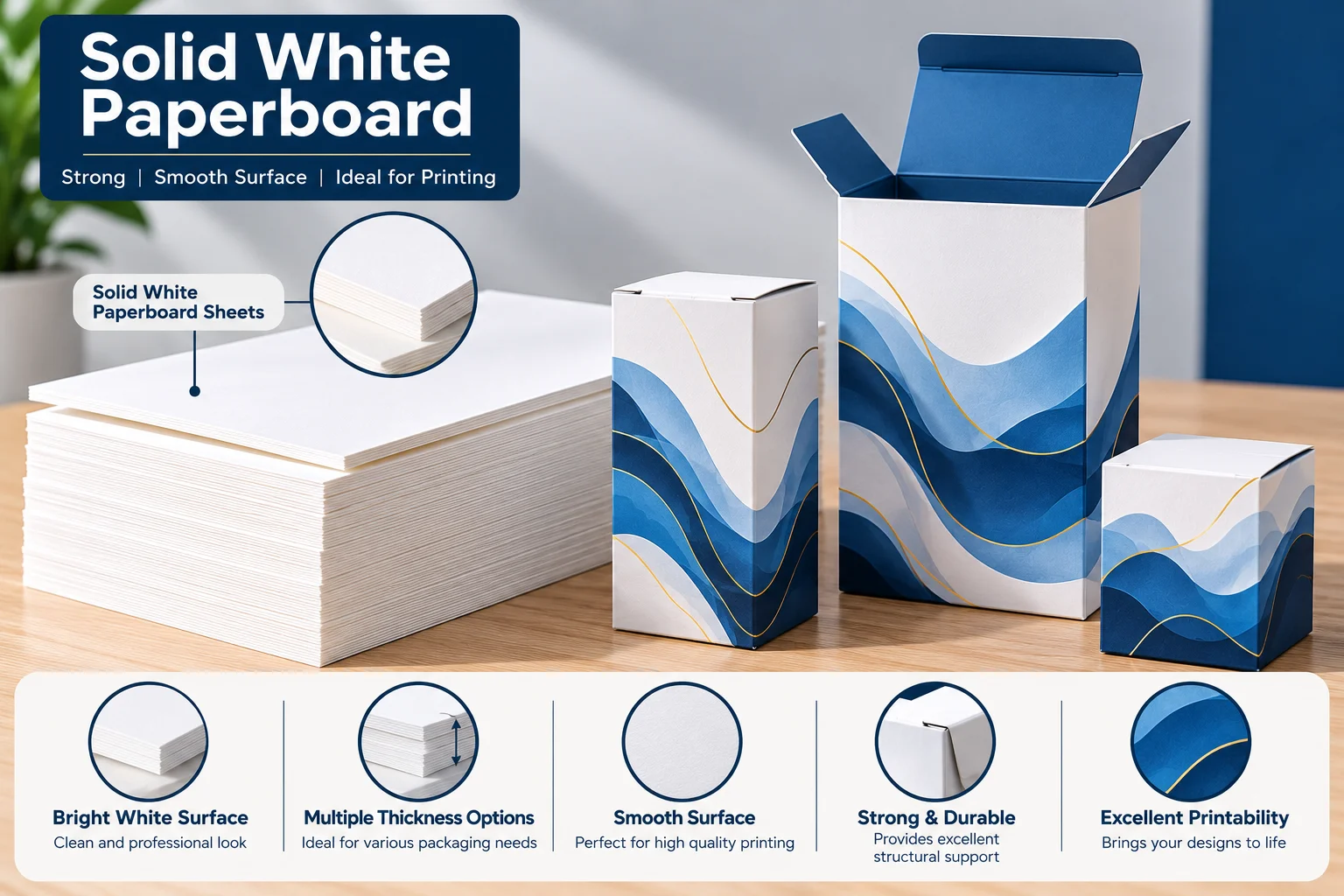
SBS paperboard is a heavy paper made from bleached virgin wood pulp that stays white from the printed face to the back. Most of it carries a smooth clay coating and it is the board printers reach for when custom packaging boxes have to look clean and premium.
You will see the same material listed as SBS board, SBS paper, SBS material or solid bleached board depending on who writes the quote. Some buyers even call it SBS cardboard although it is one solid sheet with no fluted layer inside.
Paperboard is generally thicker than 0.30 millimeters or 12 points and ISO standards draw the line at a grammage above 250 grams per square meter. Within that family bleached paperboard sits at the top for print quality and purity because every ply is bleached chemical pulp.
That simple fact explains most of what buyers like about the board. The name itself carries the rest of the story and it is worth unpacking one word at a time.
What Does Solid Bleached Sulfate Mean?
Solid bleached sulfate means the board is made of one kind of bleached fiber all the way through and that the fiber came from the sulfate pulping process. Each of the three words tells you something about how the sheet will behave on press and on the shelf.
| Word | What it means | What you notice on the box |
|---|---|---|
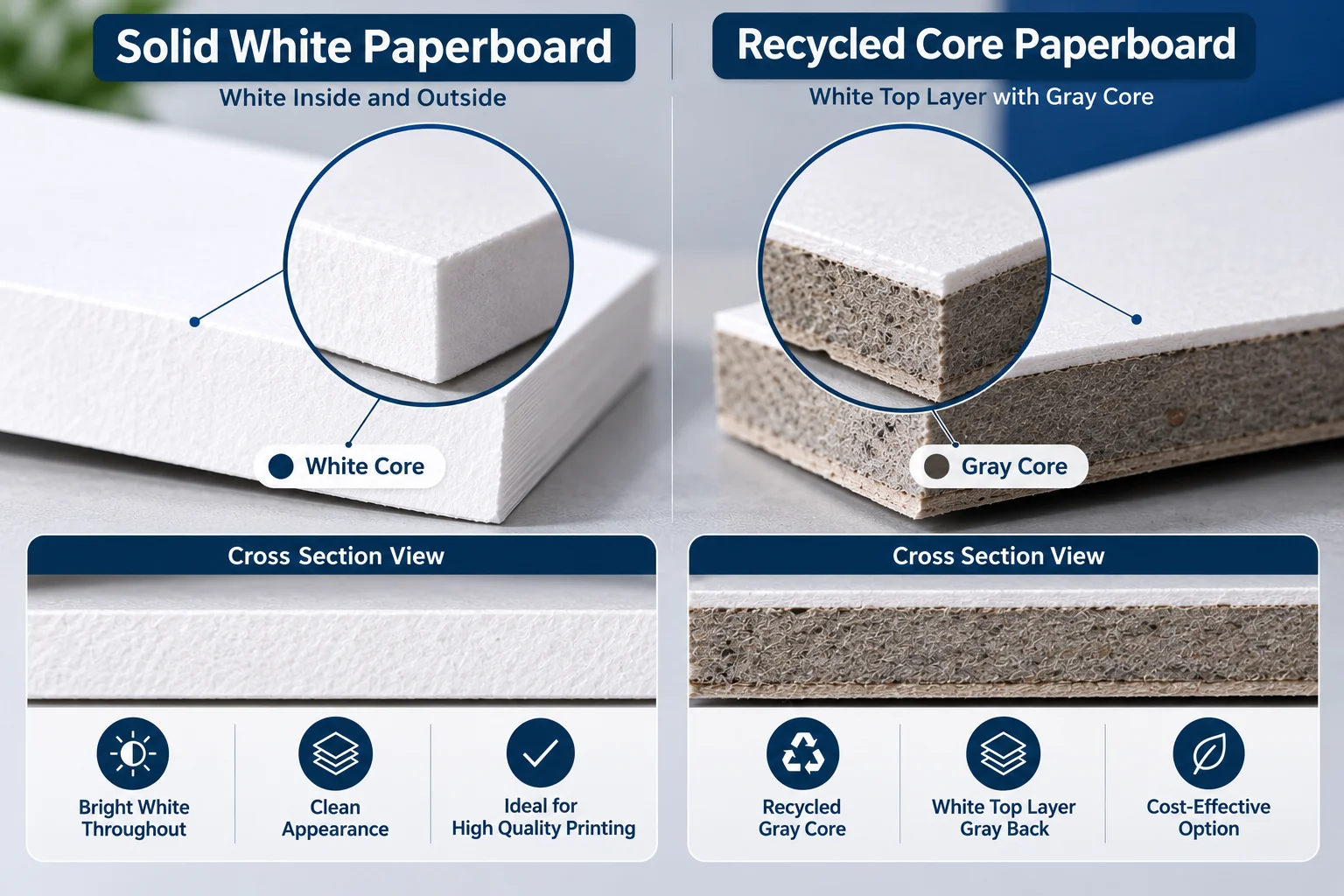
| Solid | Every ply uses the same bleached chemical pulp with no gray recycled middle | Cut edges and the inside of the box are white too |
| Bleached | Lignin and natural color are removed from the pulp in several bleaching stages | A bright neutral white that holds printed color accurately |
| Sulfate | The pulp is cooked in the kraft process, which is also called the sulfate process | Long strong fibers that fold cleanly without cracking |
The sulfate name comes from sodium sulfate, the chemical that early kraft mills added to make up losses in their cooking liquor. The liquor itself is a hot solution of sodium hydroxide and sodium sulfide that dissolves the lignin holding wood fibers together.
Kraft is the Swedish and German word for strength, which is why the same process gives brown kraft board its toughness. You will also see the British spelling solid bleached sulphate on European spec sheets and it means exactly the same board.
Knowing the name helps you read a quote with confidence. The real differences between boards come from the mill, so the next step is to follow SBS from wood chip to finished sheet.
How Is SBS Paperboard Made?
SBS paperboard is made by cooking wood chips into kraft pulp and bleaching that pulp white. The mill then forms it into a thick wet web that is pressed, dried and coated. Most SBS blends hardwood fiber for smoothness with softwood fiber for strength.
| Step | What happens at the mill | Why it matters for your box |
|---|---|---|
| 1. Pulping | Wood chips cook in white liquor until the lignin dissolves and the cellulose fibers separate | Chemical pulp keeps the long fibers that give the board its strength |
| 2. Bleaching | Several stages remove the remaining lignin, mostly with elemental chlorine free chemistry | A stable white base that keeps printed colors true |
| 3. Forming | Pulp spreads across a moving wire where water drains and the fibers knit into a mat | Even fiber spread means fewer weak spots at the folds |
| 4. Pressing and drying | Rollers squeeze out water and heated cylinders dry the web | Sets the caliper and the stiffness of the finished board |
| 5. Calendering | Polished rolls smooth and compact the surface of the sheet | A flatter surface takes ink and coating evenly |
| 6. Coating | One or more layers of clay and pigment go on one side or both | Creates the bright smooth face that prints photos sharply |
Trade data from the converting industry puts SBS at a minimum of about 80 percent virgin wood pulp. Some mills offer a share of post consumer fiber by request but the board stays a virgin fiber product at heart.
Industry comparisons describe SBS as mostly first generation chemically pulped fiber formed on fourdrinier type machines. That clean and consistent fiber is why the board works for food and medicine packaging where recycled boards raise more questions.
The coating step at the end decides how the sheet will print. It is also where the C1S and C2S labels on every SBS quote come from.
What Is the Difference Between C1S and C2S SBS?
C1S SBS is coated on one side only, while C2S SBS carries a clay coating on both faces. Most folding cartons use C1S board because only the outside of the box needs a premium print surface.
| Type | Surface | Best for | Good to know |
|---|---|---|---|
| C1S SBS | Coated outside, plain bleached fiber inside | Folding cartons, sleeves and food trays | The default for most retail boxes |
| C2S SBS | Coated on both faces | Boxes printed inside and out, tags and covers | Costs more and needs care at glue areas |
| Uncoated SBS | Bright white fiber with no clay layer | Writing surfaces and a natural paper look | Softer print with more dot gain |
| Convertible SBS | A C1S grade made for cups, plates and food trays | Forming and coating into food service items | Often paired with a poly or barrier coating |
The coated face is smoother and brighter so it holds fine detail and shows gloss well on the shelf. The plain back absorbs more and accepts water based glue easily, which is one reason C1S board runs so smoothly on carton gluing lines.
Choose C2S when the inside of a lid or a tuck flap carries print that customers will see as they open the box. A printed inside needs a second pass on press and the second coating adds a little to the board price as well.
Once the coating is settled the next question on almost every quote is thickness. That figure is where most buyers feel least sure and the chart in the next section spells it out.
How Thick Is SBS Paperboard?
SBS paperboard for packaging usually runs from 12 to 24 points thick, which equals 0.012 to 0.024 inches. In metric terms that is about 230 to 400 grams per square meter on a typical mill chart.
A point is one thousandth of an inch, so a board that measures 0.018 inches is sold as 18 point board or 18 pt. Labs measure caliper with a micrometer under the TAPPI T 411 method for the thickness of paper and paperboard.
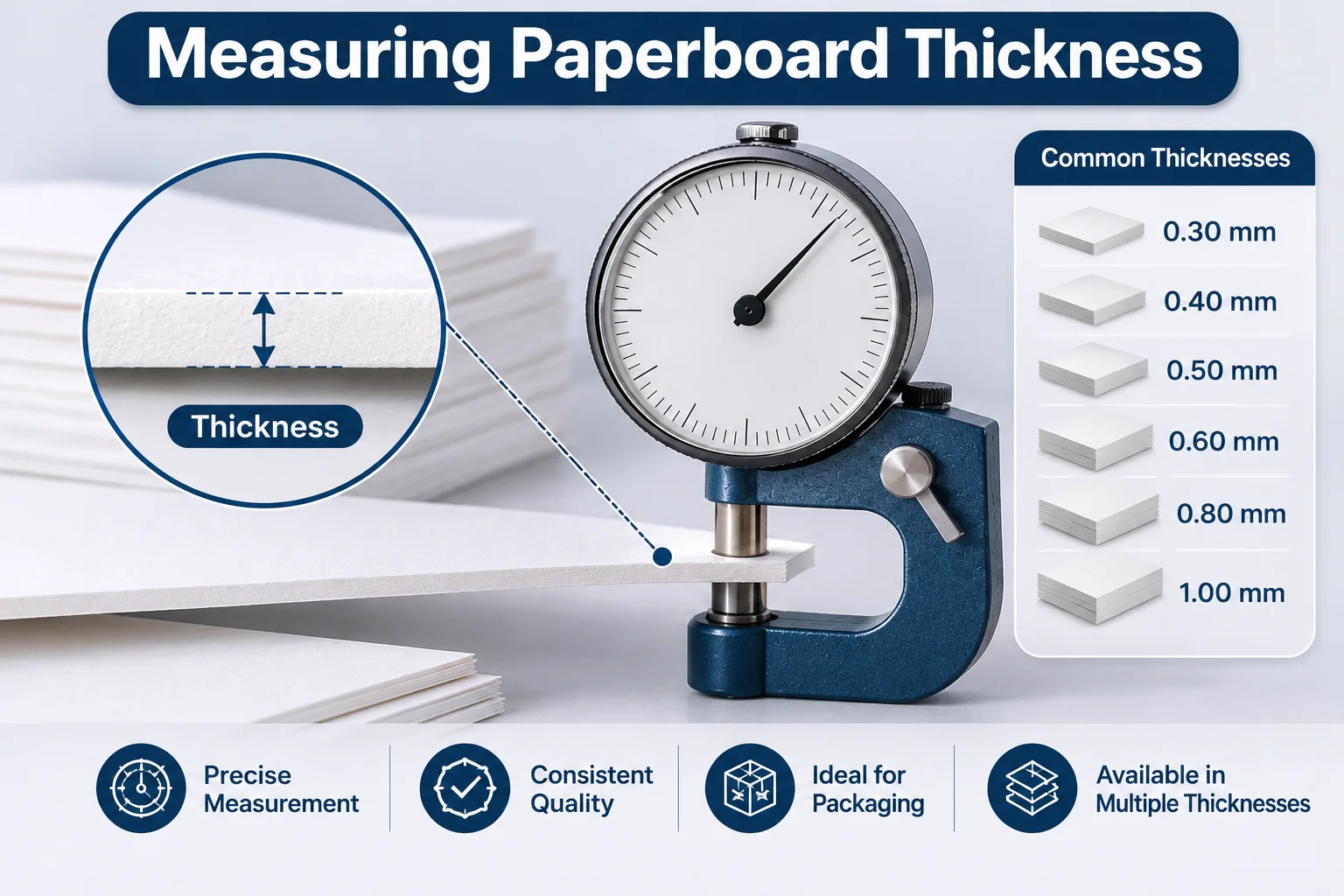
The chart below shows how caliper, basis weight and grammage line up on one published North American product guide for C1S SBS. Other mills land close to these figures but rarely on exactly the same numbers.
| Caliper | Inches | Basis weight (lb per 3,000 sq ft) | Grammage (GSM) |
|---|---|---|---|
| 8 pt | 0.008 | 108 | 175 |
| 10 pt | 0.010 | 120 | 195 |
| 12 pt | 0.012 | 140 | 230 |
| 14 pt | 0.014 | 158 | 260 |
| 16 pt | 0.016 | 178 | 290 |
| 18 pt | 0.018 | 195 | 320 |
| 20 pt | 0.020 | 207 | 340 |
| 24 pt | 0.024 | 245 | 400 |
Grammage and caliper are not locked together because density changes with the pulp mix and the amount of pressing. Hardwood pulp is denser than softwood pulp and two boards of the same thickness can weigh different amounts per square meter.
That is why a good quote names the caliper in points as the main figure and the grammage as a check. Knowing the range is the easy part and choosing the right point for your product takes a little more thought.
Which SBS Thickness Should You Choose for Your Box?
Choose SBS thickness by the weight of the product, the size of the box and the handling it faces before a customer opens it. Light items in small cartons sit well at 12 to 14 pt while heavy jars and bottles need 18 to 24 pt.
| Product | Typical SBS caliper | Why |
|---|---|---|
| Lip gloss, mascara and lipstick | 12 to 14 pt | Small light items where a clean fold matters more than stiffness |
| Bar soap and bath bombs | 14 to 16 pt | Holds shape on the shelf and resists corner crush in transit |
| Tinctures and oil bottles | 16 to 18 pt | Glass bottles need stiffer walls and a firm tuck lock |
| Cupcakes, cookies and pastries | 16 to 20 pt food grade | Bigger panels need stiffness and a food safe inside face |
| Jar candles | 18 to 24 pt | Heavy glass in a tall box needs the most stiffness |
| Perfume and premium cosmetics | 18 to 24 pt | Weight in the hand signals quality and deep embossing needs room |
The table is a starting point and we confirm the caliper against your product weight before anything prints. Brands ordering custom soap boxes or tincture boxes usually land in the middle of the range where stiffness and cost balance well.
Heavy glass is where the choice gets tight and candle boxes for large jars often move to 24 pt SBS or to a rigid set up box. A sample in the target caliper is the fastest way to test how the box feels with the real product inside.
Cosmetic boxes and bakery boxes add needs of their own such as fine embossing on one and food contact on the other. Both depend on the properties of the board, which the next section lays out side by side.
Not sure which SBS caliper fits your product?
Send us the product size and weight. We return a dieline, a board recommendation and a price for your quantity.
What Are the Key Properties of SBS Board?
The key properties of SBS board are high brightness and a smooth coated surface. Good stiffness for its weight and clean folding with no cracked fibers complete the list. It also has low odor and taste and that matters a great deal for food and cosmetics.
| Property | What SBS offers | Where it shows |
|---|---|---|
| Brightness | Coated SBS product guides list GE brightness around 92 percent | Whites look white and printed colors stay true |
| Surface smoothness | Clay coating and calendering give a flat and closed face | Photos, small type and fine lines print crisply |
| Stiffness | Good bending stiffness and compression strength | Boxes stand straight on a shelf and stack well |
| Folding and scoring | Long bleached fibers bend at the score without cracking | Clean edges on tuck end and auto lock cartons |
| Purity | Virgin fiber with no gray recycled middle ply | A safe base for food, medicine and cosmetics |
| Tear strength | Lower than unbleached kraft board | Not the first choice for heavy multipacks |
| Converting | Embosses, glues and runs well on high speed lines | Fewer jams and consistent boxes across a run |
One honest limit belongs in that list because industry comparisons note that SBS is not known for tear resistance. Beverage carriers and heavy multipacks therefore use unbleached kraft board, which the comparison section later in this guide covers.
Brightness and smoothness work together on the shelf because a bright base lets thin ink films reach full color. The same smooth face lets a die cutter and a folding line produce clean edges at high speed across a whole run.
Of all these properties the surface matters most to most brands because it decides how the artwork looks. That leads straight to printing and to the reasons SBS holds ink so well.
Why Does SBS Print So Well?
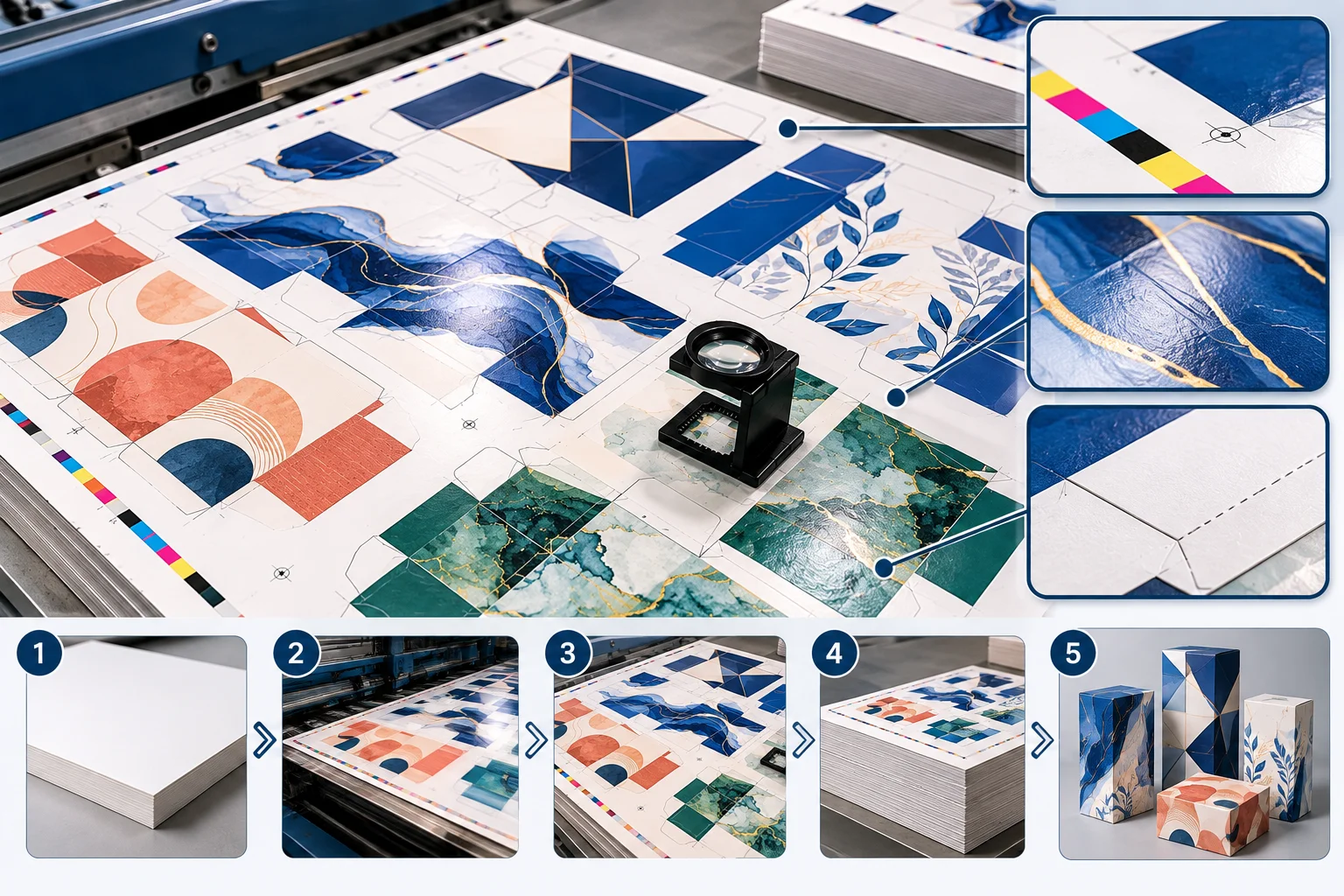
SBS prints well because its clay coated face is smooth, bright and closed so ink sits on top of the sheet instead of soaking in. That ink holdout keeps dots sharp and colors dense with less ink on press.
Offset lithography is the standard process for printed SBS paperboard because it holds fine screens and exact color across long runs. Digital presses print SBS too and suit short runs, test batches and artwork that changes from box to box.
| Process | Best for | Result on SBS |
|---|---|---|
| Offset lithography | Runs of a few hundred boxes and up with photo quality | The sharpest result on the coated face |
| Digital printing | Short runs, samples and artwork that changes per box | No plates, so setup is quick |
| Flexography | Long simple runs and food trays | Lower detail than offset on most presses |
| Screen printing | Thick opaque white and special effect inks | Used for effects rather than full images |
Full color work uses the four process inks of CMYK printing and spot colors use mixed Pantone inks when a brand color has to match exactly. Our guide called CMYK explained covers why a color on screen can shift once it lands on board.
Uncoated SBS or the plain back of a C1S sheet prints softer because the fiber absorbs more ink. Plan any inside print with that in mind and keep fine text and thin lines on the coated face.
Printing puts the color onto the board and the finish decides how that color looks and feels in the hand.
Which Finishes Work on SBS Paperboard?
Almost every packaging finish works on SBS paperboard from aqueous and UV coating to film lamination and foil stamping. Embossing and debossing work well on it too because the dense fiber holds a crisp edge. The smooth coated face gives each finish a flat and even base to grip.
| Finish | What it adds | Good to know on SBS |
|---|---|---|
| Aqueous coating | Scuff protection in gloss, satin, matte or soft touch | The lowest cost coating, applied inline on press |
| UV coating | High gloss and spot effects | Keep it off score lines so folds do not crack |
| Film lamination | Strong scuff and tear protection | Must be separated from the fiber when recycled |
| Foil stamping | Metallic logos, borders and type | Crisp edges on the smooth coated face |
| Embossing and debossing | Raised or pressed artwork you can feel | Thicker SBS gives deeper relief |
| Window patching | A clear panel that shows the product | The plastic film affects recycling claims |
Our aqueous coating guide explains the four AQ finishes and how they compare with UV coating and lamination. If a metallic logo is on the brief, the foil stamping guide covers hot foil and cold foil on board in the same plain terms.
Thicker SBS gives embossing more room to work and a deep raised logo usually calls for 18 pt board or heavier. Thin board can crack or show the shape through on the inside when the die pushes too far.
Finishes also matter on food boxes because some coatings sit close to the product. That makes food safety the next question to settle before you choose a coating.
Is SBS Paperboard Food Safe?
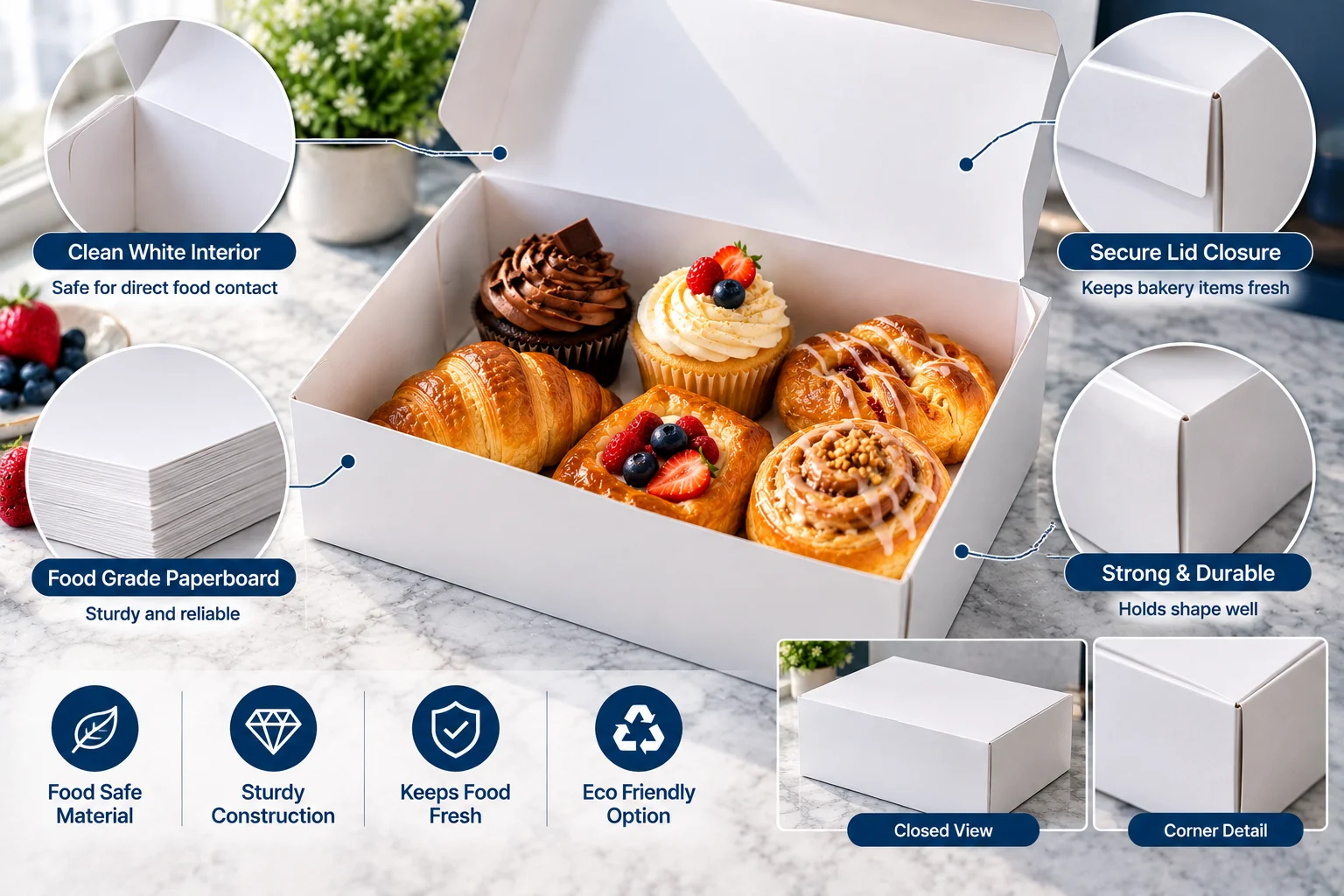
SBS paperboard is the usual choice for direct food contact because it is made from virgin bleached fiber with no recycled middle ply. In the United States the board and every coating on it must meet FDA rules for paper and paperboard that touches food.
The main rules sit in Title 21 of the Code of Federal Regulations. Section 21 CFR 176.170 covers components of paper and paperboard in contact with aqueous and fatty foods and 21 CFR 176.180 covers contact with dry food.
| Food type | FDA rule that applies | What it means for the box |
|---|---|---|
| Dry foods such as cookies, cereal and hard candy | 21 CFR 176.180 | Plain food grade SBS is a common fit |
| Moist or fatty foods such as cakes, donuts and chocolate | 21 CFR 176.170 | Every component must be cleared for aqueous and fatty contact |
| Frozen and chilled foods | 21 CFR 176.170 with a moisture barrier | A poly or barrier coating keeps the board firm when cold |
| Greasy foods such as fried snacks | 21 CFR 176.170 with a grease resistant coating | A liner of greaseproof paper adds protection |
| Boards made with recycled fiber | 21 CFR 176.260 for pulp from reclaimed fiber | Extra checks for contaminants carried in recovered paper |
Recycled boards face extra checks because recovered paper can carry mineral oil from printing inks. Published research has found mineral oil migrating from recycled cartons into foods such as rice, which is one reason brands choose SBS for direct contact.
Food safety covers the full build so ask your supplier for a food contact statement that names the board and inks along with the coating and glue. Our custom food boxes use food grade SBS for exactly that reason.
Food is only one of the markets that depend on this board. The full list shows why SBS turns up in so many aisles of a store.
Where Is SBS Paperboard Used?
SBS paperboard is used for cosmetics, personal care and pharmaceuticals. Food, confectionery, frozen meals and premium retail cartons rely on it as well. Any box that needs a bright print surface and a clean interior is a likely fit.
| Market | Typical SBS packaging | Why SBS |
|---|---|---|
| Personal care and cosmetics | Lipstick, serum, perfume and skin care cartons | Bright white and fine print for brand detail |
| Pharmaceutical | Medicine cartons and blister card backs | Clean fiber, consistent caliper and room for small text |
| Food and bakery | Cake, cookie, donut and pastry boxes | Food contact suitability and easy gluing |
| Frozen foods | Frozen meal and ice cream cartons | Takes barrier coatings and holds shape when cold |
| Confectionery | Chocolate and candy boxes | Fine print, foil and embossing on a small panel |
| Cannabis and CBD | Tincture, cartridge and gummy cartons | Room for compliance text and child resistant inserts |
| Print and stationery | Cards, tags, folders and covers | A smooth surface for photos and type |
Lower caliper SBS also appears inside corrugated packaging as a printed top sheet laminated over E flute or F flute. That build gives a shipping box the print quality of a carton with much of the strength of corrugated board.
Our CBD boxes use SBS for the same reasons and pair it with child resistant inserts where state rules require them. Chocolate makers lean on it too because foil and embossing stay crisp on a small panel.
With so many uses it helps to see how SBS stacks up against the other boards a supplier might offer.
How Does SBS Compare With Other Paperboard Grades?
SBS is the brightest and purest of the common carton boards, while folding box board is lighter for the same stiffness. Unbleached kraft board is the toughest and coated recycled board costs the least, so each grade wins on a different measure.
| Grade | Fiber | Look | Strength | Best use |
|---|---|---|---|---|
| SBS | Bleached virgin chemical pulp in every ply | White through the sheet | Good stiffness, average tear | Premium retail, food and medicine |
| FBB | Mechanical pulp middle between chemical pulp layers | White face with a cream tint inside | High stiffness for its weight | Food and personal care, common in Europe |
| SUS or CUK | Unbleached virgin kraft pulp with a white coated top | White face and brown back | Highest tear and wet strength | Beverage carriers and frozen food |
| CRB | Recycled fiber in many layers with a coated top | White face and gray back | Lower strength, more moisture | Cereal, dry goods and low cost cartons |
Our full guide to the types of paperboard compares every one of these grades in depth with FBB, SUS, CRB and CCNB board side by side. It also explains the European grade codes you may see on imported board.
In practice SBS costs more and returns the most print quality and purity per box. Folding box board is its closest rival on looks and is more common in Europe than in the United States.
Many buyers still confuse all of these boards with cardboard and that question deserves a clear answer of its own.
Is SBS Paperboard the Same as Cardboard?
SBS paperboard is not the same as corrugated cardboard, although many people use the word cardboard for both. SBS is one solid sheet, while corrugated board has a fluted middle layer glued between two flat liners.
In everyday speech cardboard can mean any stiff paper product from a cereal box to a moving carton. In the packaging trade the word usually points to corrugated board and SBS belongs to the paperboard family instead.
| Feature | SBS paperboard | Corrugated cardboard |
|---|---|---|
| Structure | One solid sheet built from several bonded plies | A fluted medium glued between two flat liners |
| Typical thickness | 12 to 24 pt for cartons | About one sixteenth of an inch for E flute and more for B and C flute |
| Print quality | Sharp offset print on the coated face | Printed liners or a laminated SBS top sheet |
| Main use | Retail cartons on the shelf | Shipping boxes and mailers |
| Crush strength | Enough for shelf display and light transit | Built for stacking and parcel shipping |
The two often work together because a retail carton made from SBS ships inside a corrugated outer box. Our custom cardboard boxes and mailer boxes cover the shipping side when your product needs both.
Whichever board you choose the end of its life is now part of the buying decision for most brands. Recycling is the question buyers ask about SBS more than any other.
Is SBS Paperboard Recyclable?
Plain SBS paperboard is recyclable in the paper stream and printed cartons with inks and an aqueous coating recycle the same way. Full film lamination, plastic windows and heavy foil can limit that claim because they must be separated from the fiber.
The US Environmental Protection Agency reports a recycling rate of about 68 percent for all paper and paperboard in its material data. Corrugated boxes recycle at a far higher rate while other paper packaging trails well behind, which shows how much collection habits matter.
If you print a recycling claim on the box, the FTC Green Guides set the rules. Under 16 CFR 260.12 an unqualified recyclable claim needs recycling programs available to a substantial majority of consumers, which the guides define as at least 60 percent.
| Box build | Recycling outlook | Claim advice |
|---|---|---|
| Plain or aqueous coated SBS carton | Accepted with paper and cartons in most programs | A plain recyclable claim is easiest to support |
| SBS with UV coating or spot UV | Accepted, though heavy coatings can slow sorting | Keep UV to spots where you can |
| SBS with full film lamination | The film has to be separated at the mill | Qualify the claim or choose a coating instead |
| SBS with a plastic window | The window film must be removed or screened out | Tell customers to remove the window first |
| Poly coated SBS for frozen food or cups | Needs mills that can separate the poly layer | Qualify the claim by local access |
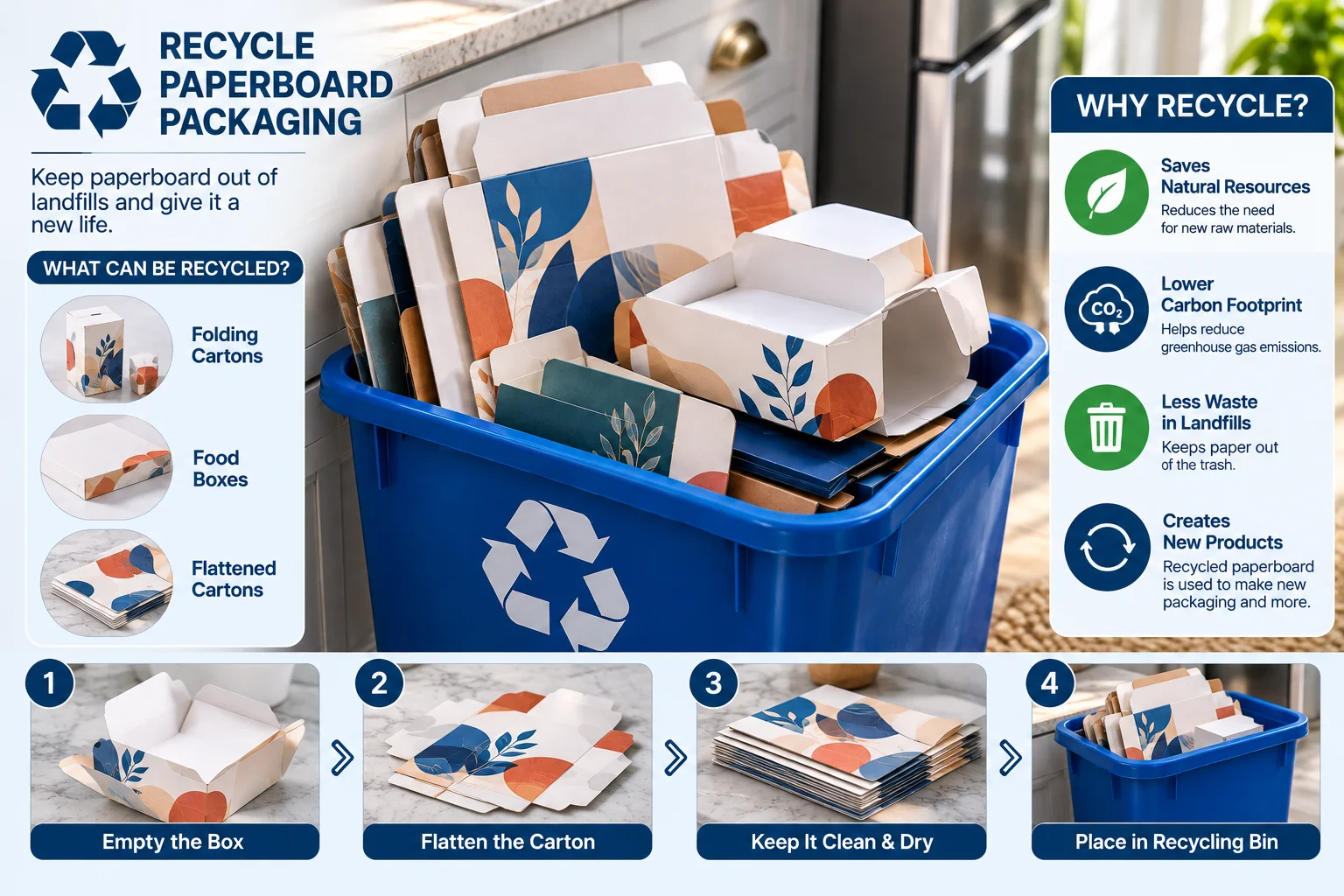
Recycling covers the end of the story and the other half is where the fiber comes from in the first place.
Is SBS Paperboard Sustainable?
SBS paperboard can be a sustainable choice when its fiber comes from certified forests and the box is designed to recycle cleanly. It is a virgin fiber product and its strength and purity come from new wood rather than recovered paper.
Forest certification is the main proof point because North American SBS mills commonly hold chain of custody certification under SFI, PEFC or FSC. A supplier can quote certified board on request and print the matching mark once the chain of custody is confirmed.
Bleaching is the other common concern and most mills now use elemental chlorine free bleaching. That method replaces chlorine gas with chlorine dioxide and cuts the release of chlorinated compounds into mill water.
Virgin fiber also has a place in the recycling loop because recycled fibers lose strength each time they are pulped. Fresh fiber from boards such as SBS keeps the recovered paper supply strong enough to use again and again.
If recycled content matters more to your brand than bright white print, our kraft boxes and eco friendly shipping boxes are worth a look. Cost is usually the next factor that weighs on the choice.
How Much Does SBS Paperboard Cost Compared With Other Boards?
SBS paperboard usually costs more per ton than recycled board and somewhat more than unbleached kraft board because it uses bleached virgin fiber. On a finished box the board is only one part of the price and the gap per unit is often small.
| Cost driver | Effect on the price per box |
|---|---|
| Board grade | SBS sits near the top of the carton board price range and recycled board at the bottom |
| Caliper | Thicker board uses more fiber and raises the price in steps |
| Box size and layout | How many boxes fit on one press sheet sets most of the board cost |
| Print colors | Spot colors add mixed inks beyond standard CMYK |
| Finishes | Foil, embossing and lamination each add a step on press or after it |
| Quantity | Price breaks at 500 and 1,000 units on the same artwork lower the unit price |
Board prices per ton move with pulp markets and energy costs, so any published figure goes stale quickly. A box quote is the useful number because it folds board, print, finish and delivery into one price you can plan around.
We print SBS cartons from 100 boxes per size and design, which lets small brands test premium board before they commit to larger runs. The last step is turning all of these choices into an order that prints right the first time.
How Do You Order Custom Printed SBS Boxes?
You order custom printed SBS boxes by choosing a style and size and then picking the caliper and finish. After that you place artwork on a dieline and approve a proof. A good supplier helps with each step and confirms the board before anything prints.
| Step | What to do | Helpful tool |
|---|---|---|
| 1. Choose the style | Pick a tuck end, auto lock, sleeve or two piece style | Our free dieline generator |
| 2. Measure the product | Take inside length, width and height with a little clearance | Our box measuring guide |
| 3. Pick caliper and coating | Match points to product weight and choose C1S or C2S | The thickness chart in this guide |
| 4. Prepare artwork | Place art on the dieline with bleed and safe zones | Our artwork guidelines |
| 5. Approve a proof | Check colors, text and folds on a digital or physical proof | A plain sample before the full run |
| 6. Production and delivery | Print, finish, die cut, glue and ship | Free shipping across the United States |
Most of our SBS work runs as folding cartons for retail shelves. The same board also wraps the trays of rigid boxes when a brand wants a premium two piece build with a lid. Both styles share the same print and finish options covered earlier in this guide.
Send the product size, quantity and a target caliper through the quote form and we return a dieline and a price. If you are still choosing between boards then the comparison guide linked above walks through each grade in turn.
Frequently asked questions
The short version
SBS paperboard is bleached virgin board that stays white through the sheet and prints sharply on its clay coated face and folds cleanly at the score. Most retail cartons use C1S SBS between 12 and 24 pt depending on product weight and box size.
It is the standard choice for food, medicine and premium cosmetics and it recycles with paper when you avoid heavy films. Match the caliper to the product and the finish to the brand and the board will do the rest of the work.
Ready to print your boxes on SBS paperboard?
At The Customized Boxes we print SBS folding cartons from 12 to 24 pt with full color, foil and coatings, from 100 boxes per size and design with free shipping across the United States.
