








Why Does a Record Arrive With a Split Corner?
Three things damage a record in transit and only one of them is a drop.
The first is corner impact. A parcel that lands on a corner puts all of the energy into one point, and on a flat square package that point is the jacket corner. This is the single most common claim in the category.
The second is movement. A record that can slide inside the box will keep sliding for the whole journey. It does not break anything. It wears a visible ring into the sleeve, which on a collectible pressing destroys the value even though the disc plays perfectly.
The third is flexing. A flat box with too much span and not enough board bends across the middle, and the jacket bends with it. Records ship flat, so the whole face of the package is unsupported.
A record mailer answers all three by being tight, being stiff and protecting the corners specifically. Board thickness alone answers none of them.
What Internal Size Does a 12 Inch LP Need?
A 12 inch record is not 12 inches. The jacket is larger than the disc, and the jacket is what has to fit.
| Format | Jacket size | Internal box size we cut |
|---|---|---|
| 12 in LP | 12.375 in square, about 314 mm | 320 to 325 mm square |
| 12 in LP in an outer sleeve | 12.625 to 12.75 in, up to 324 mm | 330 mm square |
| 10 in | 10.227 in square, about 260 mm | 265 to 270 mm square |
| 7 in single | 7.08 in square, about 180 mm | 185 to 190 mm square |
Those jacket figures are the published standards, confirmed from a vinyl reference source. The point worth taking from the table is the gap. A box cut at 315 mm for a 314 mm jacket will not close cleanly once a poly outer sleeve goes on. Most stores ship records in outer sleeves.
Tell us whether your records ship sleeved. It changes the internal by about 10 mm and that is the difference between a snug pack and a jammed one.
How Many Records Are You Shipping in One Box?
Depth is where most record mailers are specified badly, because people guess instead of measuring.
An average jacket spine runs about 3 to 4 mm. That gives you honest arithmetic rather than a guess:
- 1 to 2 records sit at roughly 8 mm and need a mailer, not a box
- 5 records sit at roughly 15 to 20 mm
- 10 records sit at roughly 30 to 40 mm
- 25 records sit at roughly 75 to 100 mm and need a box rather than a mailer
Gatefolds and heavyweight pressings break this. A gatefold is roughly double a single jacket, and a 180 g pressing adds thickness to every jacket in the stack. If you ship both, build the box around the thicker one and use a filler pad for the thinner orders.
Do not build in slack for future growth. Empty space is what wears the ring into the sleeve.
Which Board Grade Survives the Carrier?
Edge crush test, written as ECT, tells you what the box carries when it is stacked in a trailer under other parcels.
| ECT rating | Maximum gross weight | Where it fits records |
|---|---|---|
| 32 ECT single wall | about 65 lb | 1 to 5 records, short domestic routes |
| 44 ECT single wall | about 95 lb | 10 to 25 records, standard shipping |
| 48 ECT double wall | 86 to 100 lb | Bulk distribution and long routes |
Weight is rarely the constraint with records. A 180 g pressing plus jacket is well under a pound, so even 25 records sit far below any of these limits.
The reason to go up a grade is stiffness rather than load. A heavier board resists the flex across the face of the package, and flex is what bends jackets.
Flute matters here too. B flute at 2.5 to 3.2 mm is the working standard for record mailers. E flute at around 1.6 mm prints beautifully but is too thin to stop a 12 inch span from bending.
Which Mailer Style Protects the Corners?
| Style | How it works | Best for |
|---|---|---|
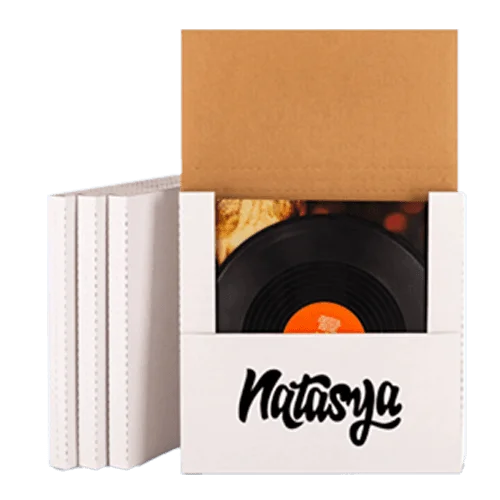
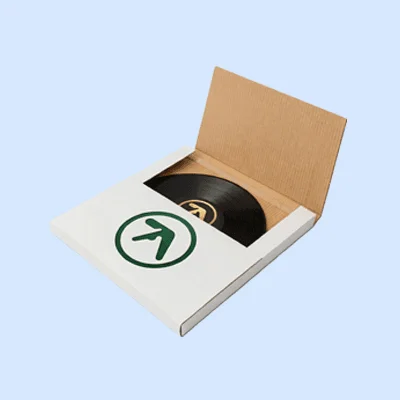
| LP mailer with folding side flaps | Flaps fold in to build a thicker corner and edge | Single and small orders, the category standard |
| Book wrap | Board wraps the stack and locks, thickness adjusts | Mixed order sizes from one blank |
| Regular slotted container | Standard flapped box, needs pads | 25 plus records, bulk distribution |
| Full overlap | Outer flaps overlap fully and double the panel | Long routes and heavy stacks |
| Rigid stayflat | Very stiff flat pack, no give at all | High value single pressings |
The folding side flap style is the one that earns its keep. Those flaps are not there for looks. They put two or three thicknesses of board exactly where the corner impact lands, which is why the style became standard in the category.
Do You Need Stiffeners or Pads?
Usually yes, and they cost very little.
- Corner pads take the impact at the four points where damage actually happens
- A stiffener board on each face stops the flex that bends jackets across a 12 inch span
- A filler pad takes up the slack when an order is thinner than the box was built for
- A poly outer sleeve on the record itself protects the jacket from scuffing inside the box
For a store shipping mixed order sizes, a filler pad is the highest value thing on that list. It lets one box size cover 5 to 12 records without the stack sliding.
Does Heat and Pressure Warp Records in Transit?
Warping is the failure mode nobody specifies for, and packaging can only partly control it.
A record warps under heat combined with pressure. A parcel sitting in a delivery vehicle through a summer afternoon gets far hotter than the warehouse it left. If the stack is under load at the same time, the discs take the shape of whatever is pressing on them.
Packaging cannot control the temperature. It can control the pressure and the flatness, which is the half you own.
- Keep the stack flat and fully supported so no single point carries the load
- A stiffener board on each face stops the box bowing, and a bowed box bows the records
- Never let the pack be loose, because a stack that shifts ends up loaded on an edge
- Ship records flat rather than on edge where you have the choice in a larger carton
For summer shipping into hot regions, a stiffener on both faces is the cheapest insurance you can buy. It costs cents and it is the difference between a flat record and a returned one.
What Should You Send Us Before We Quote?
| What you send us | What we build from it |
|---|---|
| The format, 12 in, 10 in or 7 in | Internal length and width |
| Whether records ship in poly outer sleeves | About 10 mm of extra internal size |
| The most records that go in one box | Internal depth |
| Whether you ship gatefolds or 180 g pressings | Depth allowance and filler pad spec |
| Your typical route and season | Board grade and whether to add stiffeners |
One filled and sleeved record is more useful to us than a set of measurements. We measure it here and cut a physical mock-up before any tooling is made.
What Prints Well on a Record Mailer?
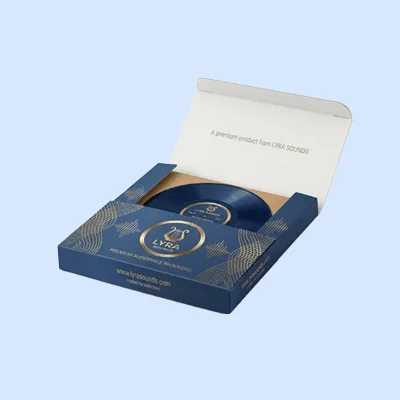
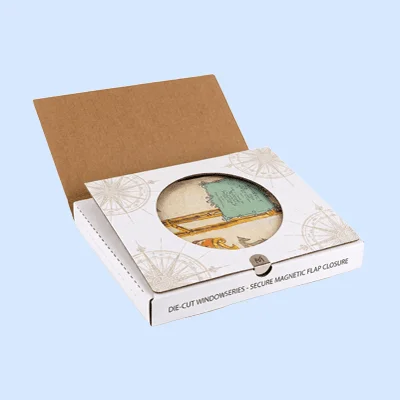
Records go to people who care what things look like, and the box is the first thing they touch.
Print quality on corrugated depends on the flute more than on the press. B flute takes flexo print cleanly for line art, a logo and solid colors, but shows washboarding across large flat areas of ink. That faint ribbing is the flute showing through.
- One or two color flexo on kraft is the cheapest route and suits most labels
- White top liner is needed if a brand color has to be accurate
- Litho lamination gives photographic quality, but works on E flute rather than B
- Interior print costs little and is the surface the buyer sees when the box opens
- Unprinted kraft with a printed tape is a genuinely cheap way to brand a low volume run
Are you a small label shipping a few hundred units? Printed tape on a plain mailer gets you most of the effect for a fraction of the cost.
Minimum Order, Lead Time, and Samples
- Minimum order: 100 boxes per size, because each size needs its own die
- Plain structural sample: 3 to 5 business days
- Printed pre production sample: 7 to 10 business days
- Production: 8 to 10 business days after you approve the dieline
- Price breaks: at 500 and at 1,000 units on the same artwork
- Setup and tooling: no charge, on the first order and on every one after it
- Artwork: vector PDF or AI on our dieline, 3 mm bleed, fonts outlined, Pantone numbers named
- Shipping: free across the United States
Request a Quote
Send us the format, whether your records ship in outer sleeves, how many go in a box and your annual volume. We will come back with a board specification, a dieline and a unit price.
 The Customized Boxes