





A box that is 5 mm too small will not close around the product. A box that is 30 mm too big lets the product rattle and costs more to ship. Both mistakes start with the same thing, which is a measurement taken the wrong way or written in the wrong order.
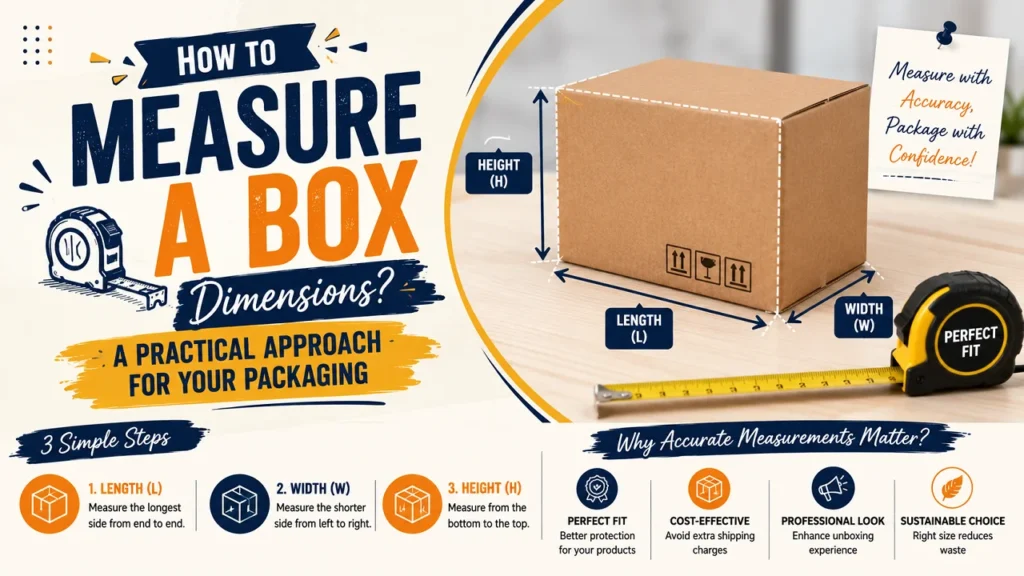
Measuring a box takes a tape measure and about two minutes once you know three rules. You need to know which side is the length and whether to measure inside or outside. You also need to write the numbers so a printer or a carrier reads them the same way you do.
This guide covers those rules with real numbers and worked examples. It then moves on to volume, girth and dimensional weight, which decide what a box costs to ship across the United States.
Key takeaways
- Box dimensions are written as length x width x height so length always comes first and height always comes last.
- For a packaging order length and width are the two sides of the opening and height is the depth from the opening to the floor.
- Measure the inside when you order a box for a product and the outside when you ship it, because board thickness sits between the two.
- Box volume is L x W x H and dividing cubic inches by 1,728 gives cubic feet.
- Dimensional weight is L x W x H divided by 139 at UPS daily rates and a smaller box can cut the shipping bill.
How Do You Measure a Box Step by Step?
You measure a box by opening it, measuring the two sides of the opening and then measuring the depth from the opening down to the floor. Those three numbers are the length, the width and the height of the box.
| Step | What to do | What you get |
|---|---|---|
| 1 | Open the box and set it on a flat surface with the opening facing up | A square view of the opening |
| 2 | Measure the longer side of the opening, wall to wall | Length |
| 3 | Measure the shorter side of the opening, wall to wall | Width |
| 4 | Measure from the floor of the box up to the top edge of the opening | Height |
| 5 | Write the numbers as L x W x H with the unit | A size anyone can read, such as 12 x 8 x 4 in |
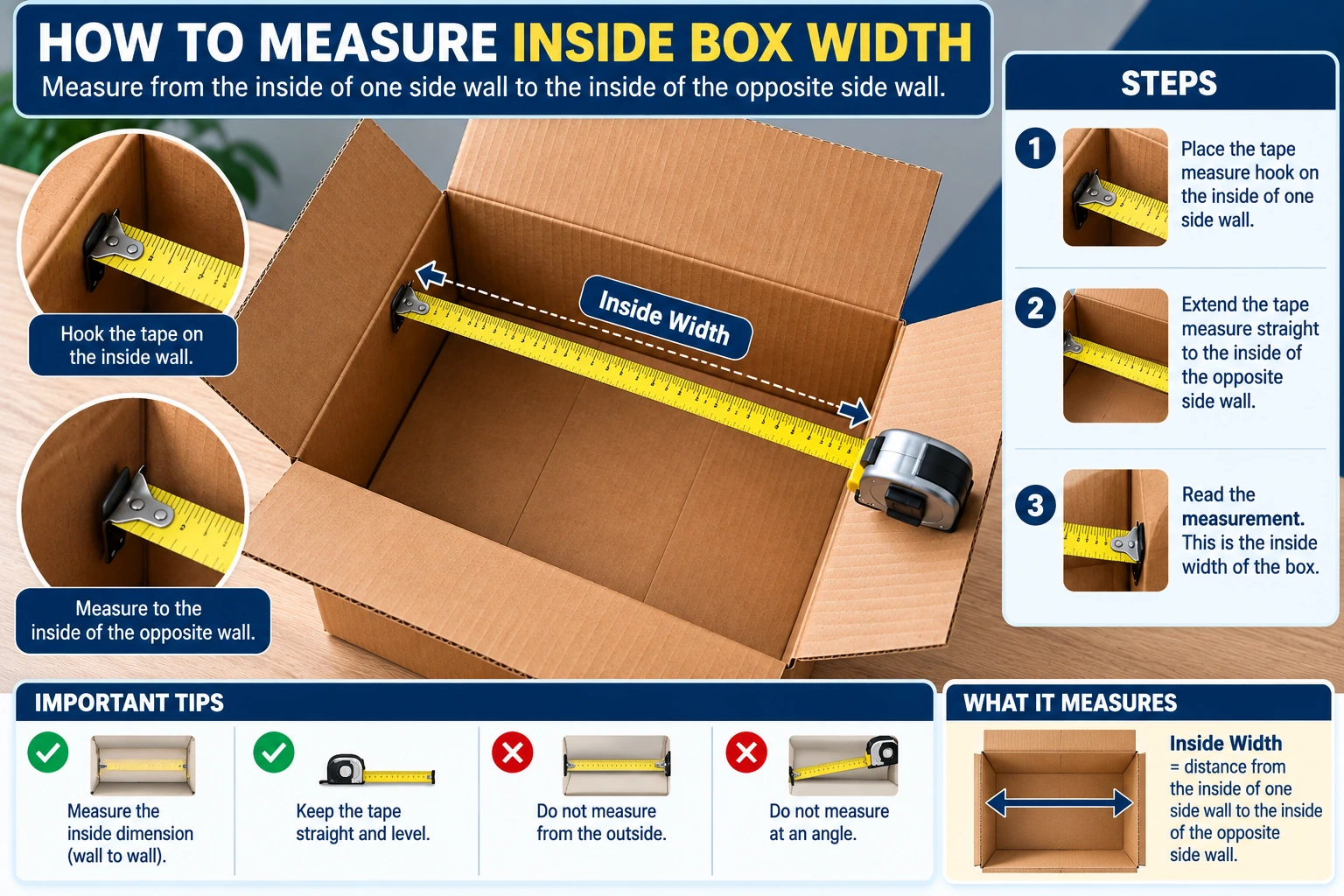
Measure along the inside of the walls with a rigid tape or a steel ruler held flat against the board. A soft sewing tape bends into the corners and adds a few millimeters to every reading.
Write each number down the moment you take it so the order never gets mixed up. The order matters more than most people expect, which is why the next question comes up so often.
What Comes First, Length, Width or Height?
Length comes first and width comes second and height comes last, so box dimensions always read L x W x H. A box listed as 12 x 8 x 4 inches is 12 inches long and 8 inches wide and 4 inches tall.
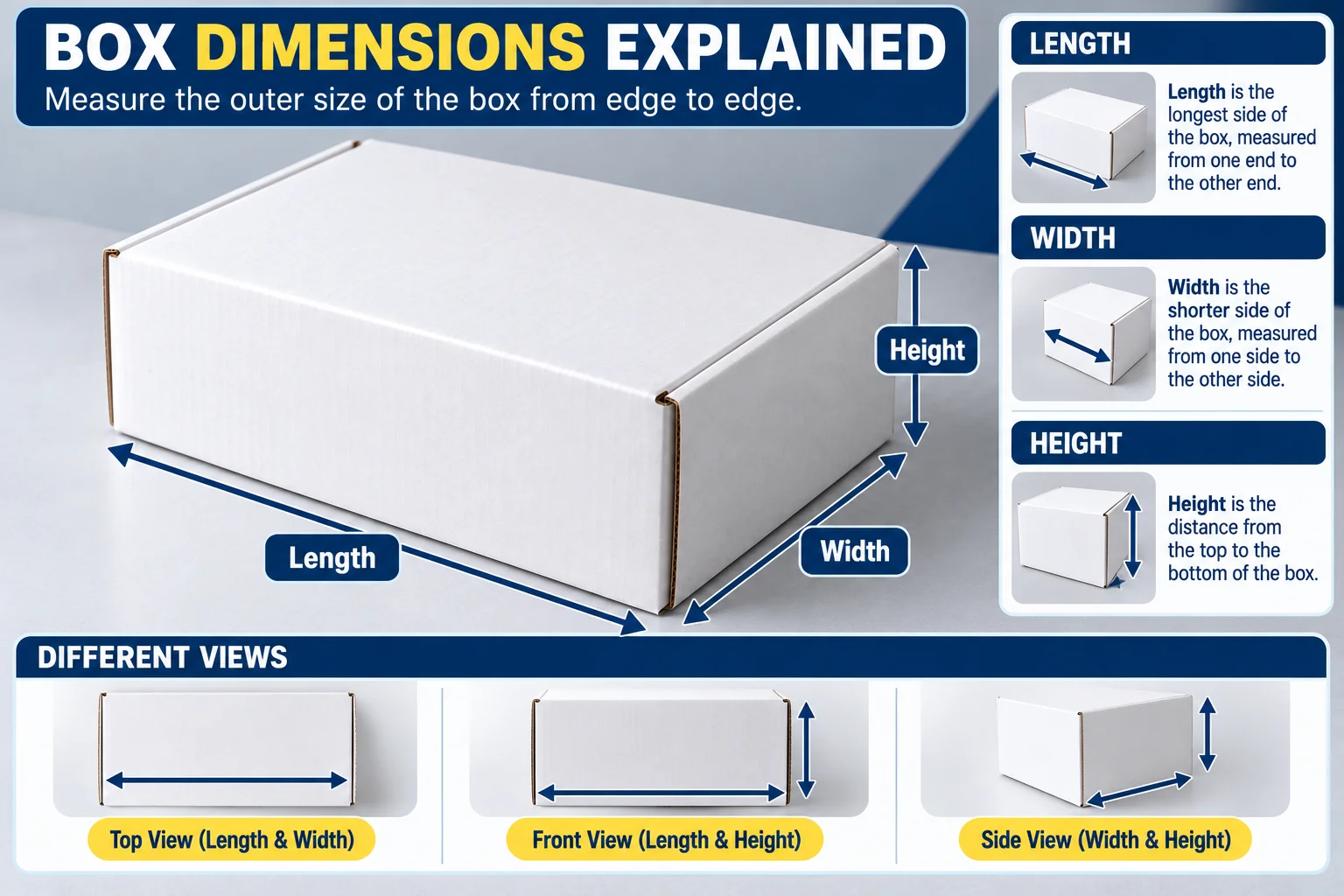
In the packaging trade the length is the longer side of the opening and the width is the shorter side of the opening. Height is the distance from the opening to the bottom and some printers call it depth.
Shipping carriers use a slightly different rule when they measure a parcel for a label. They call the longest side of the closed box the length no matter where the opening is. The next longest side is the width and the last side is the height.
| Rule | Length | Width | Height |
|---|---|---|---|
| Packaging order | Longer side of the opening | Shorter side of the opening | Opening to floor |
| Carrier shipping | Longest side of the closed box | Next longest side | Shortest side |
The two rules give the same answer for most mailers and shipping cartons. They differ for tall boxes such as a bottle carton. Tell your supplier which side opens when you send a size. The next rule is just as important because a box has two sets of measurements.
What Is the Difference Between Inside and Outside Box Dimensions?
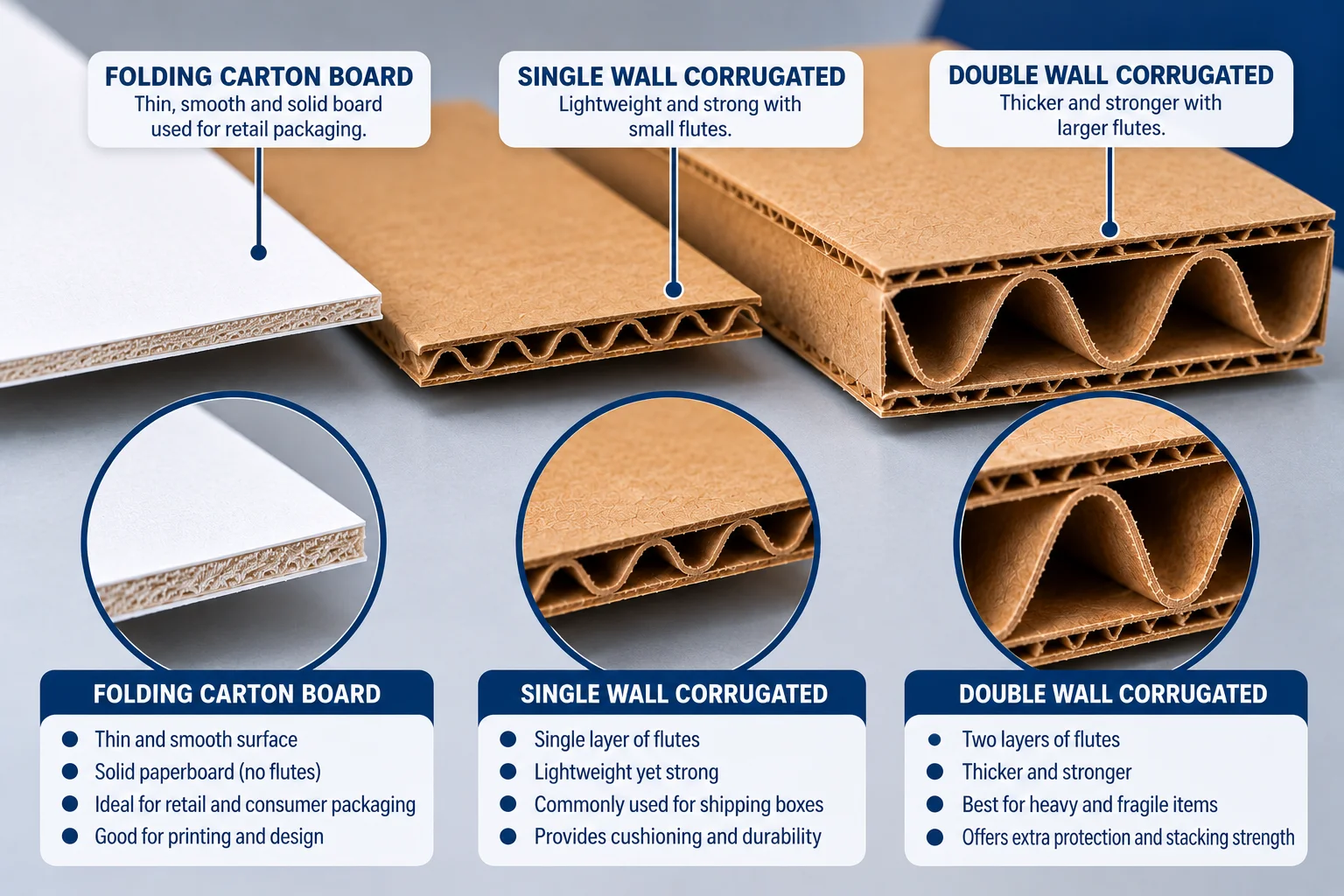
Inside dimensions measure the space your product fits into while outside dimensions measure the box as it sits on a shelf or a scale. The gap between them is the thickness of the board counted once for each wall.
Order a box by its inside dimensions because that is the space your product needs. Use the outside dimensions for shipping rates and pallet plans and shelf space.
| Board | Thickness | Inside to outside, length and width |
|---|---|---|
| Folding carton, SBS 350 GSM | About 0.5 mm | Add about 1 mm |
| E flute corrugated | About 1.6 mm | Add about 3 mm |
| B flute corrugated | About 3 mm | Add about 6 mm |
| C flute corrugated | About 4 mm | Add about 8 mm |
| BC double wall corrugated | About 7 mm | Add about 14 mm |
| Rigid gift box, chipboard | 1.5 to 2 mm plus wrap | Add about 4 mm |
For length and width the outside size is the inside size plus two board thicknesses. Height grows by two thicknesses on a tuck end carton and by about four on a shipping carton because its top and bottom flaps lie in two layers.
A shipping carton with an inside size of 300 x 200 x 150 mm in B flute board therefore measures about 306 x 206 x 162 mm outside. That gap is why the inside size of the box is never the same as the size of the product.
How Do You Measure a Product for a New Box?
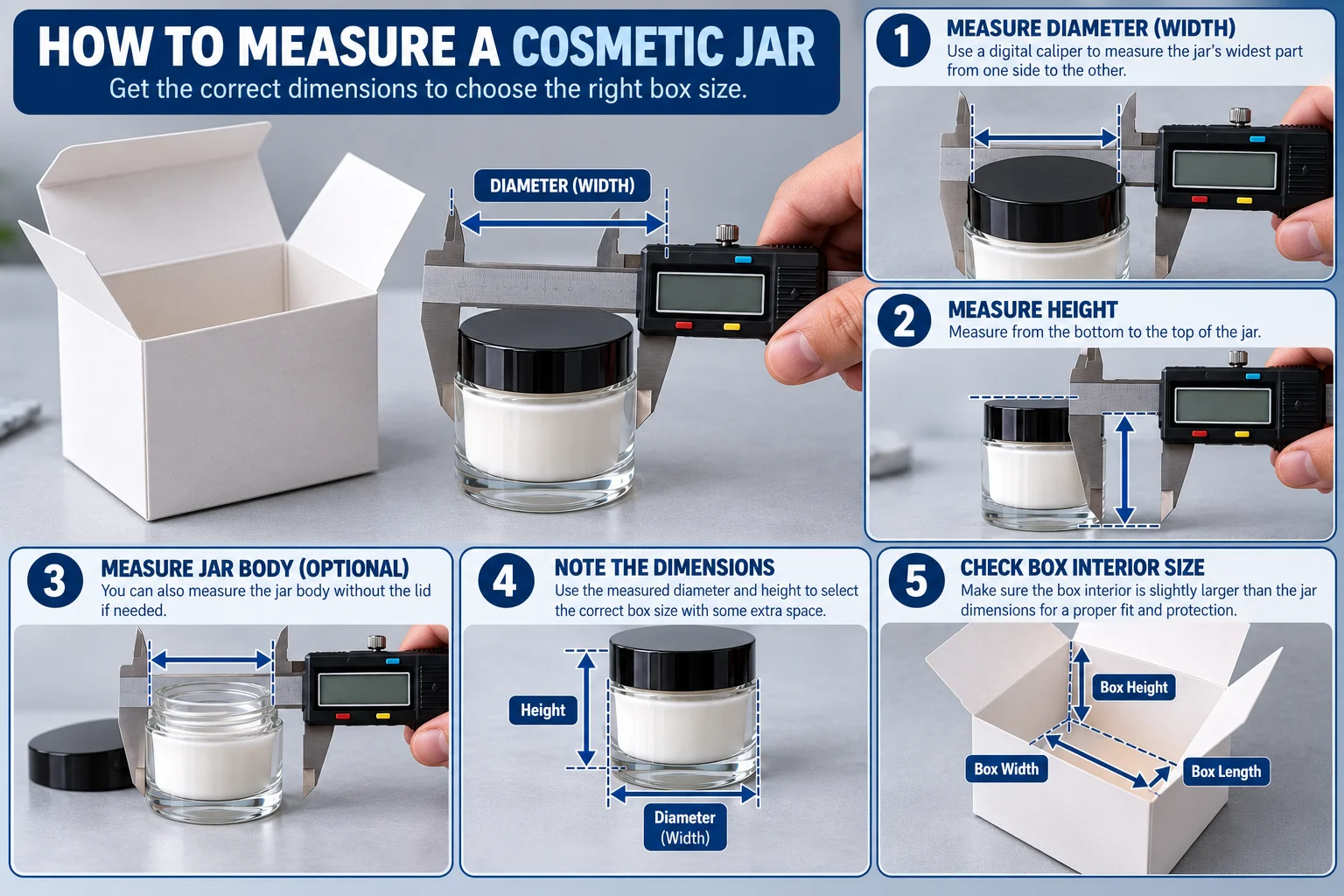
You measure a product for a new box at its widest and deepest and tallest points and then add a small clearance on every side. That clearance lets the product slide in and out without scuffing while still holding it still.
| Product | Clearance to add | Why |
|---|---|---|
| Cosmetic jar or bottle in a folding carton | 1 to 2 mm per side | A snug fit stops the product moving |
| Food and baked goods | 6 mm across, 10 mm above the top | Keeps frosting and toppings off the walls |
| Product with a printed insert | Insert thickness plus 1 mm | The insert takes up part of the space |
| Fragile item shipped in a mailer | 25 mm per side for padding | Room for wrap or a molded insert |
Measure the product as it will be packed with any lid or pump or protective sleeve in place. Our guide to cupcake pan sizes shows the same method for baked goods where the frosting sets the height. Our post on playing card dimensions applies it to a deck of cards and its tuck box.
A bar of soap is the simplest case because it is already a rectangle, and our custom soap boxes start from the bar plus 1 to 2 mm. When a product is an odd shape then measure the smallest rectangle it fits inside and use that as the starting size. You can then draw a box around those numbers in our free dieline generator before you order. Once the size is right it needs to be written down in a form that nobody can misread.
Measured your product already?
Send the inside length, width and height with your quantity. We return a dieline at your size and a price.
How Do You Write Box Dimensions?
You write box dimensions as length x width x height followed by the unit. Two clear examples are 12 x 8 x 4 in and 305 x 203 x 102 mm. The letter x reads as by and the box above is twelve by eight by four inches.
Always say whether the numbers are inside or outside dimensions. Printers mark inside sizes with ID and outside sizes with OD. A quote built on the wrong one is off by the board thickness.
| Written as | Means | Clear? |
|---|---|---|
| 12 x 8 x 4 in ID | Inside 12 long, 8 wide, 4 tall in inches | Yes |
| 305 x 203 x 102 mm OD | Outside size in millimeters | Yes |
| 12 x 8 x 4 | No unit and no inside or outside | No |
| 8 x 12 x 4 in | Width written before length | No |
Stick to one unit across the whole size and avoid fractions where you can. A size such as 12 x 8 x 4 in is clear while 12 in x 20 cm x 4 in invites a mistake. With the size written down you can work out how much the box holds.
How Do You Find the Volume of a Box?
You find the volume of a box by multiplying the length by the width by the height. A box of 12 x 8 x 4 inches holds 12 x 8 x 4 = 384 cubic inches.
To turn cubic inches into cubic feet divide by 1,728 because that is the number of cubic inches in one cubic foot. The same box holds 384 / 1,728 = 0.22 cubic feet while a 12 x 12 x 12 inch box holds exactly one cubic foot.
| Box size (in) | Cubic inches | Cubic feet |
|---|---|---|
| 6 x 6 x 6 | 216 | 0.13 |
| 9 x 6 x 3 | 162 | 0.09 |
| 12 x 8 x 4 | 384 | 0.22 |
| 12 x 12 x 12 | 1,728 | 1.00 |
| 16 x 12 x 10 | 1,920 | 1.11 |
| 18 x 18 x 16 | 5,184 | 3.00 |
Use inside dimensions when you want to know how much product fits and outside dimensions when a carrier or a warehouse asks for cubic size. Outside volume drives two more measurements every shipper needs, and those are girth and dimensional weight.
How Do You Measure a Box for Shipping?
You measure a box for shipping on the outside with the longest side as the length and round each number up to the next whole inch. UPS gives the example that a reading of 1.01 to 1.99 inches counts as 2 inches.
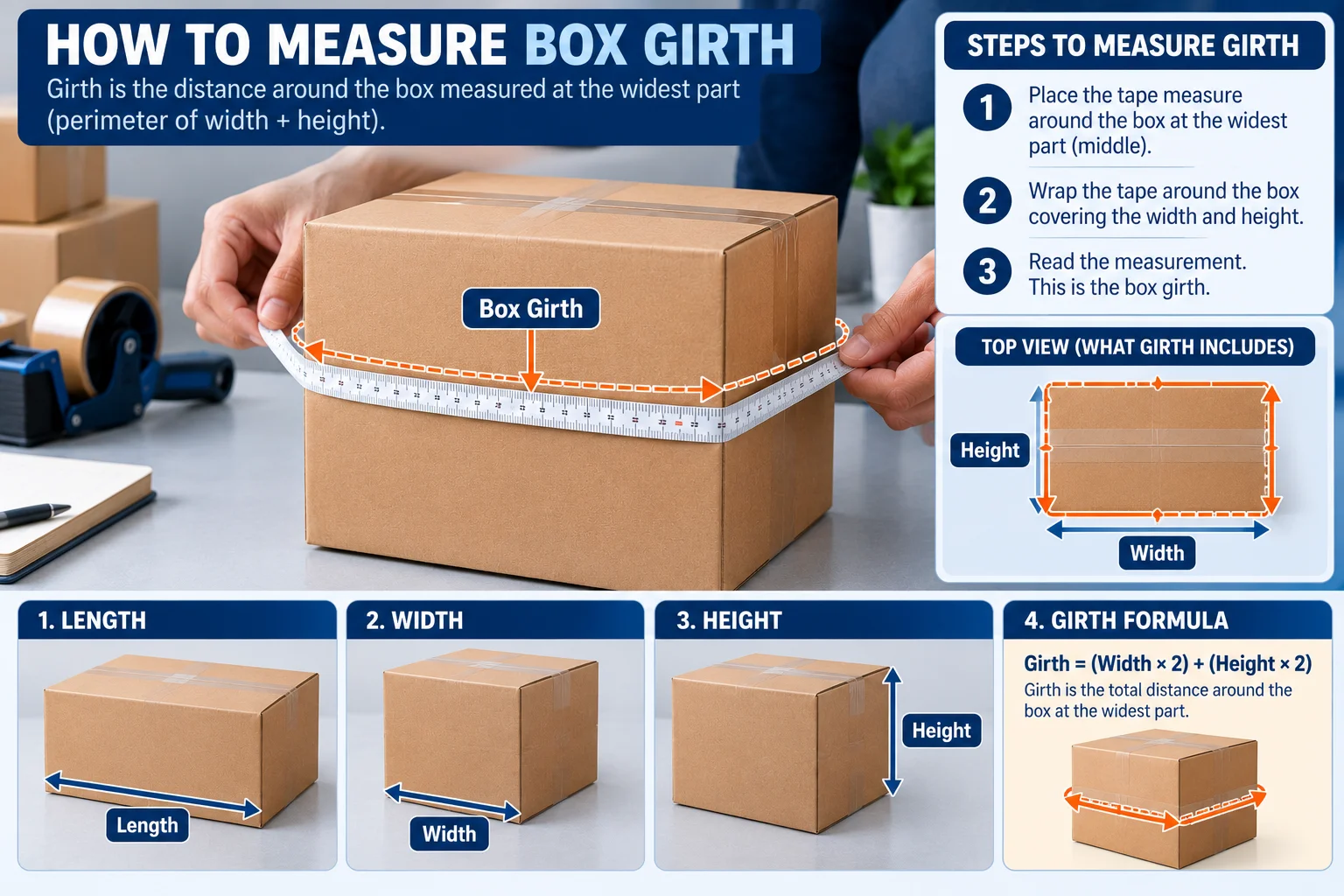
Carriers then work out the girth as twice the width plus twice the height. Adding the length gives length plus girth, the number that decides whether a parcel is too big for a service.
| Service | Maximum length | Maximum length plus girth |
|---|---|---|
| UPS | 108 in | 165 in |
| USPS Priority Mail | Included in the combined limit | 108 in |
| USPS Ground Advantage | Included in the combined limit | 130 in, with an oversized price above 108 in |
A box of 20 x 12 x 10 inches has a girth of 2 x 12 + 2 x 10 = 44 inches. Its length plus girth is 20 + 44 = 64 inches, which fits every standard service in the table.
Some products add their own rules on top of the size limits, and our guide to shipping products with lithium batteries covers that case. Size limits are only half of the shipping question for any parcel. The other half is the price, and for a large light box the price depends on its size more than its weight.
How Do You Calculate Dimensional Weight?
You calculate dimensional weight by multiplying the outside length and width and height in inches and dividing by the divisor your carrier uses. The UPS dimensional weight formula divides by 139 at daily rates and by 166 at retail rates.
The carrier then charges for the higher of the actual weight and the dimensional weight. USPS parcel size standards apply dimensional weight to parcels larger than one cubic foot and divide by 166.
| Box (in) | Cubic inches | Divided by 139 | Divided by 166 |
|---|---|---|---|
| 12 x 8 x 4 | 384 | 3 lb | 3 lb |
| 14 x 10 x 8 | 1,120 | 9 lb | 7 lb |
| 16 x 12 x 10 | 1,920 | 14 lb | 12 lb |
| 18 x 18 x 16 | 5,184 | 38 lb | 32 lb |
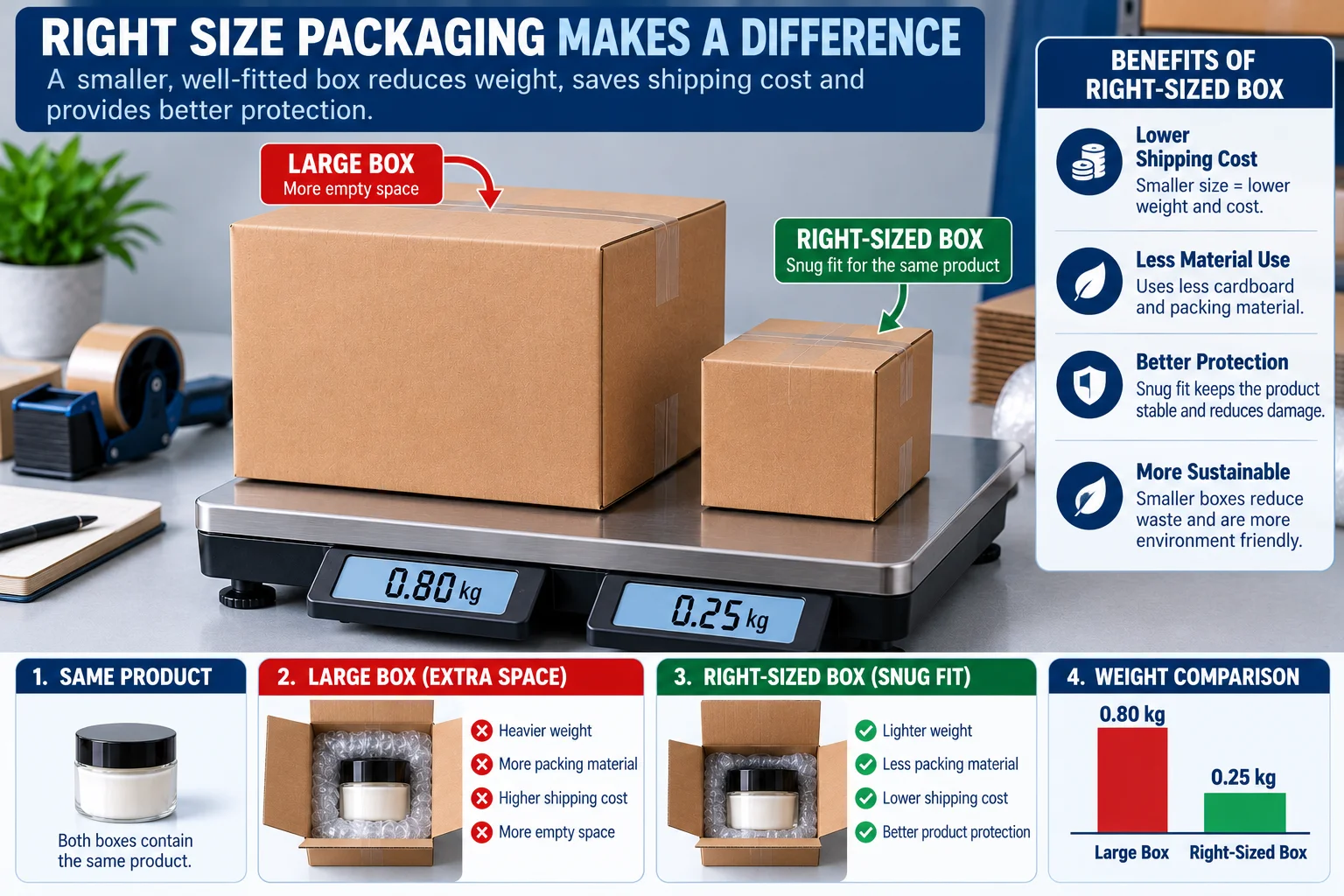
A box of 16 x 12 x 10 inches has 1,920 cubic inches. At a divisor of 139 it bills as about 14 pounds even when the product inside weighs only 3. Cutting the same product into a box of 14 x 10 x 8 inches drops the billed weight to about 9 pounds.
That saving is why right sized custom mailer boxes pay for themselves on busy shipping lines. Heavy glass jars gain the most, which is why our candle shipping boxes are cut to the jar rather than to a stock carton. The last step is choosing the tools that keep every measurement accurate.
Which Tools Help You Measure a Box Accurately?
A rigid steel tape or ruler measures a box accurately to the millimeter while a digital caliper measures board thickness and small products. A soft tape is only useful for round items such as candle jars and bottles. Measure the jar at its widest point and the lid at its tallest point before you order custom candle boxes. A jar is rarely the same width from top to bottom.
Our free dieline generator turns your three numbers into a flat box layout at true size with cut and fold lines drawn for the style you pick. Enter your own length, width and height in the size area in millimeters, centimeters or inches and then choose the material for the box.
The details panel then shows the inside and outside size for that board, which is the same gap this guide explains above. You can download the dieline as an AI, PDF or SVG file at true size and keep it.
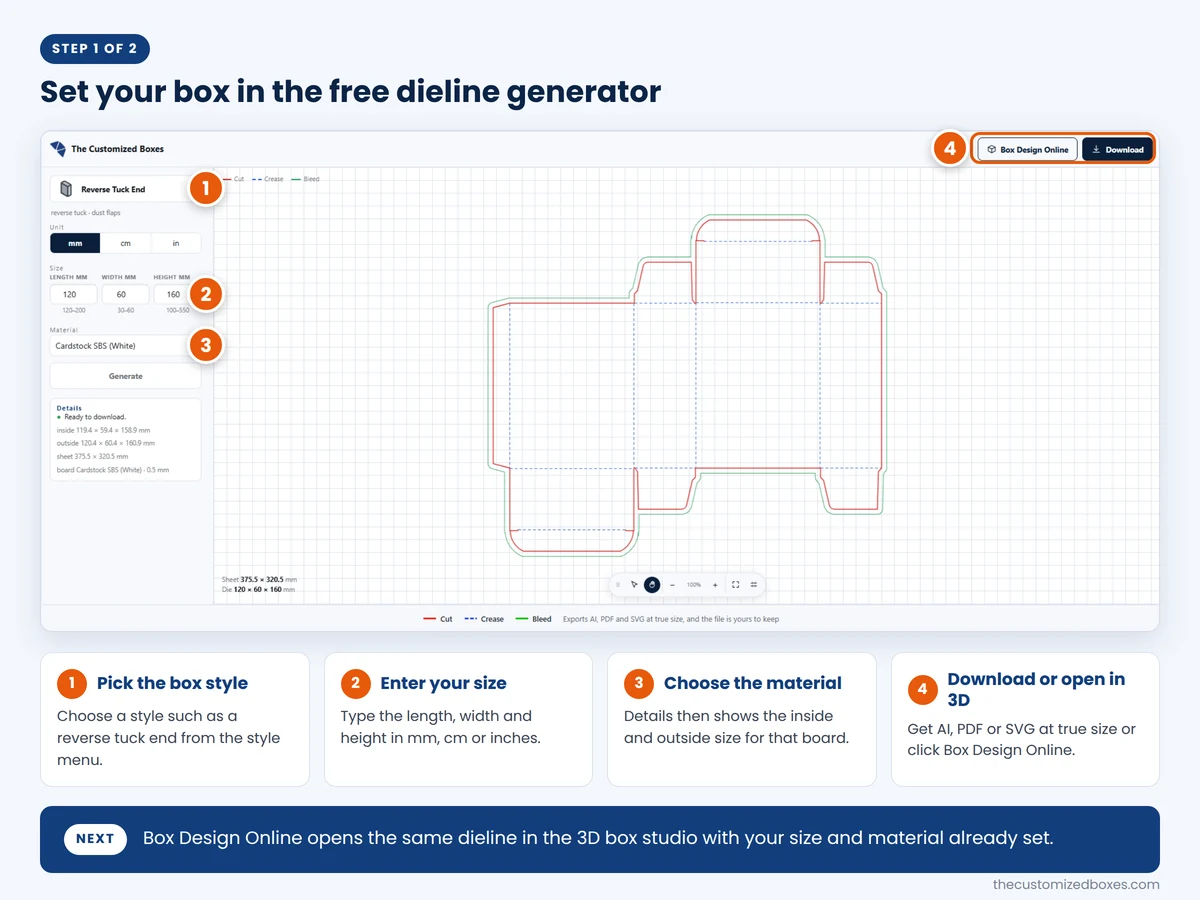
Click Box Design Online and the same dieline opens in our 3D box studio with the same size and the same material already set. Inside the studio you can still change the dimensions, switch the material, apply your own design and download the finished file.
The studio keeps the box style you started with, so a different dieline starts outside it. Go back to the 3D box studio page or the dieline generator page to choose the style you need and open it in the studio again.
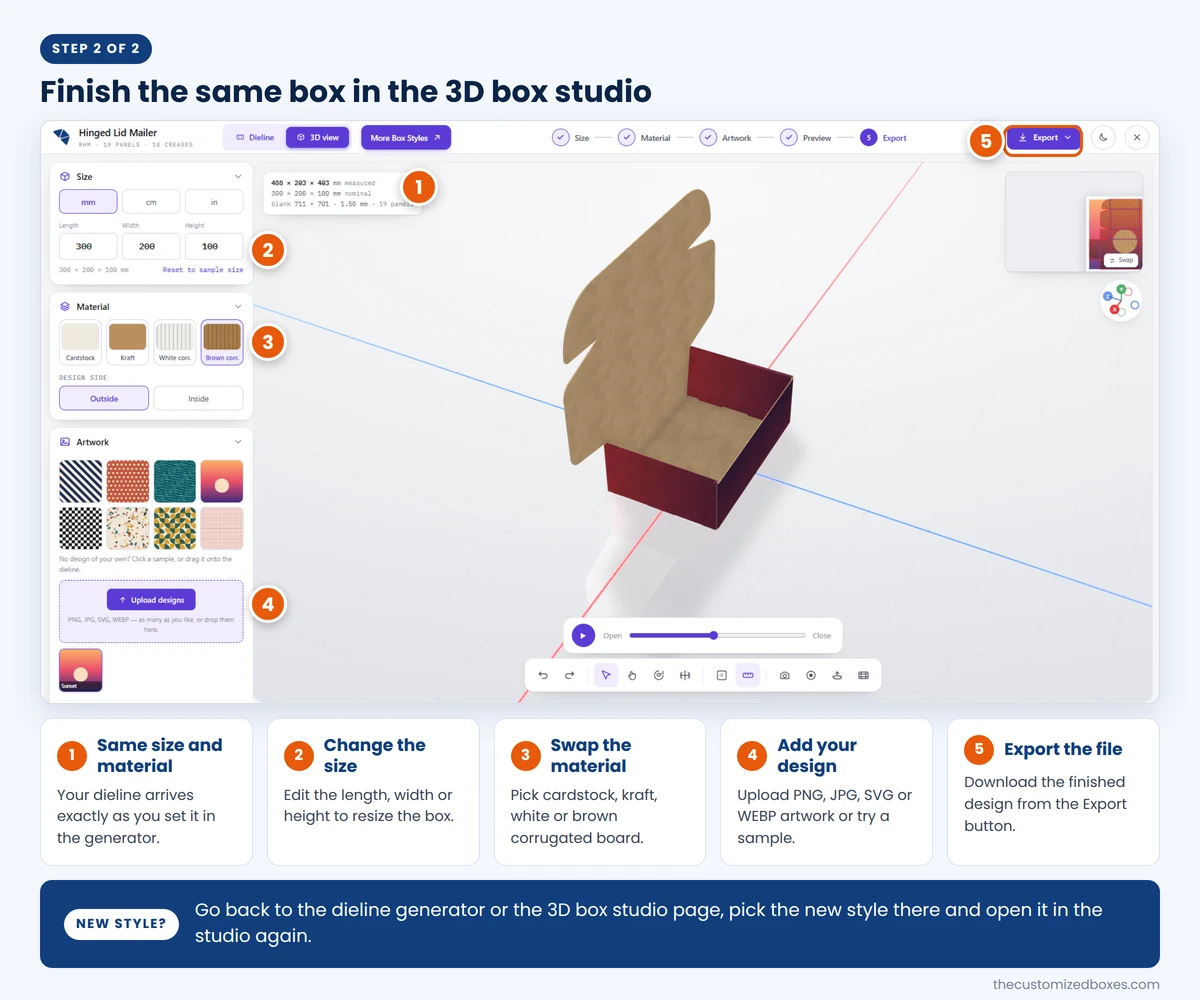
Our guide on how to design a box online walks through both tools step by step. With the size measured and checked the order itself takes only a few minutes.
How Do You Order a Box at Your Exact Size?
You order a box at your exact size by sending the inside length and width and height with the box style and quantity through our quote form. We return a dieline drawn to those numbers and a price for the run.
We make custom packaging boxes for folding cartons and mailers as well as rigid gift boxes and corrugated shipping cartons. Every size is cut from your measurements rather than picked from a stock list. Small products such as rings and earrings get the same care, and our custom jewelry boxes add a jewelry box insert cut to the piece.
- Minimum order is 100 boxes per size and design and the price per box falls as the run grows
- Price breaks arrive at 500 and 1,000 units on one artwork
- Production takes 8 to 10 business days after dieline approval for folding cartons and corrugated and 10 to 12 for rigid gift boxes
- A plain sample takes 3 to 5 business days and a printed one takes 7 to 10
- No setup or tooling fees apply on the first order or any reorder
- Shipping is free across the United States on every order
Order a plain sample when the fit is tight because a sample with the real product inside is the only test that proves a measurement. Our team checks every size against the product before production starts. Once the size is fixed you can add finishes to the box. Our guides to foil stamping and CMYK explained show what each one does to the look.
Frequently asked questions
The short version
Measure the length and width of a box inside the opening and the height from the opening to the floor. Then write the size as L x W x H with the unit. Order boxes by inside size and ship them by outside size, because board thickness sits between the two.
Volume is L x W x H and dimensional weight divides that number by the carrier divisor. Send your inside size through our quote form and we print from 100 boxes per size and design with free shipping across the United States.
Ready to order a box at your exact size?
At The Customized Boxes we print from 100 boxes per size and design with no setup fees, production in 8 to 10 business days after dieline approval and free shipping across the United States.
