





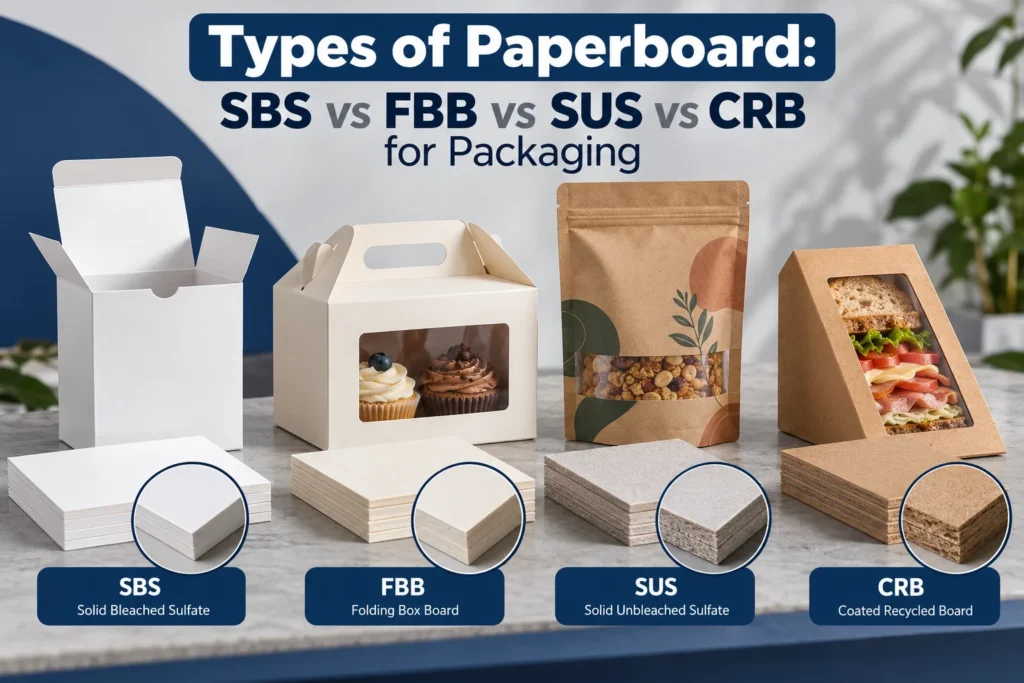
Paperboard comes in several grades that look alike on a quote but behave very differently on a shelf. The four you meet most often are SBS, FBB, SUS and CRB. Each one trades print quality against strength and cost in its own way.
This guide explains the main types of paperboard used for folding cartons in plain terms. It covers what each grade is made of and how the European grade codes map onto the names used by American printers. It also shows where kraft board and plain chipboard fit beside the four main grades.
You will also find side by side tables on print and strength plus food safety and sustainability and price. A product by product guide at the end shows which board suits soap and candles and cosmetics and bakery items. Every section opens with a direct answer so you can skip to the comparison you need.
Key takeaways
- The four main carton boards are SBS, FBB, SUS or CUK and CRB, and each one leads on a different measure.
- SBS is the premium grade with bleached virgin fiber through the whole sheet, the brightest print and the cleanest food contact.
- FBB means folding box board, a layered virgin board with a mechanical pulp middle that is stiff for its weight.
- SUS and CUK are unbleached kraft boards with the best tear and wet strength, which is why beverage carriers use them.
- CRB and CCNB are coated recycled boards with a gray back that cost the least and suit dry goods such as cereal.
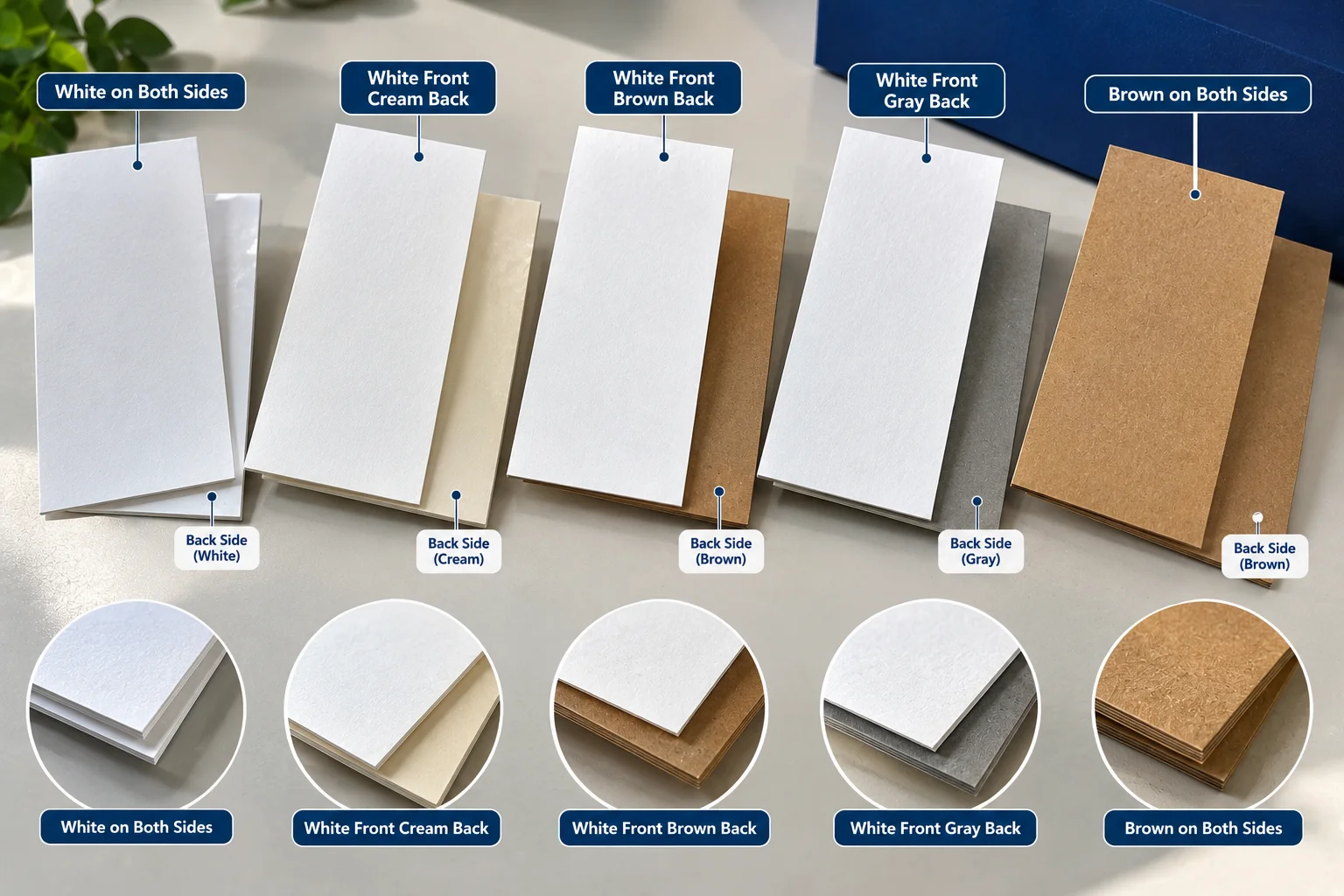
What Is Paperboard?
Paperboard is a thick and stiff paper product made from wood fiber that is generally heavier than 0.30 millimeters or 12 points. ISO standards set the line at a grammage above 250 grams per square meter although the edge between heavy paper and light board is not rigid.
Paperboard can be one ply or many plies pressed together on the paper machine. It is the material behind folding cartons and sleeves, trays and the wrapped panels of rigid boxes that brands use for custom packaging boxes every day.
In the United States board thickness is called caliper and it is measured in points and one point equals one thousandth of an inch. A board that measures 0.018 inches is sold as 18 point or 18 pt board.
Paperboard is different from corrugated board that glues a wavy fluted layer between two flat liners for shipping strength. Within the paperboard family there are several grades and the next section counts them.
How Many Types of Paperboard Are There?
There are four main types of paperboard for folding cartons and they are SBS, FBB, SUS and CRB. Uncoated kraft board and plain chipboard round out the list for natural looks and rigid box cores.
| Type | Fiber | Coating | Look | Main use |
|---|---|---|---|---|
| SBS | Bleached virgin chemical pulp in every ply | Clay coated on one or both sides | White through the sheet | Premium retail, food and medicine |
| FBB | Mechanical pulp middle with chemical pulp outer layers | Pigment coated top | White face, cream tint inside | Food and personal care cartons |
| SUS or CUK | Unbleached virgin kraft pulp | White coated top or none | White or brown face, brown back | Beverage carriers and frozen food |
| CRB or CCNB | Recycled fiber in many layers | White clay coated top | White face, gray back | Cereal, dry goods and budget cartons |
| Uncoated kraft | Unbleached virgin kraft pulp | None | Brown on both sides | Natural look retail boxes |
| Chipboard | Recycled fiber | Usually none | Gray or brown on both sides | Rigid box cores and backing cards |
Each grade is defined by two things and the first is the fiber, which can be virgin or recycled and bleached or unbleached. The second is the coating that decides how well the top face takes ink.
The names in the table are the ones American printers use. Mills in Europe and Asia label the same boards with short letter codes and the next section explains how to read them.
How Are Paperboard Grades Coded?
Paperboard grades in Europe follow the German standard DIN 19303, which names each board with two letters and a number. The first letter shows the surface treatment and the second letter shows the main fiber in the sheet.
| Position | Letter | Meaning |
|---|---|---|
| First letter | A | Cast coated surface |
| First letter | G | Pigment coated surface |
| First letter | U | Uncoated surface |
| Second letter | Z | Bleached virgin chemical pulp |
| Second letter | C | Virgin mechanical pulp |
| Second letter | N | Unbleached virgin chemical pulp |
| Second letter | T | Recycled fiber with a white, cream or brown reverse |
| Second letter | D | Recycled fiber with a gray back |
The number after the letters shows the color of the reverse side on virgin grades such as GC1 with a white back and GC2 with a cream back. On recycled D grades the number marks a bulk range instead.
| Code | Common name | What it means |
|---|---|---|
| GZ | SBS or solid bleached board | Coated board of bleached virgin chemical pulp |
| GC1 | FBB with a white back | Coated folding box board with a white reverse |
| GC2 | FBB with a cream back | Coated folding box board with a cream reverse |
| GN | Coated SUS, CUK or CNK | Coated board of unbleached virgin chemical pulp |
| GT | Recycled board with a light back | Coated recycled board with a white, cream or brown reverse |
| GD | CRB, CCNB or duplex board | Coated recycled board with a gray back |
Once you know the codes an imported spec sheet becomes easy to read. GZ is the European label for SBS, the grade most buyers picture when they think of a premium white carton.
What Does FBB Mean in Packaging?
FBB means folding box board, a multi layer paperboard with a middle layer of mechanical pulp between outer layers of chemical pulp. The top layer is bleached chemical pulp and it usually carries a pigment coating for print.
Mechanical pulp is made by grinding wood rather than cooking it and so it keeps more of the wood and adds bulk at a low weight. That is why FBB is described as low in density and high in stiffness.
| Layer | Fiber | Purpose |
|---|---|---|
| Top | Bleached chemical pulp with a pigment coating | A bright and smooth print surface |
| Middle | Mechanical pulp | Bulk and stiffness at a low weight |
| Back | Chemical pulp, white or cream | Strength and a clean inside face |
FBB board shows a slight yellow tint that sits mostly on the inside of the sheet because mechanical pulp keeps some lignin. Under DIN 19303 it carries the codes GC1 or GC2 when coated and UC when uncoated.
Folding boxboard is common in Europe for health and beauty products and for chilled and frozen foods as well as confectionery and medicine. Buyers who see both FBB and SBS on a quote usually want a direct comparison and the next section gives one.
What Is the Difference Between FBB and SBS Board?
The difference between FBB and SBS board is the middle layer. SBS uses bleached chemical pulp all the way through, while FBB hides a bulky mechanical pulp core between bleached chemical pulp outer layers.
| Feature | SBS | FBB |
|---|---|---|
| Middle layer | Bleached chemical pulp | Mechanical pulp |
| Color through the sheet | White everywhere including cut edges | White face with a cream tint inside |
| Density | Higher | Lower, so less weight for the same thickness |
| Stiffness for its weight | Good | Higher |
| Yellowing over time | Low | Slight yellow tint, mostly inside |
| Embossing and fine detail | Excellent | Good |
| Where it is common | North America | Europe |
| DIN 19303 code | GZ | GC1 or GC2 |
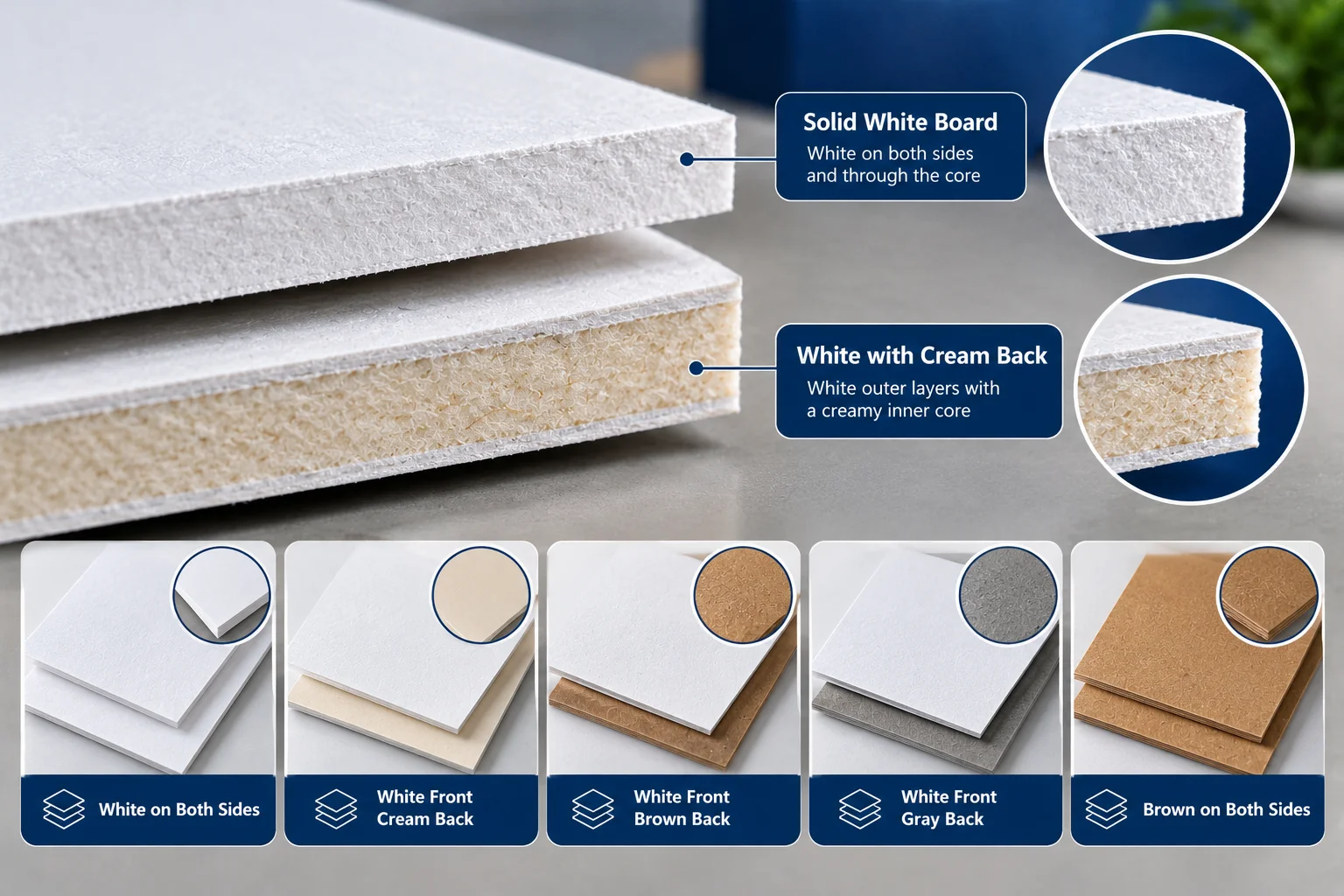
In practice FBB can reach the same stiffness as SBS with less fiber and that saves weight and shipping cost on large runs. SBS wins on whiteness through the sheet, cut edge appearance and fine embossing.
Food brands in North America lean toward SBS because the grade is made here in large volume and has a long record in direct food contact. FBB is used widely for food in Europe as well and the right choice depends on the product and the mill.
Both of these grades are bleached and that leaves one important virgin fiber board still to cover. That board keeps its natural brown color and wins on strength.
Comparing boards for your next box?
Tell us the product, the size and the quantity. We recommend a grade and a caliper and send a dieline with the price.
What Is Solid Unbleached Sulfate Board?
Solid unbleached sulfate board or SUS is a virgin kraft paperboard that skips the bleaching stage and keeps its natural brown color through the sheet. When it carries a white clay coating on top it is sold as CUK for coated unbleached kraft or CNK for coated natural kraft.
Trade sources treat SUS and CUK as the same product family under different names. The fiber is mostly long softwood pine that gives the board its toughness with a thin hardwood layer on top for a smoother print face.
| Feature | SUS or CUK |
|---|---|
| Fiber | Unbleached virgin kraft pulp, mostly long softwood fiber |
| Surface | White titanium based coating on top or natural brown |
| Back | Brown |
| Strengths | Highest tear strength and a wet strength option |
| Food contact | Suitable for direct food contact |
| Typical uses | Beverage carriers, frozen food, multipacks and hardware |
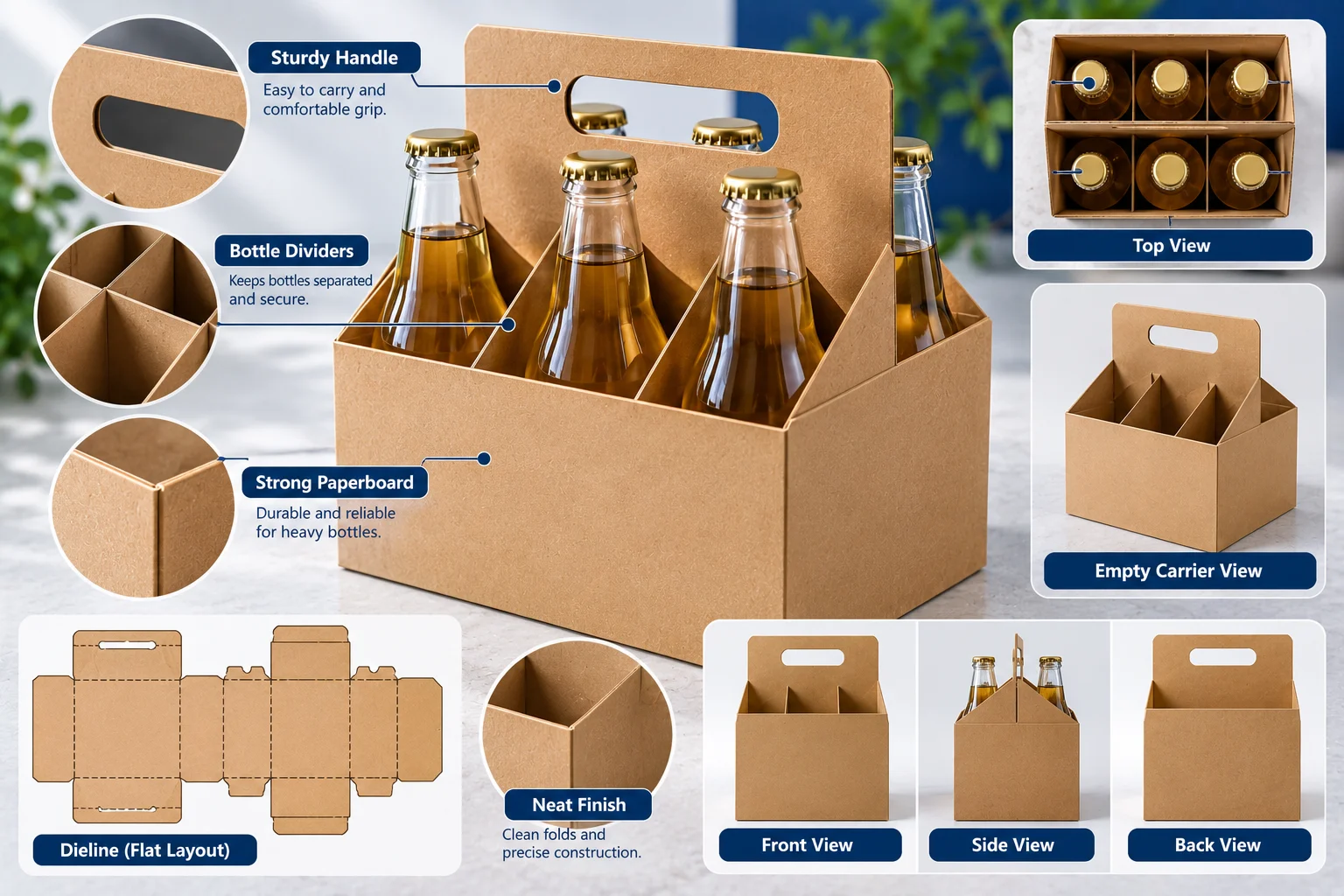
Its signature use is the beverage carrier because a wet strength version survives cold and damp bottles and cans. It also turns up in frozen food cartons, club store cereal multipacks and heavy hardware boxes.
SUS costs somewhat less than SBS and offers far more tear strength. For the lowest price per carton though most brands look at recycled board instead.
What Is Coated Recycled Board?
Coated recycled board or CRB is paperboard made from recovered paper such as old newsprint and old corrugated boxes and mixed office waste. A white clay coating on the top ply gives it a printable face while the back stays gray.
CRB is often 100 percent recycled fiber with 35 percent or more post consumer content. It is built from eight or more thin layers that give it a useful stiffness in one direction that helps carton panels resist bulging.
| Feature | CRB |
|---|---|
| Fiber | Recovered newsprint, old corrugated boxes and mixed paper |
| Recycled content | Often 100 percent with 35 percent or more post consumer |
| Structure | Eight or more thin layers with a white coated top ply |
| Strengths | Low cost and good one direction stiffness against bulging |
| Limits | Weaker, more moisture, looser tolerances and higher ink use |
| Typical uses | Cereal, rice, pet food, pancake mix and detergent cartons |
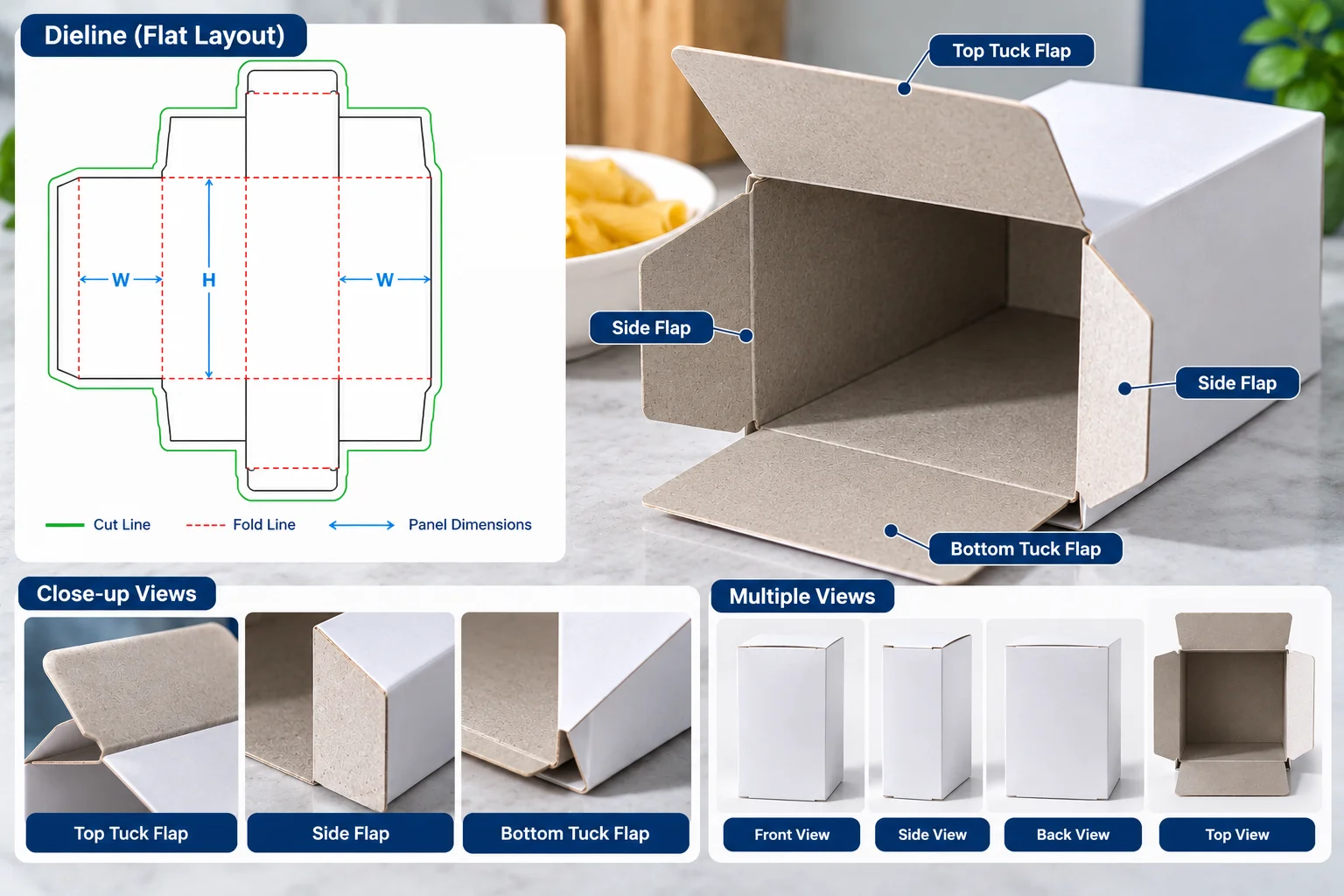
Recycled fiber is shorter and weaker than virgin fiber and CRB tolerances are looser and the board carries more moisture. It is also more absorbent and printers need a heavier ink film to reach the same color strength as on SBS.
CRB is the most common substrate for low cost folding cartons in the United States and it goes by several other names. One of those names is CCNB and it causes more confusion than any other label on a carton quote.
What Is CCNB Material and Is It the Same as Duplex Board?
CCNB material is clay coated news back, a coated recycled board with a white printable top and a gray back made largely from recycled newsprint. It is one of the most widely used members of the CRB family.
Duplex board is the term many Asian and European mills use for the same kind of board. It means a board with a coated white top and a gray or brown recycled back and it maps to the GD and GT codes.
| Name | Where you see it | What it is |
|---|---|---|
| CRB | North American printers and mills | The family name for coated recycled board |
| CCNB | Spec sheets and quotes | Clay coated news back, a CRB with a gray back |
| Duplex board | Asian and European mills | A coated recycled board with two different faces |
| White lined chipboard | Older trade sources and Europe | Another name for the same white top recycled board |
| GD2 or GD3 | DIN 19303 spec sheets | Coated recycled board with a gray back in a set bulk range |
You may also see CCNB called white lined chipboard or bending chip on older spec sheets and in European trade sources. All of these names point to a recycled carton board with a white face and a gray back.
We print on CCNB duplex board for budget runs of dry goods where the inside of the box is never seen. That brings up chipboard, a word that many buyers use for any gray board at all.
Is Chipboard the Same as Paperboard?
Chipboard is one type of paperboard, made from recycled paper and usually left uncoated with a gray or brown look on both sides. It is a low cost board used where print quality does not matter or where a paper wrap covers it.
Uncoated recycled board goes into tubes and cores and separator sheets and backing cards as well as the hidden cores of rigid boxes. Rigid gift boxes wrap thick chipboard in printed paper to get a firm and premium feel.
| Board | Coated | Typical use |
|---|---|---|
| Plain chipboard | No | Rigid box cores, backing cards and pads |
| Uncoated recycled board | No | Tubes, cores, separator sheets and drums |
| Coated recycled board | Yes, white top | Printed folding cartons for dry goods |
| SBS | Yes, one or both sides | Premium printed cartons and food boxes |
Searches for chipboard for folding cartons usually come from buyers who want coated recycled board, since plain chipboard prints poorly. Folding carton chipboard sheets sold for crafts and samples are normally CRB with a white face.
You will also see the phrase SBS chipboard online and that phrase mixes two very different boards. SBS is virgin bleached fiber and chipboard is recycled fiber and a supplier should confirm which one you are getting before you order.
Brown boards bring up one more family that buyers ask about often and that family is kraft board.
Where Does Kraft Board Fit Among Paperboard Types?
Kraft board is any paperboard made from kraft pulp and in packaging the word usually means the brown unbleached grades. Uncoated kraft boxboard, coated SUS and white top kraft all belong to this group.
Uncoated kraft boxboard or UKB keeps a natural brown face and back with no coating at all. It has a lower density than other grades so a carton of the same caliper weighs less and it is also safe for direct food contact.
| Kraft grade | Face | Back | Best for |
|---|---|---|---|
| Uncoated kraft boxboard | Natural brown | Natural brown | Earthy retail boxes and food service |
| Coated SUS or CUK | White coated | Brown | Strong printed carriers and frozen food |
| White top kraft | White fiber layer | Brown | Full color on a kraft based box |
Natural kraft suits brands that want an earthy and handmade look with one or two dark inks or a foil logo. Our kraft boxes run on natural kraft at about 18 pt, with white top kraft available when the art needs full color.
With every grade now named the practical question is which ones printers actually use for folding cartons.
Which Paperboard Types Are Used for Folding Cartons?
Folding cartons are made mainly from the four grades in this guide with uncoated kraft used for natural designs. The right folding carton material depends on the product, the look and the price per unit the brand can carry.
| Product | Usual board | Why |
|---|---|---|
| Cosmetics and skin care | SBS or FBB | Bright print and fine finishes |
| Soap and bath bombs | SBS or natural kraft | Clean look or a handmade feel |
| Bakery and confectionery | Food grade SBS | Direct food contact and fine print |
| Cereal and dry mixes | CRB or CCNB | Low cost with an inner bag |
| Frozen food | SUS, CUK or coated SBS | Wet strength and barrier coatings |
| Beverage multipacks | SUS or CUK | Tear and wet strength |
| Medicine and supplements | SBS or FBB | Clean fiber and small legible text |
Most of our folding cartons run on SBS because retail brands want a bright face and clean inside. CRB and CCNB take over when the box holds a dry product and the price per unit matters more than the inside view.
Common caliper bands for these cartons run from about 12 to 24 pt across all grades. A grade choice always comes back to three things and the first of them is how the print looks.
How Do Paperboard Grades Compare on Print Quality?
SBS gives the best print quality of all paperboard types and FBB follows closely with coated SUS next and CRB last. The order follows the brightness of the base and how smooth and closed the coated face is.
| Grade | Base color | Surface | Print result |
|---|---|---|---|
| SBS | Bright white | Smooth and closed clay coating | Sharpest detail and truest color |
| FBB | Bright white face | Smooth pigment coating | Very close to SBS on the outside |
| Coated SUS or CUK | White coated over brown | Coated but slightly rougher | Good for bold graphics |
| CRB or CCNB | White coated over gray | More absorbent coating | Needs heavier ink for the same strength |
| Uncoated kraft | Brown | Open fiber surface | Best with one or two dark inks |
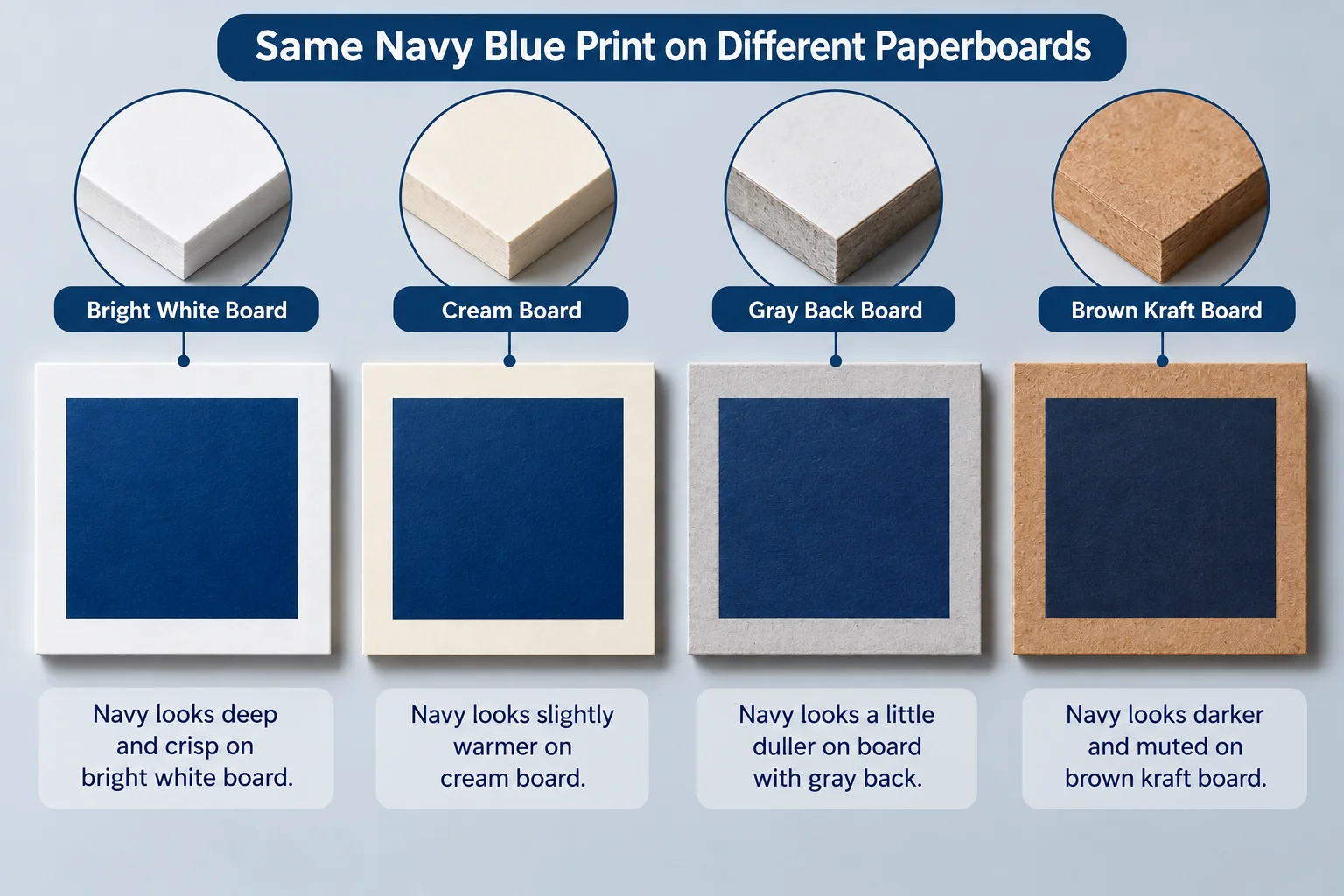
A bright base needs less ink to reach full color, while a gray or brown base can dull light tones under thin ink. That is why photo heavy artwork and pale brand colors look best on SBS and FBB.
Coatings narrow the gap a little because an aqueous coating or UV coating adds gloss and evens the surface. Our aqueous coating guide explains how each finish behaves on coated and uncoated board.
Color is also a matter of process and it helps to know how CMYK works on board before you approve a proof. Our CMYK guide covers that in detail with examples on board. Print is only one measure and many products care more about strength.
How Do Paperboard Grades Compare on Strength and Stiffness?
SUS and CUK lead on tear and wet strength, FBB leads on stiffness for its weight and SBS sits in the middle with good stiffness and compression strength. CRB is the weakest of the four for the same caliper.
| Grade | Tear strength | Stiffness for its weight | Moisture tolerance |
|---|---|---|---|
| SBS | Average | Good | Fair, better with a coating |
| FBB | Average | High | Fair |
| SUS or CUK | Highest | Good | Best, with a wet strength option |
| CRB or CCNB | Lowest | Fair, strong in one direction | Lowest |
Stiffness decides whether a carton panel stays flat on a shelf and whether a stack of boxes leans over time. Tear strength decides whether a handle cutout or a carrier survives being lifted with weight inside.
When a product needs more strength than any of these boards can give, the answer is corrugated board or a rigid box rather than a heavier caliper. Our custom cardboard boxes and rigid boxes cover those builds.
Strength protects the product in transit but for food boxes another property matters even more.
Which Paperboard Is Safe for Food Contact?
Virgin fiber boards such as SBS and FBB and SUS are the usual choices for direct food contact while recycled boards need extra checks. In the United States every component of a food contact board must meet FDA rules for paper and paperboard.
The main rule for moist and fatty food is 21 CFR 176.170, while 21 CFR 176.180 covers paper and paperboard in contact with dry food. Boards made from recycled fiber also fall under 21 CFR 176.260 for pulp from reclaimed fiber.
| Grade | Direct food contact | Rule to check |
|---|---|---|
| SBS | Common choice | 21 CFR 176.170 or 176.180 by food type |
| FBB | Used for food, more common in Europe | 21 CFR 176.170 or 176.180 by food type |
| SUS or CUK | Suitable, strong in frozen food | 21 CFR 176.170 with a barrier when wet |
| CRB or CCNB | Mostly indirect contact or with a liner | 21 CFR 176.260 plus the contact rule |
Recycled boards draw extra scrutiny because recovered paper can carry mineral oil from printing inks into the food. Published research has measured mineral oil in rice packed in recycled board, which is why many brands keep recycled grades for indirect contact.
Our custom bakery boxes and custom food boxes use food grade SBS for that reason. Food safety and sustainability sometimes pull in different directions and that is the next comparison.
Which Paperboard Is the Most Sustainable Choice?
There is no single most sustainable paperboard because recycled grades save fiber while virgin grades keep the recycling loop strong. The best choice is the board that does the job with the least material and recycles cleanly at the end.
| Grade | Fiber source | Recycles with paper | Note |
|---|---|---|---|
| SBS | Virgin fiber, often from certified forests | Yes when free of heavy film | Adds strong fiber to the loop |
| FBB | Virgin fiber with a high yield mechanical core | Yes | Uses less wood for the same stiffness |
| SUS or CUK | Virgin unbleached fiber | Yes | No bleaching step |
| CRB or CCNB | Recovered paper | Yes | Keeps paper out of landfill |
CRB and CCNB use recovered paper and keep it out of landfill and that makes them strong choices for dry goods. Virgin grades such as SBS and SUS come from managed forests and add fresh fiber that recycled grades need to stay strong.
Every grade on this list recycles with paper when it is free of heavy films. If you print a recyclable claim the FTC Green Guides at 16 CFR 260.12 require programs available to at least 60 percent of consumers for an unqualified claim.
Our eco friendly shipping boxes pair recycled content with simple builds that recycle well. Cost is the last comparison and for many brands it is the deciding one.
How Do Paperboard Prices Compare?
CRB and CCNB are the lowest cost paperboard types, unbleached kraft and SUS sit in the middle and SBS is usually the most expensive. FBB often prices between recycled board and SBS because it reaches its stiffness with less fiber.
| Grade | Relative board cost | Where the money goes |
|---|---|---|
| CRB or CCNB | Lowest | Recovered fiber with a simple coating |
| Uncoated kraft | Low to middle | Virgin fiber without bleaching or coating |
| SUS or CUK | Middle | Virgin kraft fiber and a white coating |
| FBB | Middle to high | Virgin fiber with a lighter mechanical core |
| SBS | Highest | Fully bleached virgin fiber and a premium coating |
Board is only one part of a box price and the gap between grades shrinks once print, finish and die cutting are added. We do not charge setup or tooling fees, so even a short run shows the true price gap between grades.
We print every grade from 100 boxes per size and design so you can compare a CRB box and an SBS box with the same artwork. All that is left is matching the board to your product.
Which Paperboard Should You Choose for Your Product?
Choose SBS for premium retail and cosmetics and direct food contact and pick CRB for dry goods on a budget. SUS suits heavy or wet items and kraft suits a natural look. The table below matches common products to a first choice and a budget alternative.
| Product | First choice | Budget alternative |
|---|---|---|
| Lipstick, serum and perfume | SBS 14 to 24 pt | FBB |
| Bar soap and bath bombs | SBS 14 to 16 pt | Natural kraft or CCNB |
| Jar candles | SBS 18 to 24 pt | Kraft at about 18 pt |
| Cupcakes, cookies and donuts | Food grade SBS 16 to 20 pt | SBS with a lighter caliper |
| Cereal, tea and dry mixes | CRB or CCNB | Plain CRB with fewer colors |
| Tinctures and CBD products | SBS 16 to 18 pt | CCNB for outer sleeves |
| Heavy hardware and tools | SUS or CUK | Corrugated with a printed label |
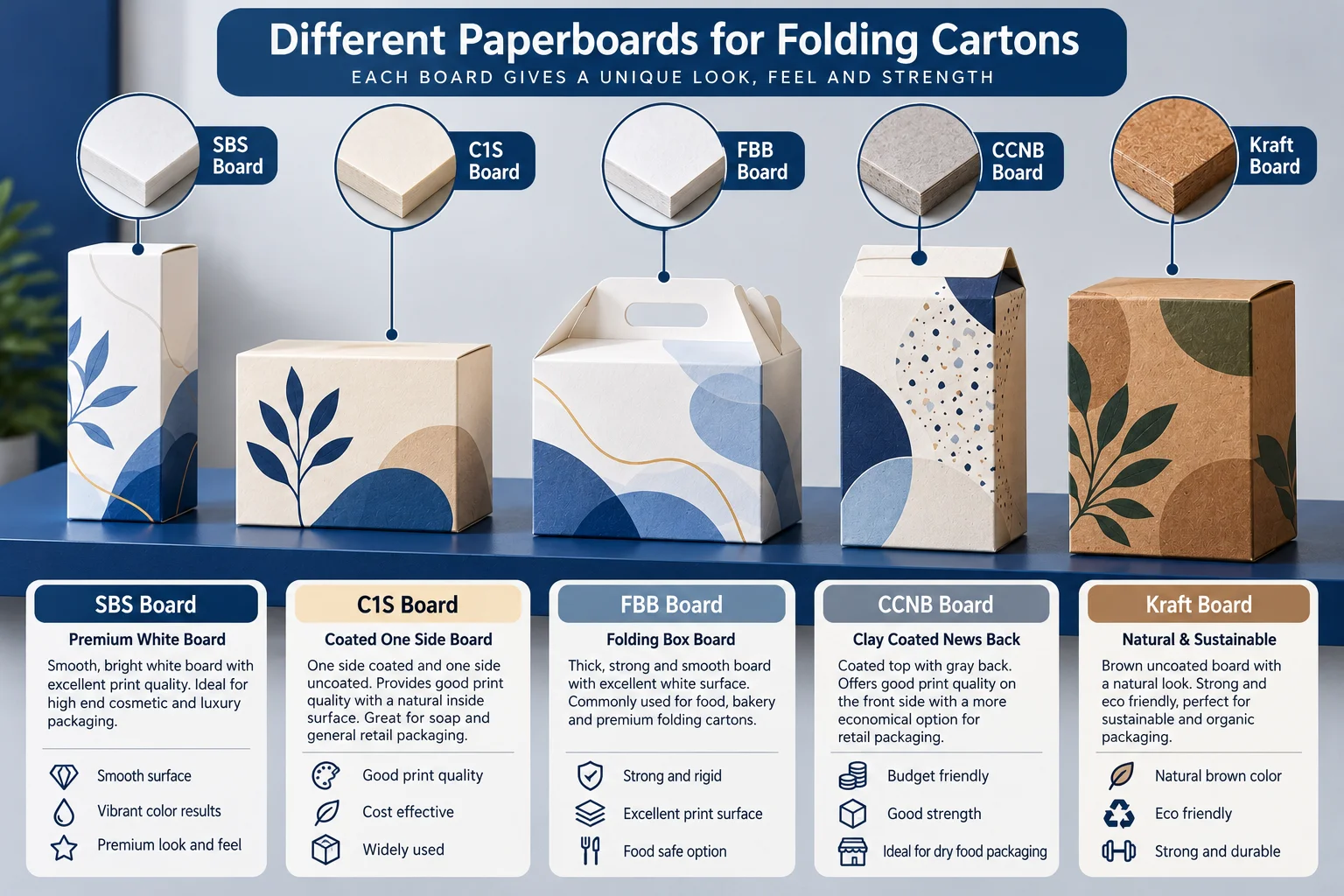
Custom soap boxes and candle boxes often run on SBS or kraft depending on the brand style. Custom cosmetic boxes almost always use SBS for the bright print, while custom cereal boxes are a classic CRB job.
CBD boxes need room for compliance text and often a child resistant insert and they usually run on SBS at 16 to 18 pt. A plain sample in the target board is the quickest way to feel the difference before a full run.
When you are ready send the product size and quantity through the quote form and we will recommend a grade and caliper with the price. You can also build the dieline first in our free dieline generator.
Frequently asked questions
The short version
The main types of paperboard are SBS, FBB, SUS and CRB with uncoated kraft and chipboard as specialist options. SBS leads on print and purity while FBB leads on stiffness per gram. SUS wins on tear strength and CRB wins on price.
Match the board to what the box must do first and then to the look you want. Use SBS for premium and food boxes and SUS for heavy or wet loads. Choose kraft for a natural feel and CRB for budget dry goods.
Ready to choose the right paperboard?
At The Customized Boxes we print SBS, kraft, CCNB and corrugated boxes with full color and premium finishes, from 100 boxes per size and design with free shipping across the United States.
