



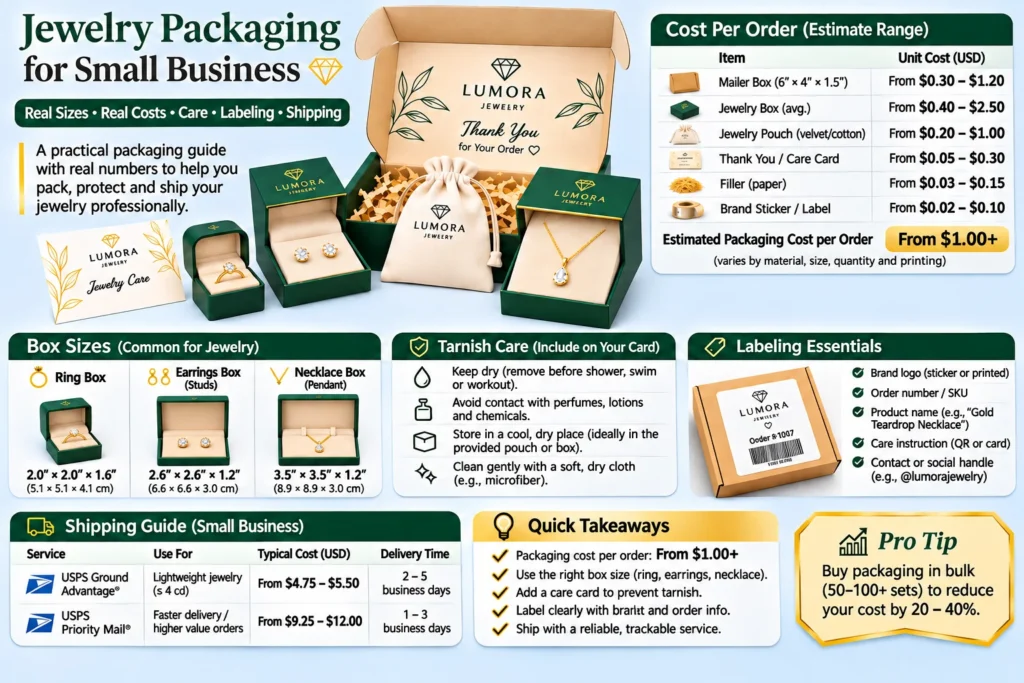
Jewelry packaging for small business has one hard job which is making a piece that costs you a few dollars feel worth the price on the tag. The box is the first thing your buyer touches so it sets the value of everything inside it.
Most guides stop at a list of pretty ideas and never tell you what those ideas cost or how many boxes you need to buy. That leaves new sellers guessing at budgets, ordering the wrong sizes and paying twice to fix it.
This guide works through the numbers instead, from cost per order and box sizes to tarnish care, product card wording and safe shipping. By the end you will have a starter plan you can quote, sample and launch with confidence.
Key takeaways
- Keep the full packaging set for each order under one tenth of the selling price with every part of the set counted in that one figure.
- Two or three inside sizes fit most collections and a 2 inch ring box plus a 3.5 inch square box covers many first launches.
- Seal silver in a zip bag with an anti tarnish strip and keep rubber bands and wool felt away from it.
- Words like sterling, gold filled and vermeil carry federal meanings so check the metal before printing them on a card.
- Order from 100 boxes per size and design with lower prices at 500 and again at 1,000 boxes on the same artwork.
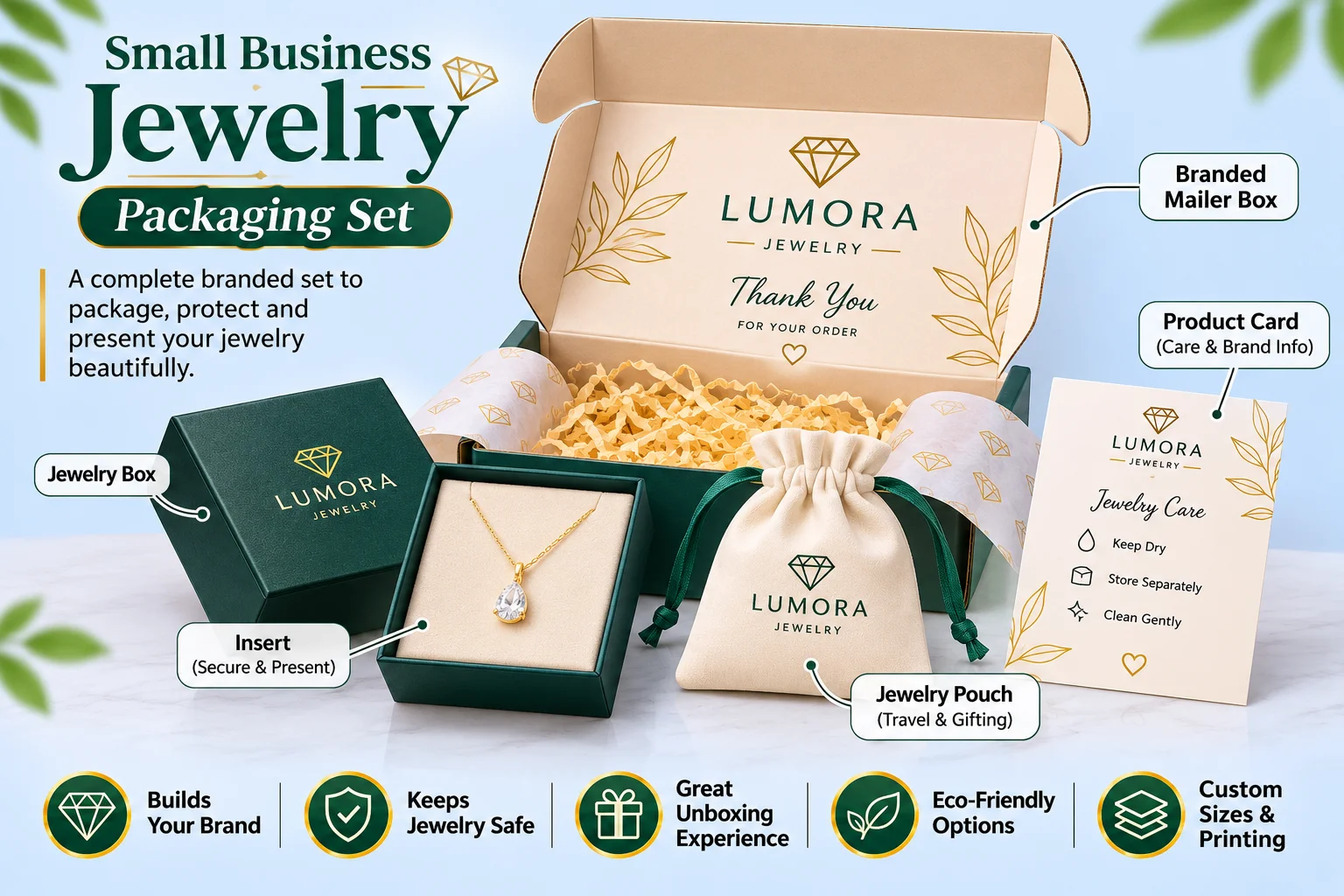
What Does Jewelry Packaging for a Small Business Need to Do?
Jewelry packaging for a small business needs to do four jobs at once and a box that fails any one of them costs you sales or returns.
| Job | What it means in practice | What happens when it fails |
|---|---|---|
| Protect the piece | Holds the item still and keeps chains, stones and plating safe | Scratched plating, bent posts and tangled chains arrive at the door |
| Present the piece | Shows the jewelry at its best the moment the lid opens | A good piece looks cheap and the buyer questions the price |
| Carry the brand | Puts your name and look in front of the buyer and anyone they gift to | The buyer remembers the piece but forgets where it came from |
| Ship at low cost | Fits a small mailer without wasted space or extra weight | Every order carries a higher postage bill than it needs |
The trick for a small brand is choosing packaging that handles all four jobs with as few parts as possible. A box that presents beautifully but needs a second outer carton for every order costs more than it saves.
With those jobs in mind the first real question is how much of each sale you can afford to spend on the box.
How Much Should a Small Jewelry Brand Spend on Packaging?
A small jewelry brand should plan its packaging spend per order rather than per box because the box is only one of five parts the buyer opens.
A simple rule we give new sellers is to keep the whole packaging set under one tenth of the selling price. On a necklace that sells for forty dollars that means a packaging budget of four dollars or less.
| Part of the order | Lean set for pieces from 40 dollars | Premium set for pieces from 150 dollars |
|---|---|---|
| Jewelry box | Printed two piece or tuck box, 0.80 to 1.50 dollars | Rigid or magnetic box, 3.00 to 6.00 dollars |
| Insert | Card slot insert, 0.10 to 0.30 dollars | Foam or velvet cavity insert, 0.60 to 1.50 dollars |
| Pouch | Organza or cotton pouch, 0.12 to 0.40 dollars | Printed microfiber pouch, 0.80 to 2.40 dollars |
| Product card | Printed card with care notes, 0.05 to 0.15 dollars | Thick card with foil logo, 0.20 to 0.50 dollars |
| Shipping mailer | Small printed mailer box, 0.80 to 1.50 dollars | Mailer printed inside and out, 1.50 to 3.90 dollars |
| Total per order | About 1.90 to 3.85 dollars | About 6.10 to 14.30 dollars |
The lean set suits earrings, stacking rings and everyday pieces that sell in volume. The premium set belongs on fine silver, gold vermeil and gift pieces where the box is part of what the buyer is paying for.
Most new brands land between those two columns with a printed box and a plain pouch on everyday pieces and one premium box saved for bestsellers. Price ranges fall at 500 and again at 1,000 boxes on the same artwork so your cost per order drops as the brand grows.
Count your packaging cost the same way you count the metal and stones in the jewelry itself. A brand that knows its packaging cost per order can set a free shipping threshold and a gift wrap price with real numbers behind both decisions.
Once the budget is set the next step is choosing the few sizes that fit your whole line.
Which Box Sizes Fit Rings, Earrings, Necklaces and Bracelets?
Three or four inside sizes fit almost every piece a small jewelry brand sells and keeping to that short list keeps your order costs low.
| Piece | Common inside size | Insert that holds it |
|---|---|---|
| Ring | 2 x 2 x 1.5 in | Slotted foam or a velvet ring roll |
| Stud earrings | 2 x 2 x 1 in | Card with two punched holes |
| Drop earrings and small sets | 3 x 3 x 1 in | Card with holes or a flat foam pad |
| Pendant necklace | 3.5 x 3.5 x 1 in | Card with a chain slot or a cotton pad |
| Long necklace or collar | 6 x 6 x 1 in | Card with a top slot and a chain notch |
| Bangle or charm bracelet | 3.5 x 3.5 x 1 in | Pillow cushion or a cotton pad |
| Tennis or chain bracelet | 8 x 2 x 1 in | Long card with two end slots |
| Watch | 4 x 4 x 2.5 in | Pillow cushion that the strap wraps around |
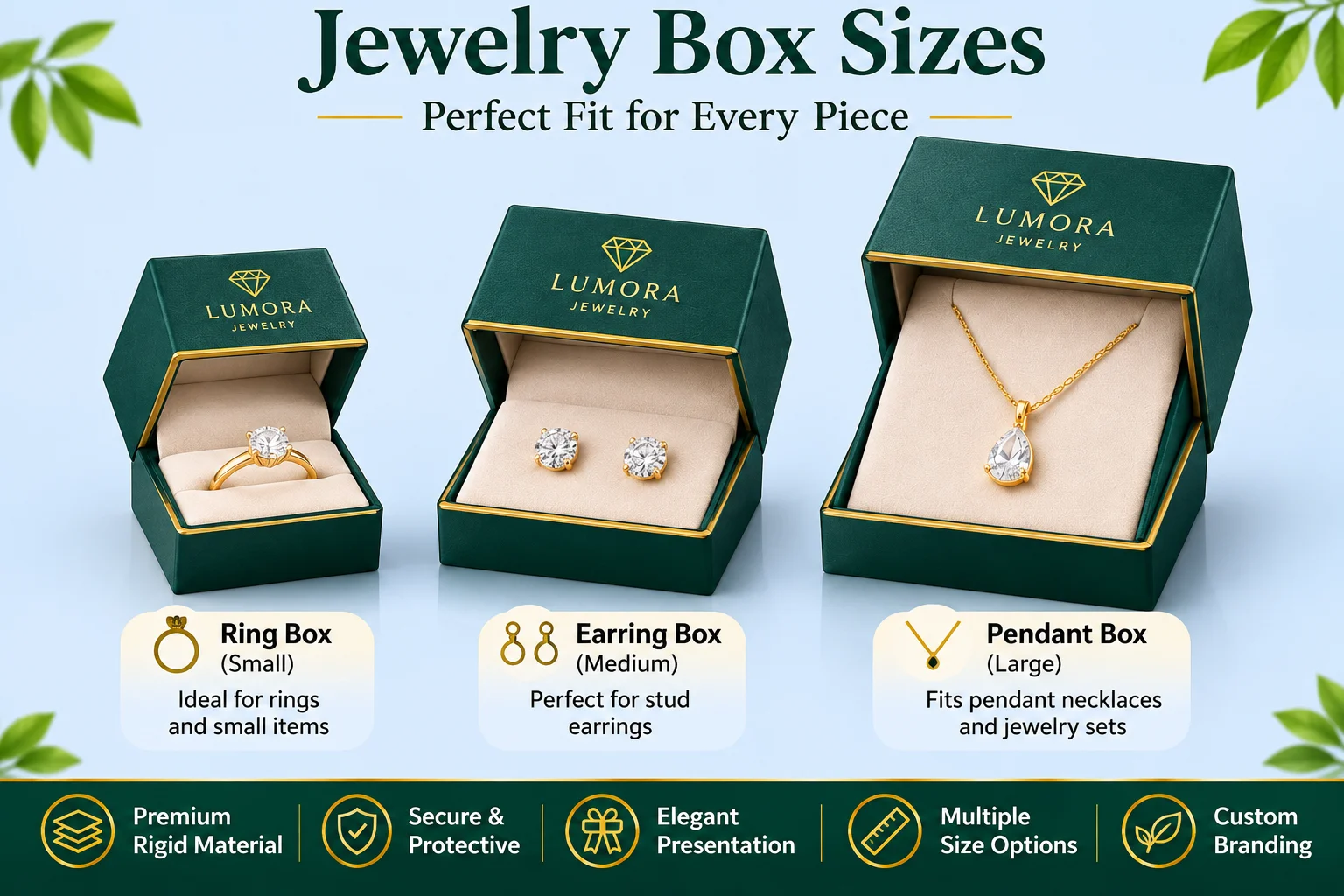
Notice that one 3.5 inch square box covers pendants, bangles and small earring sets. Many small brands launch with just that box and a 2 inch ring box and the two sizes cover their entire first collection.
Always measure the largest piece that will go in each size including the clasp and any hanging charms. Our guide on how to measure a box explains which side counts as length and why inside sizes matter more than outside sizes.
If a piece sits between two sizes, choose the larger box and let the insert take up the space. A jewelry box insert costs a few cents and stops the piece from sliding far better than a tighter box can.
Earrings deserve one extra thought because many small brands sell them on printed cards rather than in boxes. A card shows the pair upright on a shop stand and slips into a pouch or a small box when the order ships online.
With the sizes settled you can choose the box style that matches your brand and your price point.
Which Jewelry Box Styles Suit a Small Brand?
The best box style for a small brand matches your price point because a box that looks too cheap or too grand sends the wrong signal.
| Style | Best for | Price per unit |
|---|---|---|
| Two piece box with lid | Necklaces, bracelets and gift sets | 0.80 to 12.00 dollars across our jewelry boxes |
| Hinged or rigid ring box | Rings and single statement pieces | 1.20 to 9.00 dollars |
| Bracelet box | Bangles, cuffs and chain bracelets | 1.00 to 8.00 dollars |
| Necklace and pendant box | Pendants, chains and lockets | 1.50 to 10.00 dollars |
| Earring box or card | Studs, hoops and drop earrings | Card or small box, priced on the earring page |
| Pouch or bag | Everyday pieces and a second layer inside a box | 0.12 to 2.40 dollars |
| Mailer box | Shipping the whole set to an online buyer | 0.80 to 3.90 dollars |
Our custom jewelry boxes page covers the two piece and drawer styles that suit most collections. Rings sit best in wholesale ring boxes and bangles or chains fit our bracelet boxes with a cushion or a slotted card.
For pendants and chains see our necklace packaging and for studs and hoops our earring packaging includes printed cards as well as boxes. Men who buy cufflinks expect a rigid box with a firm insert that holds both pieces level. That is the reason our cufflink boxes use thicker board than anything in the earring range.
Pouches deserve a special mention because they do two jobs at a very low price. A printed jewelry pouch protects a piece inside a box during shipping and becomes the travel bag the buyer keeps afterward.
Whichever style you choose, silver and plated pieces need one more layer of protection that most guides forget to mention.
Planning packaging for your jewelry line?
Send us the pieces you sell, the sizes you think you need and a rough quantity. We return a dieline, a price per order and a sample plan you can act on right away.
How Do You Stop Silver and Plated Jewelry From Tarnishing in the Box?
You stop tarnish in the box by keeping air, moisture and sulfur away from the metal because silver darkens when sulfur in the air reacts with its surface.
A piece that sits in a warehouse or a shop drawer for weeks before it sells is exposed to that air the whole time. Buyers who open a dull piece blame the seller and not the chemistry so tarnish protection belongs in your packaging plan.
- Seal each silver piece in a small zip bag before it goes into the box because a closed bag limits the air that reaches the metal
- Add an anti tarnish strip or tab inside the bag or under the insert since these absorb the sulfur compounds that darken silver
- Keep rubber bands and wool felt away from silver because both release sulfur that speeds up tarnish
- Store finished stock with a silica gel pack in a closed tote so damp air in the storeroom cannot settle on the pieces
- Ask for a lined insert rather than raw board on premium silver so the metal rests on a soft and clean surface
Gold plated and vermeil pieces need the same careful packing even though the reason is a little different. Thin plating wears where it rubs so an insert that holds each piece still matters as much as the seal.
Add one line about storage to your product card as well telling buyers to keep the piece in its pouch when they are not wearing it. That small note on the card protects your reviews long after the buyer has opened the box.
The product card has another job too and getting its wording right keeps your brand on the right side of federal guidance.
What Should a Jewelry Product Card Say About the Metal?
A jewelry product card should describe the metal in the exact terms federal guidance allows because words like sterling carry legal meanings.
The Federal Trade Commission publishes the Guides for the Jewelry, Precious Metals, and Pewter Industries and they set out what each metal term must mean. Small brands print these words on cards, boxes and pouches every day so it pays to know them before your artwork goes to print.
| Term on the card | What the piece must be | Section of the guides |
|---|---|---|
| Sterling silver or 925 | At least 925 parts per thousand pure silver | 16 CFR 23.5 |
| Gold with a karat mark | A correct karat mark placed right before the word gold, such as 14K gold | 16 CFR 23.3 |
| Gold filled | Gold of at least 10 karat that makes up at least one twentieth of the total metal weight | 16 CFR 23.3 |
| Gold plate | Gold of at least 10 karat that makes up at least one fortieth of the total metal weight | 16 CFR 23.3 |
| Gold electroplate | Gold of at least 10 karat with a minimum thickness of 0.175 microns | 16 CFR 23.3 |
| Heavy gold electroplate | Gold of at least 10 karat with a minimum thickness of 2.5 microns | 16 CFR 23.3 |
| Vermeil | Sterling silver coated with gold of at least 10 karat and at least 2.5 microns thick | 16 CFR 23.4 |
The most common mistake we see is a card that says vermeil on a piece with a brass base. The vermeil section of the guides treats that wording as misleading unless the card discloses the base metal clearly.
Check the mill or supplier certificate for each metal before you write the card and keep a copy on file with your artwork. If you are unsure of a term, describe the piece plainly as gold tone or silver tone which makes no claim about the metal content at all.
The same care applies to origin claims printed on the box or the card. A Made in USA line tells the buyer that all or virtually all of the piece was made here. Keep it off your packaging unless your supplier records support that claim in full.
This is general information for packaging copy and not legal advice so ask a trade adviser if your line uses unusual alloys. With the card wording settled, the next challenge is getting the finished set to your buyer in one piece.
How Do You Ship Jewelry Without Damage or Theft?
You ship jewelry safely by packing a snug inner box inside a plain outer mailer so the piece cannot move and nobody can tell what is inside.
- Secure the piece in its insert so it cannot slide when the box is shaken from side to side
- Close the jewelry box and wrap it in tissue which adds a soft layer and makes the unboxing feel deliberate
- Place the box in a mailer that fits with little spare room and fill any gap with paper so the box cannot rattle
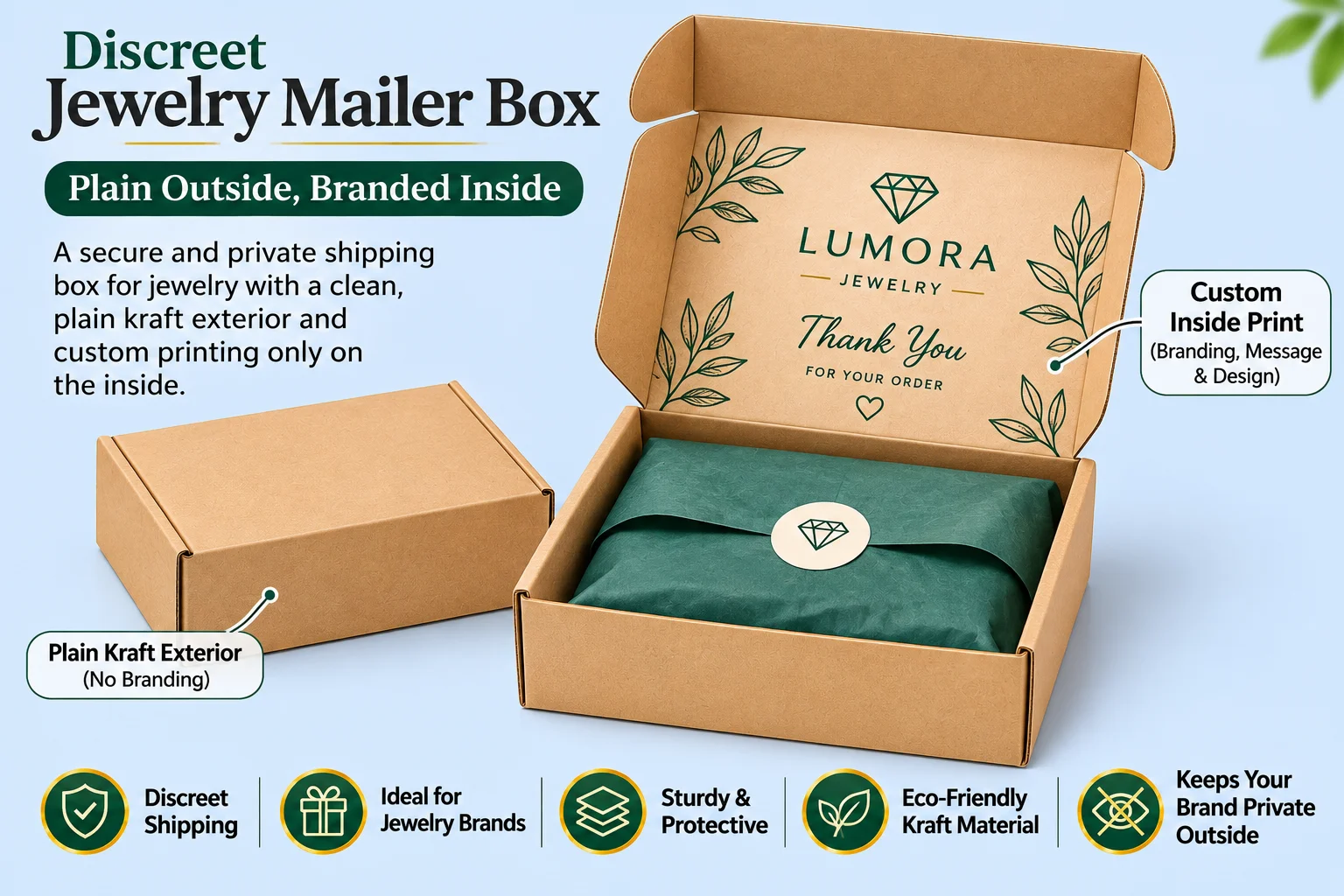
- Keep the outside plain apart from the shipping label and never write the word jewelry or a fine brand name on the outer box
- Add tracking to every order and insurance on high value pieces so a lost parcel becomes a claim rather than a loss
A small custom mailer box printed only on the inside solves the discretion problem neatly. The outside looks like any other parcel on the porch while the buyer sees your brand the moment the lid opens.
| Option | What it offers | When it suits a small brand |
|---|---|---|
| Priority Mail | A one to three day service that is not guaranteed | Everyday orders that need tracking and speed |
| Insured Mail | Coverage against loss or damage up to 5,000 dollars | Orders worth more than you can afford to lose |
| Registered Mail | Insurance up to 50,000 dollars with extra security and no delivery time frame | Fine pieces where security matters more than speed |
These figures come from the Jewelers Mutual guide to USPS options so check current terms with the carrier before you set your shipping policy. Small jewelry mailers stay well under one cubic foot so USPS bills them on actual weight rather than dimensional weight.
If you also ship lithium powered display pieces or smart jewelry, read our guide to shipping products with lithium batteries before you book the carrier. Safe shipping protects the piece and the next section is about making that same parcel feel like a gift.
How Many Jewelry Boxes Should You Order the First Time?
Your first order should cover about three months of sales in each size, starting from our order point of 100 boxes per size and design.
Each size and each printed design needs its own cutting die and plate so they are counted separately rather than added together. Two sizes with one design means at least 200 boxes while one size with two designs means the same 200.
| Step | What you do | Time it takes |
|---|---|---|
| Choose sizes | Pick two or three inside sizes from the size table above | One afternoon |
| Request a quote | Send sizes, style, quantity and your logo file | Quick when your sizes and quantity are complete |
| Approve the dieline | Place your artwork on the flat template we return | One to three business days |
| Check a sample | Plain structural sample or printed pre production sample | 3 to 5 or 7 to 10 business days |
| Production | Boxes printed, cut, folded and packed | 8 to 10 business days, rigid 10 to 12 |
| Delivery | Free shipping across the United States | A few days in transit |
Order a plain sample first if you are unsure about fit and then a printed sample once the size is right. Our sample box page explains both options and what each one tells you before the full run.
You can also build the flat template yourself in our free dieline generator which exports AI, PDF and SVG files at any size. Design support is free at every level so our in house team will place your logo or build the full design from scratch.
For a wider look at quotes, lead times and supplier checks, read our guide to wholesale boxes for small business. Knowing the order steps is useful and knowing the common mistakes saves even more money.
Which Jewelry Packaging Mistakes Cost Small Brands the Most?
The mistakes that cost small jewelry brands the most are ordering too many sizes, printing claims that are not true and packing pieces loosely.
- Ordering a new size for every piece multiplies your order count while a good insert lets one box fit several pieces
- Printing a season or a year on the box leaves you with stock you cannot use next year so put dated messages on a card instead
- Writing metal claims you cannot prove on cards and boxes, when plain tone wording is safe and honest
- Choosing a box that is far too large for the piece which looks empty when opened and costs more to ship
- Leaving silver unsealed in storage so the first buyers receive dull pieces and leave poor reviews
- Branding the outside of the shipping box with fine jewelry names that tell everyone on the route what is inside
Every one of these mistakes is cheaper to avoid than to fix after a launch. Our custom packaging boxes team checks sizes, inserts and artwork with you before anything goes to print which catches most of them at the quote stage.
If you are still deciding whether custom packaging is worth it at all, our guide to custom packaging for small business covers the reasons in detail. The sections that follow pull everything together into quick answers and a short summary.
Frequently asked questions
New jewelry sellers ask us the same handful of questions about cost, sizes and shipping and the short answers are collected below.
The short version
Good jewelry packaging for a small business protects the piece, presents it well, carries your brand and ships at a low cost. Keep the whole set under one tenth of the selling price and choose two or three inside sizes that fit your line.
Seal silver against tarnish, print only metal claims you can prove and ship in a plain mailer with the brand printed inside. Start from 100 boxes per size and design and let your prices fall as your orders grow.
Send us your pieces and sizes today and our packaging team will return a dieline, a price and a sample plan.
Ready to order jewelry packaging for your brand?
We print from 100 boxes per size and design with no setup fees, free design support and free shipping across the United States. Boxes take 8 to 10 business days to produce once you approve the dieline and the proof.
