








What do the flute letters mean?
Corrugated board is three layers and the wavy one sitting in the middle is called the flute. It is doing all of the structural work because those little arches carry load exactly the way an arch does in a bridge. The letters in the table below are simply telling you how big each of those arches is.
| Flute | Thickness | What to use it for |
|---|---|---|
| A | 4.8 mm | Fragile items and maximum cushioning |
| C | 4.0 mm | The default shipping box and almost certainly yours |
| B | 3.2 mm | Heavy products and pallet stacking |
| E | 1.6 mm | Mailers and retail where print quality matters |
| F | 0.8 mm | Small retail cartons |
How much board strength do you need?
Board strength gets measured two different ways that are not interchangeable so it helps to know which is which. ECT stands for Edge Crush Test and measures how much downward force the board takes before it buckles so that number is about stacking. Burst strength measures puncture resistance instead and that is what matters when boxes get thrown or dragged across a floor.
| Board grade | ECT | Rated to roughly |
|---|---|---|
| Single wall standard | 32 ECT | 65 lb gross weight |
| Single wall heavy | 44 ECT | 95 lb |
| Double wall | 48 ECT | 120 lb |
| Double wall heavy | 61 ECT | 180 lb |
Here is a check you can run yourself in about ten seconds on any corrugated box you have to hand. Turn the box over and look at the bottom flap for a round printed stamp called the box maker’s certificate. That stamp states the board grade and the rating and the maximum gross weight so a sample answers the question even when a supplier cannot. For most eCommerce shipping the answer is 32 ECT single-wall corrugated boxes unless your product says otherwise.
How does box size change your shipping cost?
Carriers charge for the space that a parcel occupies as well as for what it weighs. You pay whichever of those two figures comes out higher and this is where most eCommerce brands quietly lose money. To find your dimensional weight you multiply the three dimensions in inches and divide by 139 which is the common US domestic divisor.
A 2 lb product in a box measuring 12 by 10 by 8 inches works out at 960 cubic inches. Dividing that by 139 bills you at 6.9 lb and you are paying for nearly five pounds of air. Put that same product into a 10 by 8 by 4 inch box and you get 320 cubic inches. That bills at only 2.3 lb because you stopped shipping empty space around the product.
There is a floor to this though because you should never size a box so tightly that the product touches the walls. Corrugated protects a product by keeping a layer of board between it and the outside world. Squeezing that cushioning out to save a fraction of a pound arrives back later as a damage claim.
Which corrugated box style do you need?
Choosing a style is a structural decision rather than a design one and six constructions cover almost everything eCommerce ships. Die-cut corrugated boxes near the bottom are where you stop picking from a menu and have the box drawn around your product.
| Box style | Suits | Purpose |
|---|---|---|
| RSC or regular slotted container | Standard shipping and cheapest | Custom shipping boxes |
| Roll end tuck top mailer | eCommerce unboxing with no tape | Custom mailer boxes |
| FOL or full overlap | Heavy products | Heavy duty boxes |
| HSC or half slotted | A tray or a base | Corrugated trays |
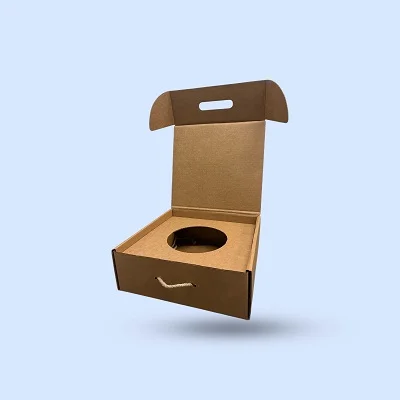
| Die-cut to your shape | Products no standard box fits | Die-cut boxes |
| Any of these with an insert | Fragile and multi-item orders | Corrugated box inserts |
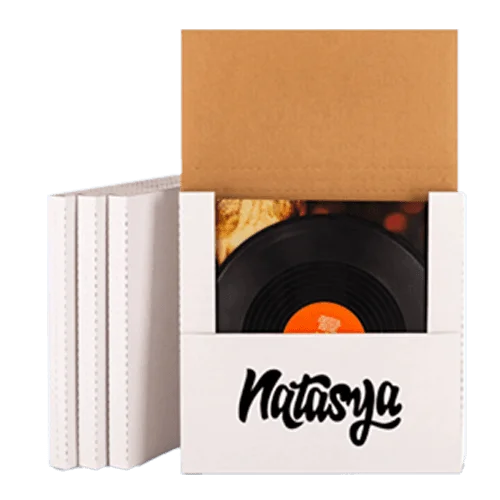
For most brands the decision comes down to the first two rows in that table. Regular slotted corrugated boxes handle straightforward shipping where the box gets taped and sent and recycled without anybody thinking about it. Custom corrugated mailer boxes are what you want when your customer’s first impression is the moment they open the parcel. Mailers cost more per unit and that is not a premium because die-cutting wastes more board and that waste is material you still pay for.
Kraft or white board and how is it printed?
Kraft corrugated board is cheaper and reads as honest and unfussy which is why so many sustainable brands pick it deliberately. What you give up is color accuracy because every ink sits over a warm brown base. Bright colors go muddy on kraft and true white only comes from leaving the board unprinted. White corrugated board costs more and reproduces your palette faithfully so it is usually the only option if your branding includes photography. Either way your custom corrugated packaging stays recyclable as long as you avoid plastic film lamination and wax coating.
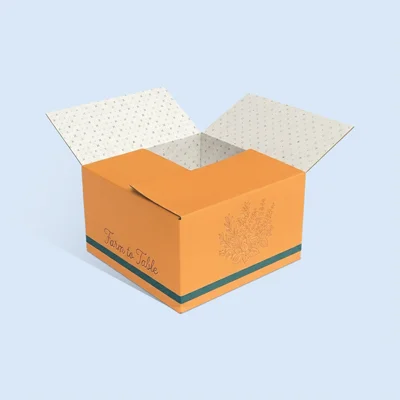
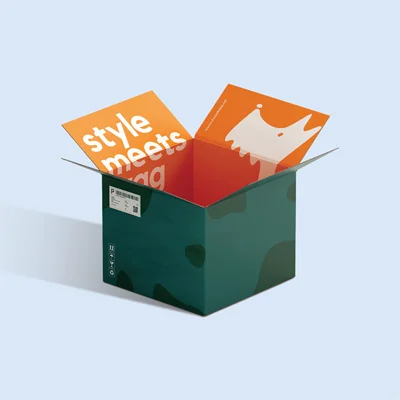
Custom printed corrugated boxes get produced in three different ways and quantity decides which one fits you. Flexo prints directly onto the board and handles logos and solid colors very well. Each color needs a plate of its own so two colors cost noticeably less than four. Litho lamination prints onto a separate sheet that is then bonded to the board which gives photographic quality with no washboarding at all. Digital needs no plates whatsoever and that makes it right for short runs and seasonal artwork.
What are your minimum order and lead times?
- Minimum order is 100 boxes per size because every size needs its own die.
- Samples come as a plain mock-up within 3 to 5 business days or a printed pre-production sample within 7 to 10.
- Production runs 8 to 10 business days from the day you approve your dieline.
- Artwork should be a vector PDF or AI file on our dieline with 3 mm bleed and CMYK plus any named Pantones and fonts outlined.
- Incoterms are FOB or EXW as standard and we quote DDP to the US and the EU on request.
Tooling is a one-off cost rather than a recurring one and that is why your first order feels expensive per box while every reorder does not. Send us your product dimensions and packed weight and quantity and artwork and tell us whether the boxes travel by parcel or by pallet. We will recommend a flute and a grade and send you a dieline and a firm price.
Request a quote
Send us your product dimensions, quantity and destination and we will return a dieline, a 3D mock-up and a firm price. Samples in 3 to 5 business days, production in 8 to 10. MOQ 100 per SKU, FOB or EXW, DDP available to the US and EU.


