







Is Your Product Soap or a Cosmetic?
This one question decides how much printed label space your packaging has to carry. Most makers find that out only after the artwork is finished.
Under FDA’s definition a product is regulated as soap only when all three of these are true. The bulk of the nonvolatile matter is an alkali salt of fatty acids. The detergent properties come from those same fatty acid compounds. And the product is labeled, sold and represented solely as soap.
That third condition is the one that catches makers out. Your bar stops being sold solely as soap the moment you market it as moisturizing, deodorizing or fragranced. It becomes a cosmetic at that point and cosmetic labeling rules apply to it.
| If your product is | Regulated by | What the label must carry |
|---|---|---|
| Sold solely as soap | Consumer Product Safety Commission | Far less required on the pack |
| Marketed as moisturizing, deodorizing or fragranced | FDA as a cosmetic | Ingredient declaration, net quantity, name and place of business |
For a cosmetic FDA requires the ingredient declaration to be easy to read at the time of sale and listed in descending order of predominance. Colorants and anything at one percent or less can go outside that order. The information panel also needs the full name and place of business plus the country of origin on imported goods.
None of this is legal advice and your formulator or counsel should confirm where you stand. What it means for your packaging is simple enough to plan around. A cosmetic needs far more printed panel than soap does and that space has to be designed in before the die is cut rather than squeezed on later.
How Many Bars Does a Counter Display Hold?
Capacity, not dimensions, is what a buyer is really asking about when they ask us for a size.
A typical handmade bar runs 90 to 140 g at around 85 x 60 x 30 mm, which is roughly 3 to 5 ounces. Yours will almost certainly be different so send us an actual bar.
| Bars | Layout | Typical internal footprint | Filled weight at 115 g a bar |
|---|---|---|---|
| 6 | 2 x 3 upright | 135 x 195 mm | about 0.7 kg |
| 12 | 3 x 4 upright | 195 x 260 mm | about 1.4 kg |
| 24 | 4 x 6 upright | 260 x 390 mm | about 2.8 kg |
| 36 | 6 x 6 upright | 390 x 390 mm | about 4.1 kg |
That last column is the number nobody publishes and it is the one that decides the board. A 36 bar display carries four kilos on a paperboard base and it sits on a counter being knocked for weeks.
Stand the bars upright in the display rather than laying them flat. Upright shows the label and it lets a customer take one bar without disturbing the rest. It also holds far more product in the same footprint.
Why Does a Display Sag as It Empties?
A full display is held up partly by the product inside it. That support disappears as the bars sell and the walls end up with nothing to push against.
Four things fix it and none of them are expensive.
- A front lip holds the front row upright and stops bars sliding forward as the unit empties
- Dividers turn one large cavity into several small ones so every remaining bar still has walls around it
- A folded double wall at the front and sides carries the load without letting the panel bow
- A rear riser angles the display so bars lean back into the unit rather than forward out of it
The divider is the part most people cut to save money and then regret. A twelve bar display with dividers still looks deliberate with only four bars left in it. Without dividers those same four bars look like something got knocked over.
Do You Need a Counter Display or a Floor Display?
These are two different products and most soap packaging pages treat them as one.
| Type | Typical size | Holds | Board |
|---|---|---|---|
| Counter display | Up to about 260 x 390 mm footprint | 6 to 36 bars | Folding carton or E flute |
| Countertop with header | Same footprint, taller back panel | 12 to 36 bars | E flute for the extra rigidity |
| Half pallet floor display | About 600 x 400 mm footprint | 150 to 300 bars | B flute with a reinforced base |
| Full floor stand with shelves | About 600 x 400 mm, several tiers | 300 plus bars | BC double wall, tray per shelf |
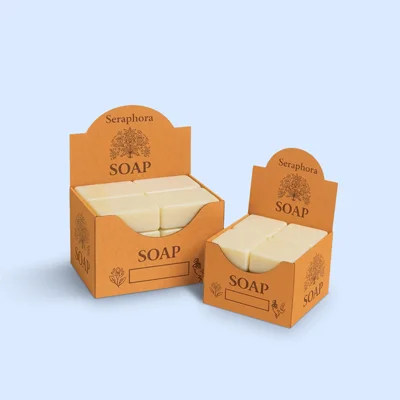
A counter unit sits beside a till and gets picked up, moved and refilled during the day. A floor unit is loaded once, wheeled into place and then never moved again, so its whole problem is the base carrying the stack. Those larger units are built as cardboard display stands rather than as boxes.
The counter unit is almost always the right answer if you supply independent stores. Floor displays need a retailer with both the floor space and the sales volume to justify them.
Which Board Grade Carries a Full Display?
The edge crush test or ECT tells you what a corrugated structure carries when it is stacked. On a display that load is the product inside the unit plus anything put on top of it in transit.
| Board | Thickness or rating | Where it fits a soap display |
|---|---|---|
| 300 to 350 GSM folding carton | 0.35 to 0.46 mm | 6 and 12 bar counter units |
| E flute | around 1.6 mm | 24 and 36 bar counter units, headers |
| B flute at 32 ECT | 2.5 to 3.2 mm, about 65 lb | Floor display bases |
| BC double wall at 48 ECT | 5 to 7 mm, 86 to 100 lb | Multi tier floor stands |
Humidity is the part that gets left out of most specifications. Board loses a large share of its strength as it takes up moisture and a bathroom aisle or a coastal store is a humid place. Go up a grade rather than adding a second layer if your displays sit for months.
Can Soap Fragrance Migrate Into the Board?
Yes, and it matters more on a display than it does in a box. The bars sit unwrapped against the board for weeks rather than for the hour it takes to open a carton.
Fragrance and essential oils move into uncoated paperboard over time. Two things follow from that on a mixed display. The board takes up the scent and then holds it for the life of the unit. Scents also transfer between neighboring bars whenever they share an open cavity.
The measurable handle is the Kit test TAPPI T 559. It rates a board against a numbered series of increasingly aggressive oil solutions and reports the highest one the surface survives. Ask a board supplier for the Kit rating the same way you ask for the GSM.
One caveat comes from the testing labs rather than from board sellers. The Kit method was built for boards treated with fluorochemical sizing. A Kit number therefore does not fully describe a board whose barrier comes from a coating or a film.
Most soap brands solve this with a physical layer instead of a treated board. A coated inner face, a wrapped bar or a divider between scents will all slow the migration down. The same problem shows up on candle boxes where fragrance oils sit against board for months. Dividers stop being optional if your range mixes a strong scent like patchouli with a delicate one like lavender.
Which Display Style Suits Your Soap?
| Style | How it works | Best for |
|---|---|---|
| Open tray | Low walls, bars visible from above | Counter impulse and fast turnover |
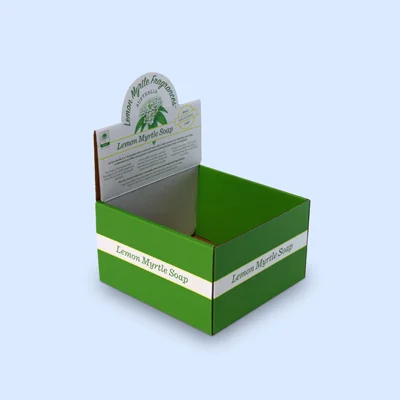
| Tray with a printed header | Tall back panel carries the branding | Anywhere the display needs to be seen across a room |
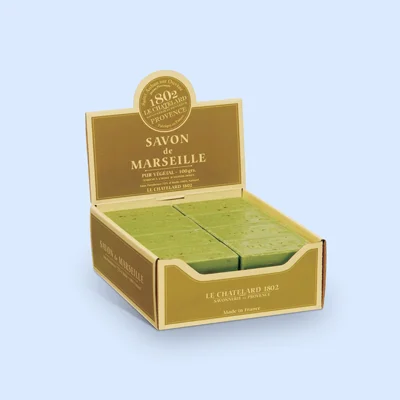
| Shelf ready case | Ships full and tears open to become the display | Wholesale accounts, saves retailer labor |
| Tiered riser | Stepped shelves so the rear rows stay visible | Larger ranges and gift sets |
| Divided grid | A cavity per bar or per scent | Mixed scent ranges and fragrance separation |
| Dump bin | Loose bars in an open bin | Discount lines and sale ends |
The same structures apply to our display boxes if you run counter units for other product lines as well. Shelf ready is worth asking about if you sell wholesale. The retailer opens one case and has a display standing with no unpacking at all. That single feature wins listings with buyers who count staff minutes.
What Prints Well on a Kraft Soap Display?
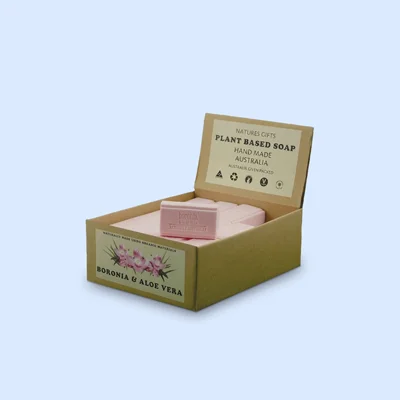
Kraft is the most requested board in this category because it looks natural and handmade. That look matches how most artisan soap is already positioned on the shelf. The same board runs right across our kraft boxes range.
Kraft prints cleanly in one or two colors and it takes white ink. What it will not do is hold a photograph or a pale tint accurately because the brown ground shifts every color warm. White SBS is the better choice if your artwork depends on soft botanical pastels.
- One or two color print on kraft is the standard route and it looks deliberate rather than cheap
- CMYK plus a spot color on white SBS suits photographic and pastel artwork properly
- White ink on kraft gives you contrast without giving up the natural ground
- Digital print makes short runs under 1,000 units workable with no plate cost
- The header panel is the surface a customer sees first so put the range name there
Leave room on the header for the ingredient declaration if your product is a cosmetic. That is the panel space people forget to design for.
What Should You Send Us Before We Quote?
| What you send us | What we build from it |
|---|---|
| One of your actual bars | Cavity size, layout and filled weight |
| Bars per display and how many scents | Divider layout and fragrance separation |
| Counter, shelf or floor | Structure, board grade and header height |
| Whether it ships full or gets loaded in store | Shelf ready or plain display |
| Whether the bar is sold solely as soap | How much printed panel the label needs |
Send us a bar rather than a set of measurements. Handmade soap varies more than any spec sheet suggests and a cavity cut to a nominal size will either rattle or refuse to take the bar.
Minimum Order, Lead Time, and Samples
- Minimum order: 100 units per size because each size needs its own cutting die
- Plain structural sample: 3 to 5 business days from your dimensions
- Printed pre production sample: 7 to 10 business days from approved artwork
- Production: 8 to 10 business days after you approve the dieline
- Price breaks: at 500 units and again at 1,000 units on the same artwork
- Setup and tooling: no charge on the first order or on any reorder after it
- Artwork: vector PDF or AI on our dieline with 3 mm bleed and fonts outlined
- Shipping: free across the United States
Request a Quote
Send us one of your bars along with the number per display, how many scents you run and where the unit sits. We will come back with a structure, a board specification, a dieline and a unit price. You can also start on our quote page if you already have the dimensions.
 The Customized Boxes