





Buying wholesale boxes for a small business is one of the first real spending decisions a growing brand makes. The box you pick shapes your product cost, your shipping bill and the first thing a customer touches when the order arrives.
Most small businesses get the box itself right and still lose money on the details around it. They order the wrong inside size or too many boxes at once, or they approve artwork that prints darker than it looked on screen. Those details decide whether the order saves money or quietly costs more than it should.
This guide walks you through every decision in the order a supplier will ask for it. It starts with quantity, style and size and then moves through board, print and finish. It ends with artwork, samples, price and lead time so your first wholesale order lands right.
Key takeaways
- Start with your product size, weight and how it ships because every other choice on the quote depends on those three facts.
- Our minimum is 100 boxes per size and design, with price breaks at 500 and 1,000 units on the same artwork.
- Size the box from the inside dimensions and keep it tight, since carriers bill large parcels by dimensional weight.
- Order a sample before the full run, with a plain sample in 3 to 5 business days and a printed one in 7 to 10.
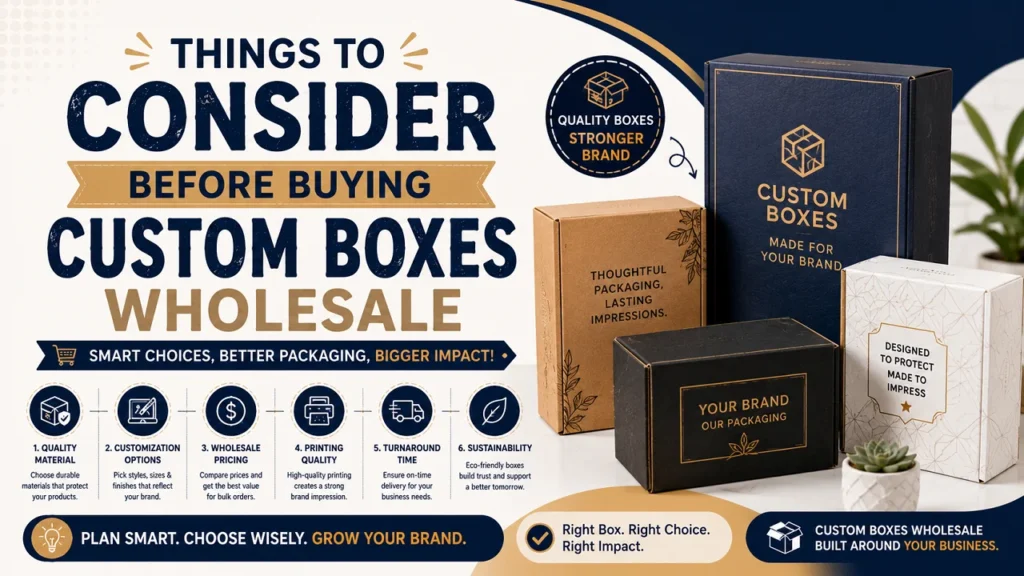
- Compare quotes like for like on board, caliper, print, finish, quantity, lead time and shipping, not on the unit price alone.
Why Do Small Businesses Buy Custom Boxes Wholesale?
Small businesses buy custom boxes wholesale because the price per box drops as the quantity rises. A box made to fit also protects the product better than a stock carton. The savings free up money for marketing, stock and the next product launch.
Wholesale boxes for small business brands simply mean ordering a production run from a manufacturer instead of buying a few boxes at retail prices. Some people call the result bespoke packaging, which simply means a box designed around one product with its own size, print and finish.
A custom box also does work that a plain shipper cannot do. It carries your logo and colors into every unboxing photo and it tells the customer what they bought before they open the lid.
Our earlier post on why custom packaging for small business matters covers the branding side in more depth. This guide stays practical and starts with the homework you should finish before you ask anyone for a price.
What Should You Know Before You Contact a Box Supplier?
Before you contact a box supplier you should know the size and weight of your product. You also need the number of boxes and the way each box will reach the customer. These four facts let a supplier quote the right box on the first try instead of the third.
| What to gather | Why the supplier needs it | Example |
|---|---|---|
| Product length, width and height | Sets the inside size of the box | Jar 3.1 x 3.1 x 3.5 inches |
| Product weight | Decides the board thickness and any insert | 11 ounces filled |
| Quantity per size | Sets the price tier | 300 boxes |
| How the box travels | Retail shelf, parcel or both | Sold online and in two shops |
| Target price per box | Lets the supplier suggest the right build | Under a set budget per unit |
| Launch date | Sets the latest artwork approval date | Product goes on sale in six weeks |
Write these answers down in one short brief and send the same brief to every supplier you ask. That way each quote prices the same box and you can compare the numbers fairly later in the process.
A photo of the product next to a ruler helps too for odd shapes such as tapered bottles or candles with lids. Once the brief is ready the first number to settle is how many boxes you actually need.
How Many Boxes Should a Small Business Order First?
A small business should order enough boxes to cover two to three months of sales for its first run and no more. That keeps cash free while still reaching a quantity where the unit price makes sense.
Our minimum order is 100 boxes per size and design and that suits brands testing a new product or a small batch launch. Many buyers search for custom packaging suppliers with no minimum order quantity. A true one box minimum still costs far more per unit than a short run of 100 boxes.
| Situation | Sensible first order | Why |
|---|---|---|
| Testing a new product | 100 boxes per size | Proves the box and the demand before a larger spend |
| Steady seller with a fixed design | 500 boxes | Reaches the first price break |
| Core product selling every week | 1,000 boxes | Reaches the second price break on the same artwork |
| Seasonal or limited edition | Expected season sales only | Leftover seasonal boxes rarely sell later |
Price breaks arrive at 500 and 1,000 units on the same artwork and a brand that sells steadily saves by moving up a tier on the second order. Every box size counts as its own design and each extra size starts its own count at 100.
Quantity also depends on how many products share one box and that leads straight to the question of box style.
Which Box Style Fits Your Product?
The right box style depends on what you sell, where it sits and how it ships. Folding cartons suit retail shelves and mailer boxes suit online orders and rigid boxes suit premium gifts where the box is part of the value.
| What you sell | Usual box style | Where to see it |
|---|---|---|
| Cosmetics and skin care | Tuck end folding carton | Custom cosmetic boxes |
| Jewelry | Two piece or drawer box | Custom jewelry boxes |
| Bar soap and bath bombs | Tuck end, sleeve or window box | Custom soap boxes |
| Candles | Tuck end or rigid box with insert | Candle boxes |
| Bakery and treats | Food grade tuck top or window box | Custom bakery boxes |
| Online orders of any kind | Corrugated mailer box | Custom mailer boxes |
| Premium gifts and kits | Rigid set up box | Rigid boxes |
| Counter and shelf displays | Display box | Custom display boxes |
| CBD and wellness | Tuck end carton with insert | CBD boxes |
Each row in the table links to a page with sizes, photos and prices for that style. Our free dieline generator lets you try several styles at your own dimensions before you ask for a quote.
Style and size are decided together because a tuck end carton and a mailer of the same product end up with very different outer dimensions. Getting those dimensions right is the next step and it takes only a ruler and a few minutes.
How Do You Size a Custom Box Correctly?
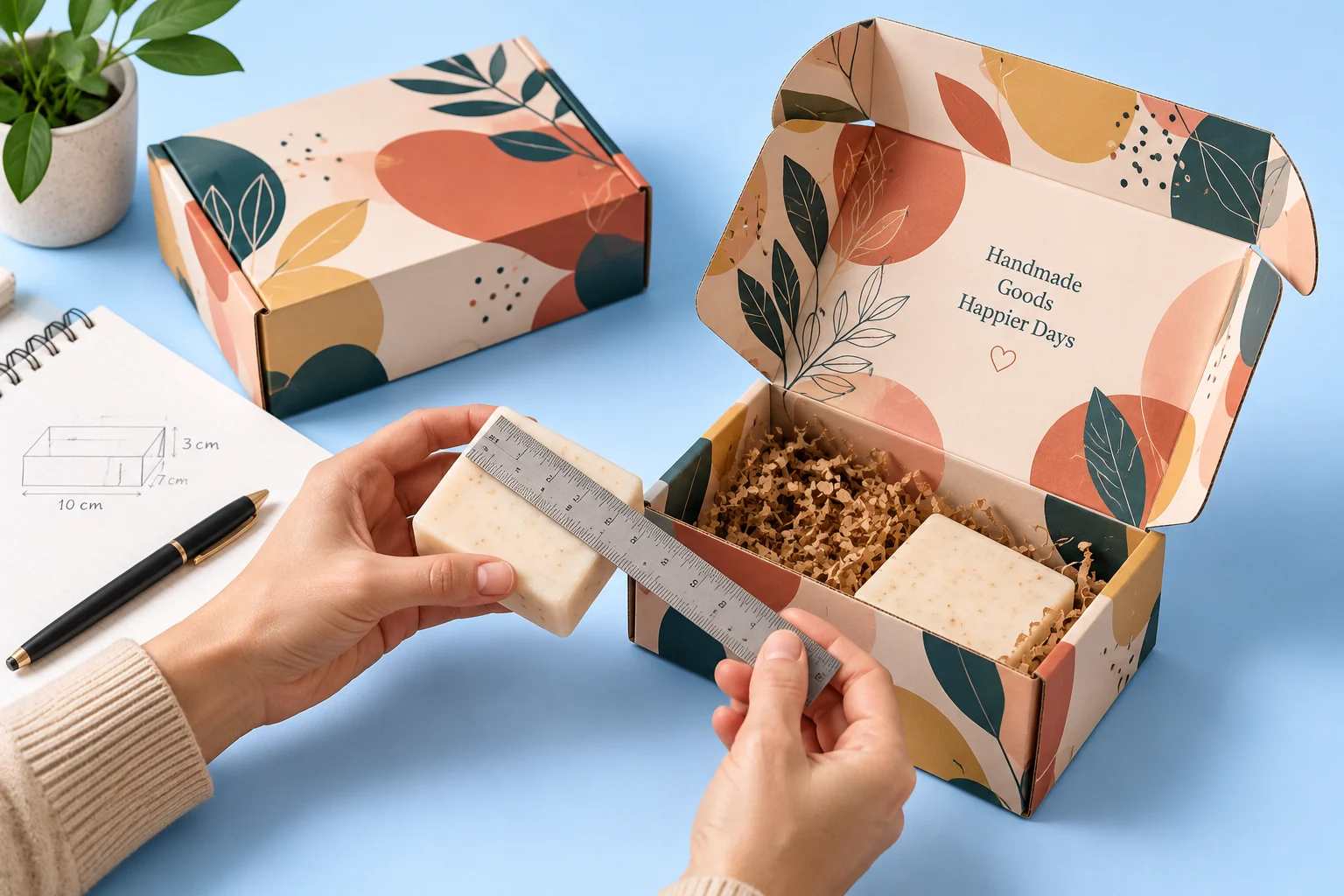
You size a custom box from the inside dimensions in the order length, width and height with a small clearance around the product. For most retail cartons we add about 3 millimeters on length and width and a little more on height so the product slides in without rattling.
Our box measuring guide shows where to place the ruler and how inserts change the numbers. Always measure the largest version of the product with its caps, pumps and any outer label.
Size matters for shipping cost as well as fit because carriers bill large parcels by space as well as weight. UPS divides length times width times height in inches by 139 to get dimensional weight on daily rates. USPS moved its divisor to 139 for parcels over one cubic foot as well.
| Box size (inches) | Volume (cubic inches) | Dimensional weight at 139 | Billed if the parcel weighs 2 pounds |
|---|---|---|---|
| 8 x 6 x 4 | 192 | 1.4 pounds | 2 pounds, the actual weight |
| 12 x 10 x 6 | 720 | 5.2 pounds, rounded up to 6 | 6 pounds |
| 14 x 12 x 10 | 1,680 | 12.1 pounds, rounded up to 13 | 13 pounds |
The table follows UPS daily rates and shows how a few extra inches turn a light parcel into a much heavier billable one. USPS applies the same math only once a box passes one cubic foot. A snug custom box often pays for part of itself through lower postage for brands that ship every order.
With the size fixed the next decision is what the box is made of.
Which Material Should You Choose for Wholesale Boxes?
Choose paperboard for retail cartons and corrugated board for anything that ships by parcel and rigid board for premium gift boxes. Within each family the thickness changes with the weight of the product.
| Material | Typical thickness | Best for |
|---|---|---|
| SBS paperboard | 14 to 24 pt | Retail cartons with sharp full color print |
| Natural kraft board | About 18 pt | Earthy brands and one or two color designs |
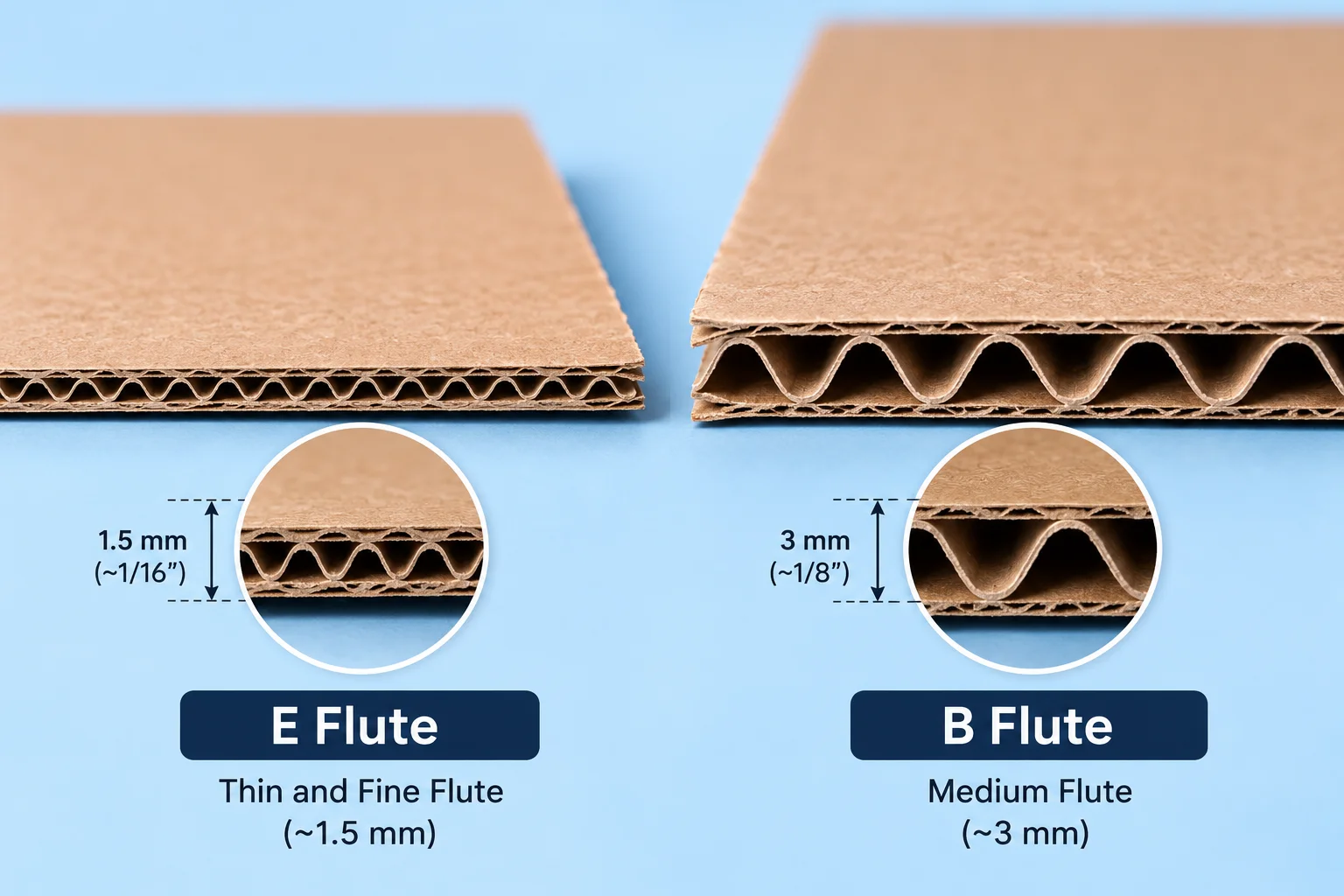
| Corrugated E flute | About one sixteenth of an inch | Printed mailers and light parcels |
| Corrugated B flute | About one eighth of an inch | Heavier products and shipping boxes |
| Rigid board wrapped in paper | About 1.5 to 2 mm | Premium gifts, kits and presentation boxes |
Bright white SBS board gives the sharpest print and our guide on what is SBS paperboard explains its thickness chart in detail. Natural kraft suits brands that want an earthy look and it prints best with one or two dark inks.
Corrugated board adds a fluted middle layer that cushions the product and resists crushing. The flute size changes how strong the board is and that matters most when the box has to survive a parcel network.
Planning your first wholesale box order?
Send us your product size, quantity and launch date. We return a dieline, a board recommendation and a price for your boxes.
How Strong Does a Box Need to Be to Survive Shipping?
A box needs to be strong enough to protect the product through drops, vibration and stacking from your shelf to the customer door. For most small products a single wall E flute or B flute mailer does that job well.
The Fibre Box Association lists about 90 flutes per foot for E flute and about 47 for B flute. More flutes per foot give a thinner and smoother board for print while fewer and larger flutes give more cushioning and stacking strength.
| Product | Suggested build | Extra protection |
|---|---|---|
| Light cosmetics or apparel | E flute mailer | Tissue or a simple card insert |
| Glass jars and bottles | E flute or B flute mailer | Die cut insert that separates each item |
| Heavy or multi item kits | B flute shipper | Corrugated partitions or a double wall box |
| Retail cartons sent by parcel | Folding carton inside a plain shipper | Void fill around the carton |
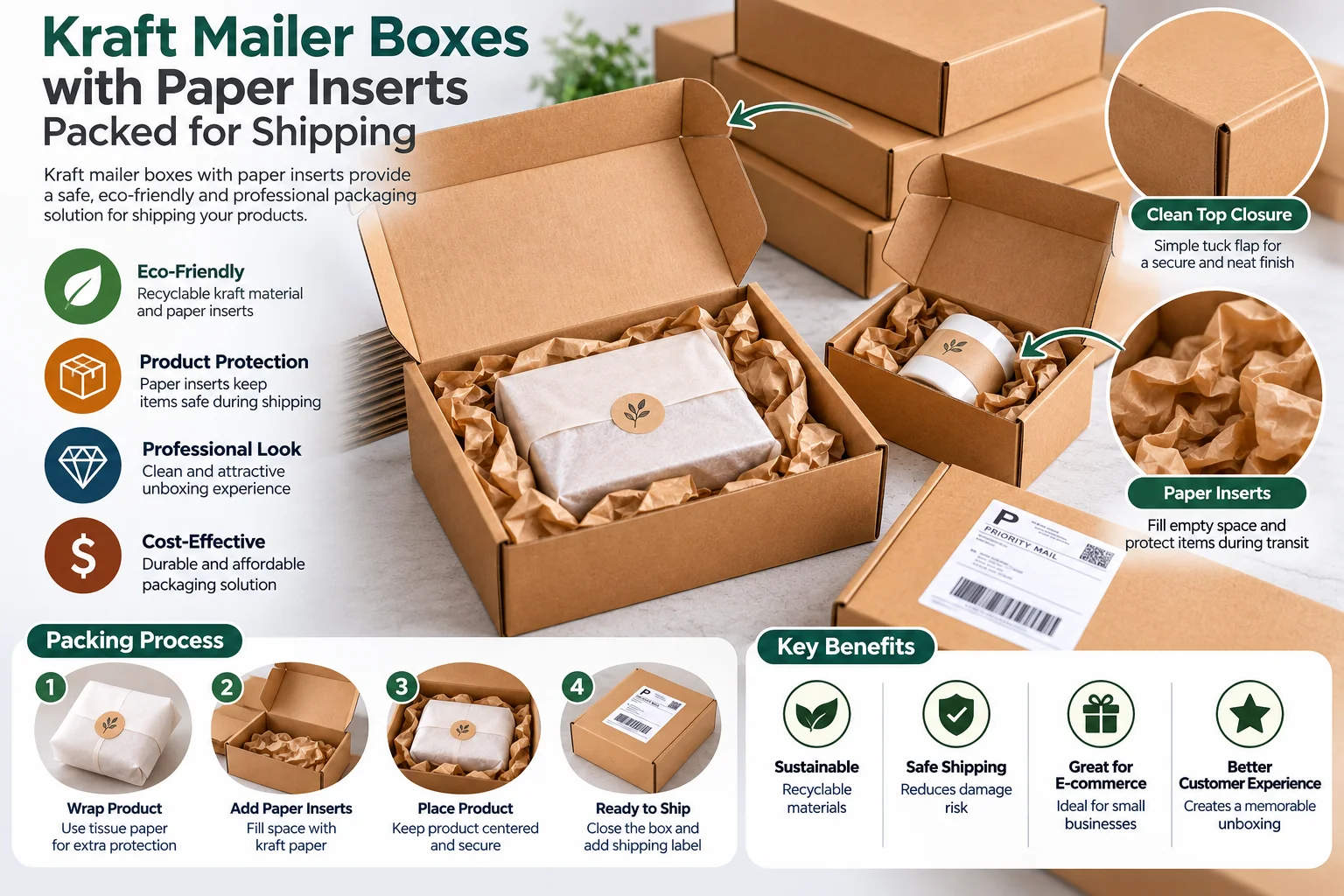
Inserts do as much for safety as the board itself because they stop the product moving inside the box. A cardboard or foam insert keeps glass bottles and jars apart and that is how small businesses reduce shipping damage with custom boxes.
Large brands test parcels against ISTA 3A as a procedure for single packages up to 150 pounds that combines vibration, drops and impacts. You do not need a lab for a first order but a few drop tests from waist height with the real product tell you a lot.
Once the box is strong enough the next question is how it should look and that starts with the printing method.
Which Printing Method Should You Pick?
Pick digital printing for short runs and many designs, while offset printing gives sharp photo quality on larger runs. Flexographic printing suits simple logos and line art on corrugated shippers. The method changes the look and the price per box and how exact your brand colors can be.
| Method | Best for | Good to know |
|---|---|---|
| Digital printing | Runs from 100 boxes and many different designs | No plates, so short runs stay affordable |
| Offset printing | Larger runs with photos and fine detail | The sharpest result on paperboard |
| Flexographic printing | Simple logos on corrugated shippers | Lower detail but fast on long runs |
| Pantone spot colors | Brand colors that must match every time | Mixed inks instead of CMYK blends |
Short run packaging printing has improved a lot because digital presses now print boxes without plates. That is why a run of 100 custom digitally printed boxes is realistic for a new brand that wants to test a design.
Brand color is the detail most buyers notice first when the boxes arrive. Our guide called CMYK explained shows why screen colors shift on board and a Pantone match is the safer choice when one color defines your brand.
Printing sets the color and the finish on top decides how the box feels in the hand.
Which Finishes Are Worth Paying For?
The finishes worth paying for are the ones a customer sees or feels in the first few seconds. A matte or soft touch coating and a foil logo or embossing all fit that test. A clear protective coating is worth it on almost every printed box because it stops scuffs in transit.
| Finish | What it adds | When it earns its place |
|---|---|---|
| Aqueous coating | Clear scuff protection | Almost every printed box |
| Matte or soft touch coating | A calm premium feel | Cosmetics, candles and gifts |
| Foil stamping | A metallic logo or border | One strong brand detail on the lid |
| Embossing or debossing | Raised or pressed artwork you can feel | Logos on rigid and premium boxes |
| Spot UV | A glossy highlight on a matte box | Logos and patterns that should catch the light |
| Window patch | A clear panel that shows the product | Food, soap and products that sell on looks |
Our aqueous coating guide explains the clear coatings that protect print at the lowest cost. If your brand calls for metal then the foil stamping guide covers how a foil logo is made and where it works best.
One premium finish usually beats three cheaper ones because the eye goes to a single strong detail. A matte box with one foil logo looks more deliberate than a box that mixes spot UV, foil and embossing at once.
Every finish has to line up with the artwork file and that is where many first orders go wrong.
How Do You Prepare Artwork So the Order Prints Right?
You prepare box artwork by placing your design on the supplier dieline as a vector PDF or AI file with 3 millimeters of bleed. Every spot color in the file should be named as a Pantone number. That file goes through a digital proof before anything prints.
A dieline is the flat outline of the box with cut lines, fold lines and glue areas marked. Designing on the supplier dieline means your logo lands on the front panel and not across a fold.
| File rule | What it means | Why it matters |
|---|---|---|
| Vector PDF or AI file | Text and logos stay sharp at any size | Low resolution images blur in print |
| Built on our dieline | Art sits on the exact panels of your box | Logos never land across a fold |
| 3 mm bleed | Background color runs past the cut line | No white edges after die cutting |
| Pantone colors named | Each spot color has a number | Brand colors match from run to run |
| CMYK not RGB | Images use print colors | Screen colors shift less on board |
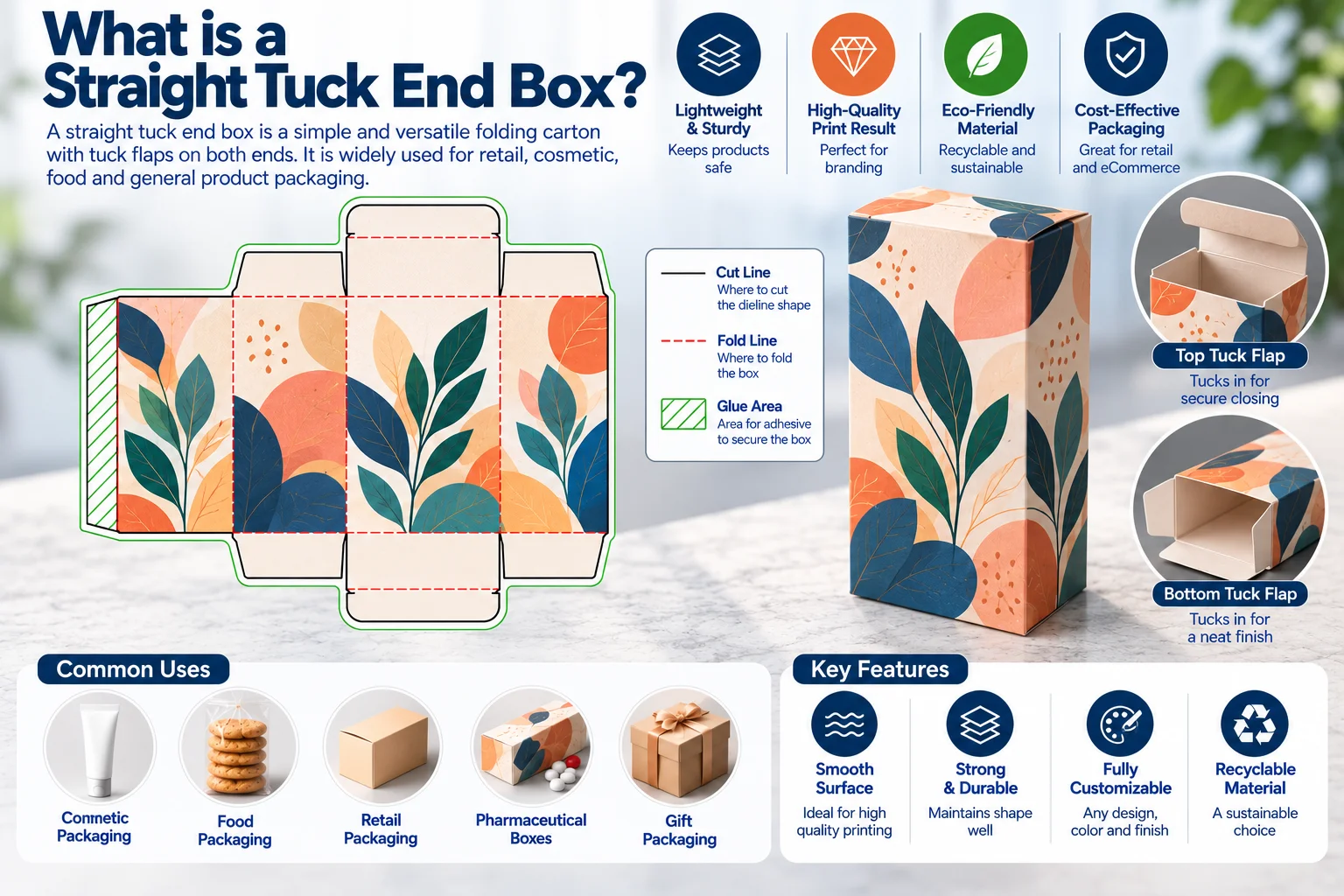
A simple packaging artwork approval workflow saves days on every order. One person owns the file and one person checks spelling and barcodes while one person signs the proof so changes never arrive from three directions at once.
Our artwork guidelines list the file rules in one place. The proof shows the design on screen but only a sample shows how it looks and feels in real life.
Should You Order a Sample Before the Full Run?
You should order a sample before the full run whenever the box is new, the product is fragile or the brand color matters. A sample costs a few days and protects the whole order from a size or color mistake.
| Sample type | Time | What it proves |
|---|---|---|
| Digital proof | Before any sample | Layout, text and position on the dieline |
| Plain sample | 3 to 5 business days | Size, fit and board strength |
| Printed pre-production sample | 7 to 10 business days | Colors, finishes and the final look |
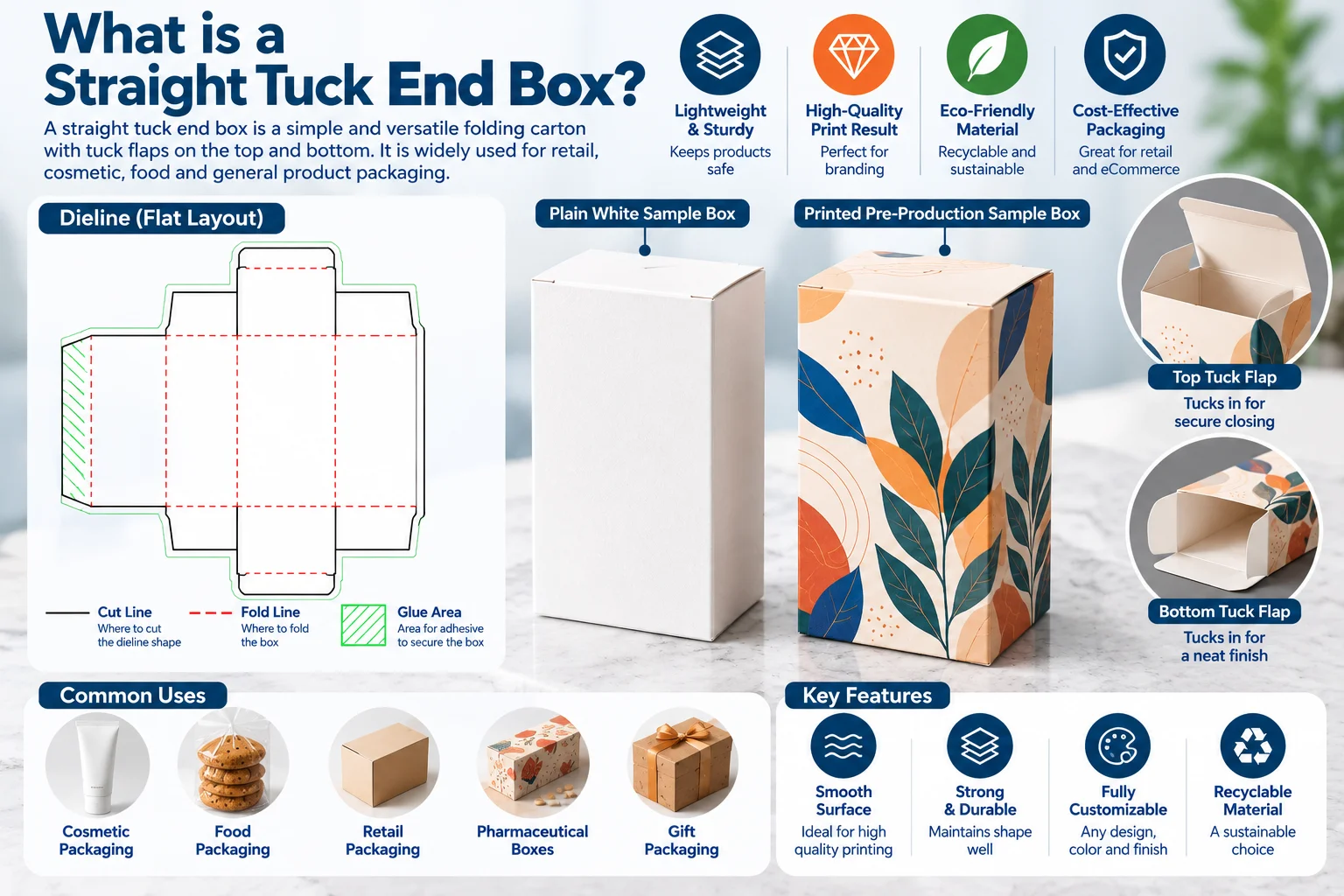
A plain sample is unprinted and proves the size, the fit and the strength of the board. A printed pre-production sample proves the colors, the finish and the position of every element on the box.
Put the real product inside the sample, close it and ship it to yourself if the box will travel by parcel. That one test answers more questions than any spec sheet. You can request a plain sample from us before you commit to the full quantity.
Once the sample is approved the conversation turns to money and what drives the price per box.
How Much Do Custom Boxes Cost per Unit?
The cost per unit of a custom box depends on its size, board, print, finishes and quantity. A small printed carton and a large rigid gift box can differ in price by ten times or more. That is why a quote on your own spec is the only number you can plan around.
| Cost driver | How it moves the price per box |
|---|---|
| Box size | Larger boxes use more board and fewer fit on each press sheet |
| Board and thickness | Rigid and heavy corrugated cost more than paperboard |
| Full color both sides costs more than one side | |
| Finishes | Each finish adds a step on press or after it |
| Inserts | A custom insert adds material and assembly |
| Quantity | Price breaks at 500 and 1,000 units on the same artwork |
We do not charge setup or tooling fees on any custom box order. The cutting die and the printing plates sit inside the unit price on the first order and on every reorder after it.
The most cost effective packaging material is the lightest board that still protects the product and not the cheapest board on the list. A box that fails in transit costs the product, the replacement and the shipping twice.
Cost effective wholesale packaging also comes from fewer sizes and a simpler finish list. Two well chosen box sizes for five products often beat five perfect sizes with five separate runs. Price is half of the plan and timing is the other half.
How Long Does a Wholesale Box Order Take?
A wholesale order of folding cartons or corrugated boxes takes 8 to 10 business days after dieline approval and rigid boxes take 10 to 12 business days. Add the time for quotes, artwork and any sample to see the full timeline.
| Step | Typical time |
|---|---|
| Quote and dieline | Usually within a business day |
| Artwork and digital proof | Depends on how fast the file is ready and signed |
| Plain sample, if needed | 3 to 5 business days |
| Printed pre-production sample, if needed | 7 to 10 business days |
| Production of folding cartons or corrugated | 8 to 10 business days after dieline approval |
| Production of rigid boxes | 10 to 12 business days after dieline approval |
| Delivery | Free shipping across the United States |
Plan backward from your launch date rather than forward from today. If your product goes on sale on a set day then count the production days, the delivery days and a few spare days for a proof change.
Working with a US supplier keeps approvals in the same time zone so a proof sent in the morning can come back signed the same afternoon. We also ship free across the United States and that keeps the delivery step simple to plan.
Timing affects reorders as well and it pays to think about how the box will work beyond the first run.
Can One Box Work Across Products and Seasons?
One box can work across several products and seasons when you design it with a stable base and changeable details. A shared box size with a product sticker, sleeve or insert gives you variety without a new run for every item.
This was one of the points in the original version of this post and it matters even more for a growing catalog. Every new SKU with its own box adds a new minimum, a new sample and a new reorder to track.
| Approach | How it works | Best for |
|---|---|---|
| One size, many labels | A shared box with a product sticker | Ranges with the same shape such as candles or jars |
| Printed sleeve | A plain or branded box with a changeable sleeve | Seasonal editions and gift sets |
| Custom insert | The same outer box with different inserts | Kits that change their contents |
| Neutral base print | Brand pattern with no product name | Growing catalogs that add products often |
Seasonal designs are a good use for sleeves because the box underneath stays the same all year. A holiday sleeve on a standard mailer gives the season its own look while the main box keeps selling in between.
A flexible box plan also makes the next topic easier because fewer box types mean less material to source responsibly.
Is Eco Friendly Packaging Worth It for a Small Business?
Eco friendly packaging is worth it for a small business when it uses less material, recycles easily and still protects the product. Plain paperboard and corrugated boxes are the easiest place to start because most US recycling programs accept them.
The EPA reports in its material data that corrugated boxes recycle at a rate of about 97 percent across the United States. That makes a well sized corrugated mailer one of the most sustainable packaging choices for small businesses that ship.
| Choice | Why it helps | Watch out for |
|---|---|---|
| Right sized box | Less board and lower postage | Leave enough room for protection |
| Kraft or recycled content board | Uses recovered or unbleached fiber | Kraft prints darker and less bright |
| Paper inserts instead of foam | The whole box recycles together | Fragile items still need firm support |
| Aqueous coating instead of film | Keeps the box easy to recycle | Film lamination is harder to recycle |
| Clear recycling message | Helps the customer sort the box | Follow the FTC Green Guides wording |
If you print a recyclable claim on the box then the FTC Green Guides set the rules. Under 16 CFR 260.12 an unqualified recyclable claim needs recycling programs available to at least 60 percent of consumers. Heavy plastic films on the box can make that claim harder to support.
Our kraft boxes and eco friendly shipping boxes are built for brands that want the natural look and the simple recycling story. With the box itself planned the final step is choosing who makes it.
How Do You Compare Quotes From Different Box Suppliers?
You compare box supplier quotes by checking that each one prices the same board, caliper, print and finish at the same quantity. A lower unit price often hides a thinner board, fewer colors or a sample charge that appears later.
| Check on every quote | What to look for |
|---|---|
| Board and thickness | The same material and caliper on every quote |
| Print and colors | Sides printed, CMYK or Pantone, inside print |
| Finishes | Every coating, foil and embossing listed |
| Quantity and price breaks | The same quantity and the next tier price |
| Setup, plates and dies | Included or charged separately |
| Samples and proofs | What is included and how long each takes |
| Lead time | Business days and the point the clock starts |
| Shipping | Included or added at checkout |
Reputation was the last point in the original version of this post and it still matters. Read recent reviews, ask for photos of similar boxes and look for a supplier that answers technical questions clearly before you pay.
Our guide on where to find the best custom boxes in the USA covers the types of suppliers you will meet. A short list of the right questions makes the final choice much easier.
What Questions Should You Ask a Packaging Supplier?
Ask a packaging supplier about the minimum order and the price breaks and any setup fees. Then ask about the board and caliper, the lead time, samples, proofs and shipping. The answers show you the real cost and the real timeline before you sign anything.
| Question to ask | A clear answer looks like |
|---|---|
| What is your minimum order per size? | 100 boxes per size and design |
| Where are your price breaks? | 500 and 1,000 units on the same artwork |
| Do you charge setup or tooling fees? | No, the die and plates sit inside the unit price |
| Which board and caliper is this quote for? | A named board and thickness, such as 18 pt SBS |
| How long does production take? | 8 to 10 business days after dieline approval |
| Can I see a sample first? | Plain in 3 to 5 days and printed in 7 to 10 |
| Who checks my artwork? | A named proof step on your dieline |
| Is shipping included? | Free across the United States |
Good suppliers answer these questions in writing and in plain numbers. Vague answers such as a few weeks or a small setup charge are a reason to ask again before you place an order.
Even with the right supplier a few common mistakes still catch first time buyers and the last section lists them so you can avoid every one.
What Mistakes Do Small Businesses Make When Buying Boxes in Bulk?
The most common mistake is measuring the outside of the product instead of the inside of the box. Skipping the sample and ordering too many boxes for a product that has not sold yet come close behind. Each one is easy to avoid with a little planning.
| Mistake | What happens | How to avoid it |
|---|---|---|
| Measuring the product, not the box inside | The product does not fit or rattles | Size from inside dimensions with clearance |
| Skipping the sample | Color or fit problems arrive with the full run | Order a plain or printed sample first |
| Ordering too many boxes too early | Cash sits in boxes for a slow product | Cover two to three months of sales |
| Too many box sizes | Each size needs its own minimum and reorder | Share sizes across similar products |
| RGB or low resolution artwork | Colors print dull and images blur | Send vector files with CMYK and Pantone |
| Ignoring dimensional weight | Postage costs more than the box saved | Keep the box snug around the product |
| Choosing on unit price alone | Thinner board or hidden extras | Compare quotes like for like |
Most of these mistakes come from rushing the order to meet a launch date. Planning backward from that date and leaving room for one sample round removes most of the pressure.
The checklist in this guide covers every decision in the order a supplier needs it. Work through it once and your first wholesale order should arrive right and on time at a price you planned for.
Frequently asked questions
The short version
Buying wholesale boxes for a small business goes smoothly when you settle the facts in the right order. Start with the product size, weight, quantity and shipping route. Then choose the style, board, print and finish around those facts.
Order a sample before the full run and compare every quote on the same specification and plan backward from your launch date. Our minimum of 100 boxes per size with no setup fees and free US shipping makes that first run easy to test.
Ready to order custom boxes wholesale?
At The Customized Boxes we print custom boxes from 100 per size and design with no setup or tooling fees, production in 8 to 10 business days after dieline approval and free shipping across the United States.
