







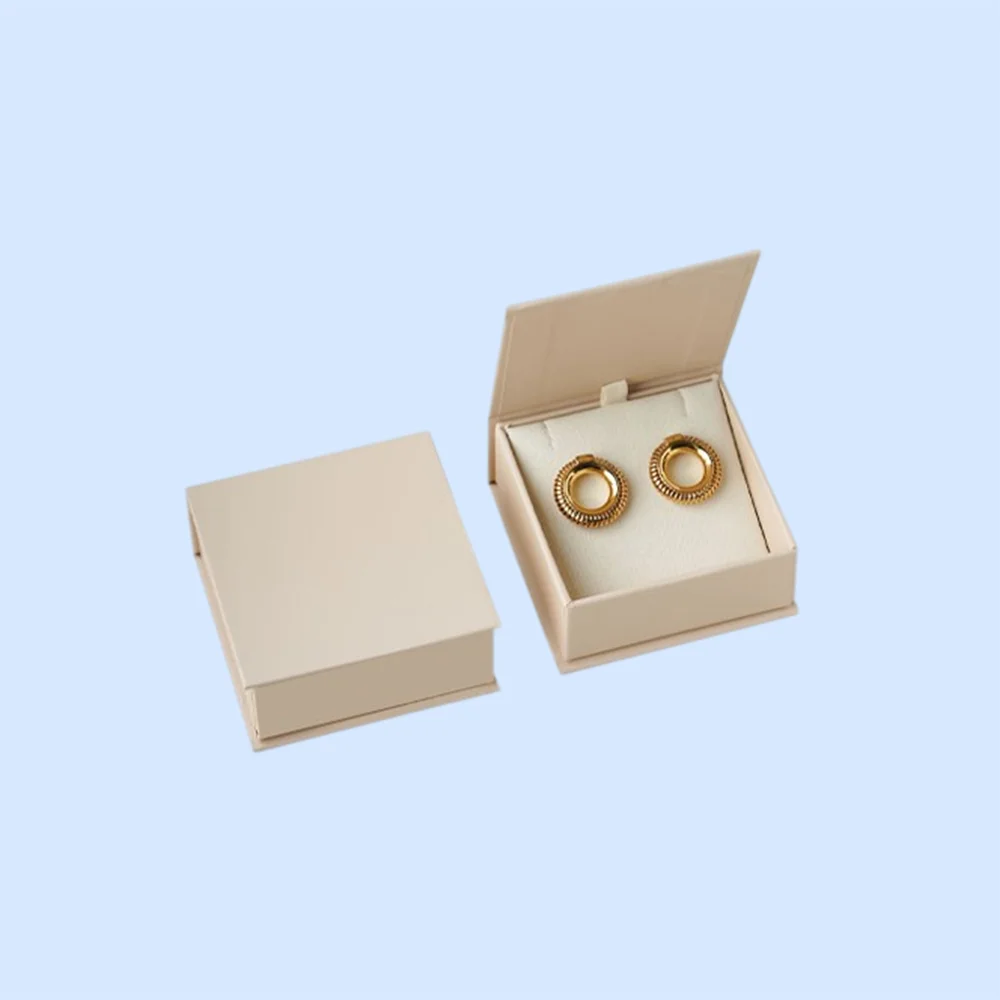
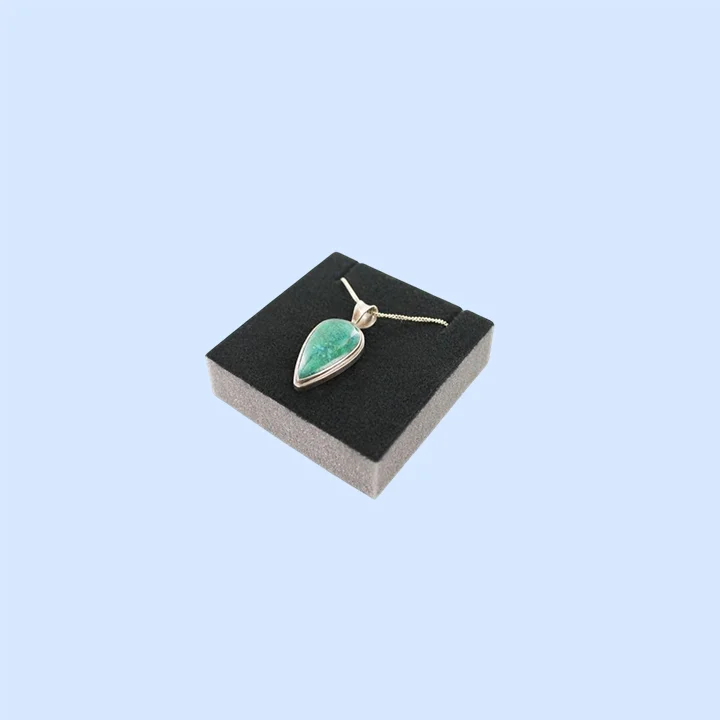
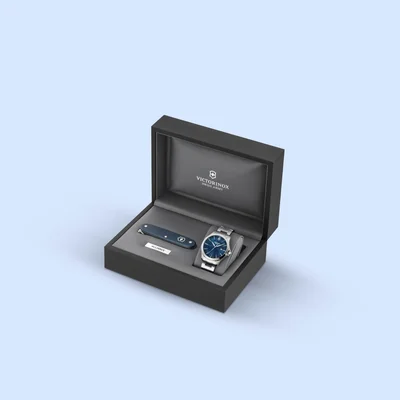
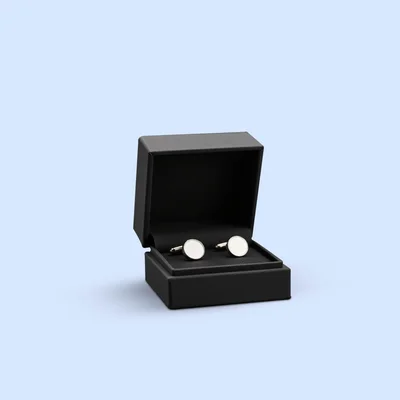
Why Does A Stock Size Rarely Fit Your Piece?
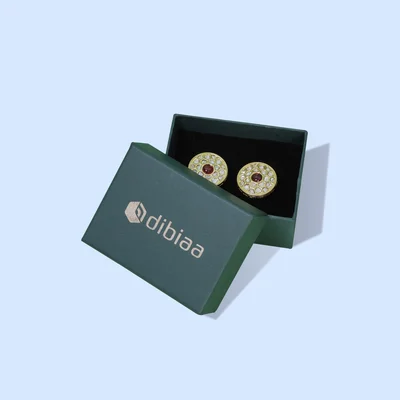
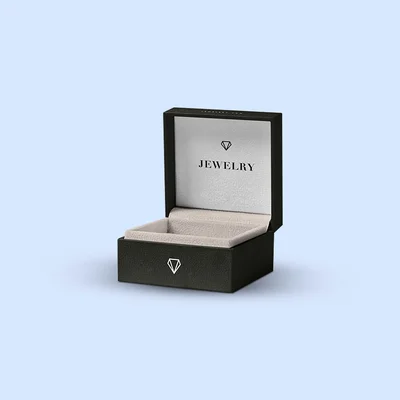
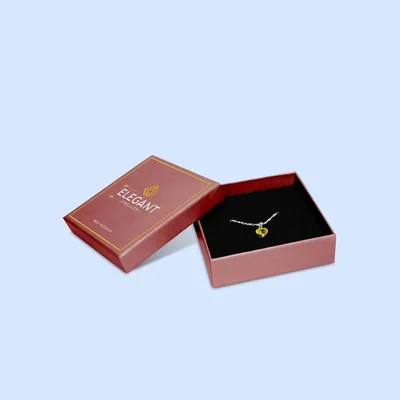
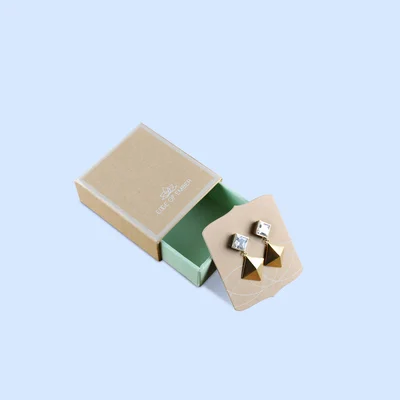
A jewelry box is sized from the finished piece with the clasp closed and the setting standing up. The figures below are trade reference sizes and only ever a starting point for the real one.
| Piece | Published internal size | What actually decides it |
|---|---|---|
| Ring | 51 x 51 x 38 mm | Outside band diameter plus stone height |
| Earring | 64 x 64 x 25 mm | Post backing or hook, plus drop |
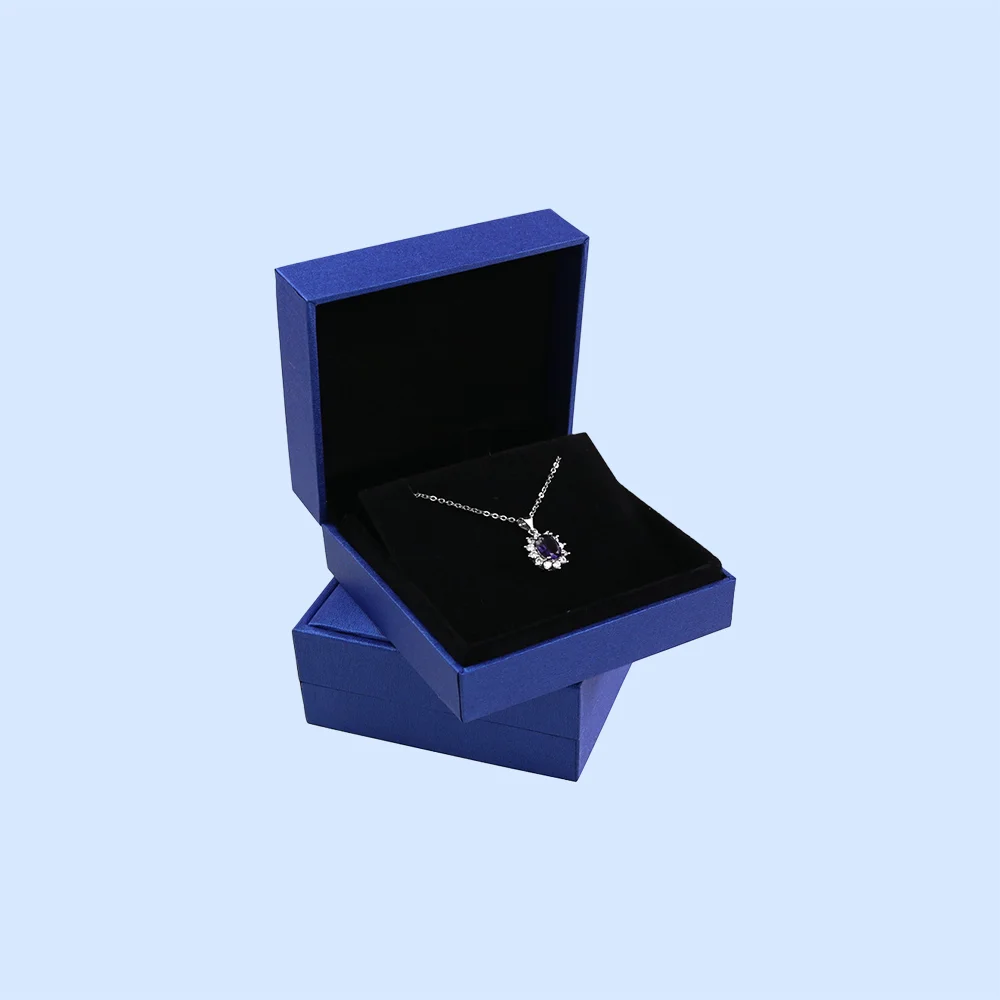
| Pendant | 89 x 89 x 25 mm | Bail height and any chain with it |
| Necklace | 178 x 127 x 25 mm | The longest chain you sell |
| Bracelet | 203 x 51 x 25 mm | Clasp closed, not laid open |
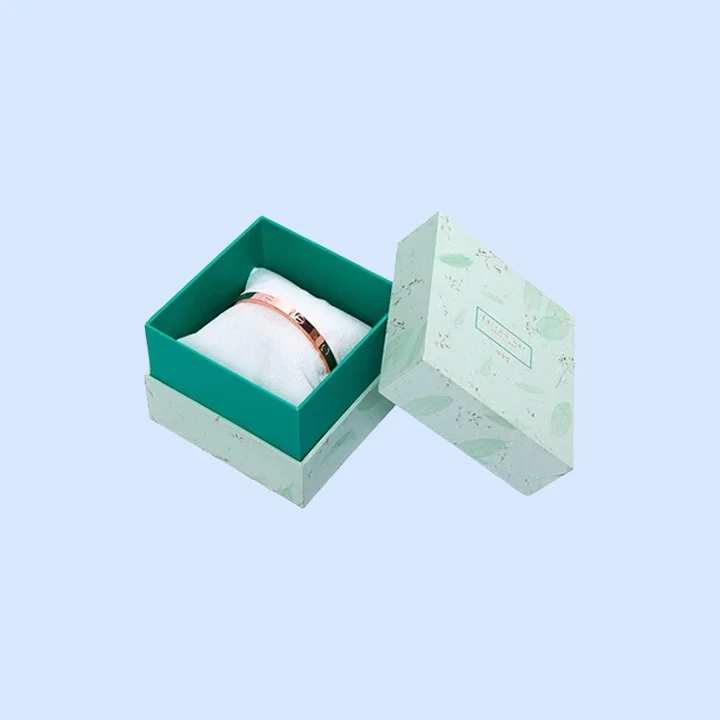
| Bangle | 102 x 102 x 32 mm | The rigid diameter of the bangle itself |
| Watch | 102 x 102 x 51 mm | Case diameter and strap type |
| Multi piece set | 229 x 229 x 51 mm | Every piece gets its own cavity |
Wall thickness then moves every one of those figures inward. Rigid board takes three to six millimeters out of each internal dimension while folding carton takes one to three. A tray that measured right on paper arrives too tight because nobody subtracted the wall twice.
What Does A Jewelry Box Cost At Wholesale Volume?
Buyers shopping jewelry boxes wholesale want numbers rather than a brochure. The minimum is 100 units per size and design and that phrase catches people out. A three size range in one artwork counts as three separate minimums because every size needs its own die.
No setup fee or tooling fee appears anywhere in our pricing. Several suppliers quote a die charge on the first order and a plate charge against every color you print. Both costs sit inside our unit price instead so bulk jewelry boxes and a small first run carry identical terms.
Which Material Should Your Piece Sit In?
Material decides cost and weight and what the surface accepts.
| Material | Caliper or weight | What it takes | Suits |
|---|---|---|---|
| Wrapped rigid greyboard | 1,200 to 1,500 micron | Full print on the wrap, foil | Fine jewelry and bridal |
| SBS folding carton | 350 to 400 GSM | Full CMYK, foil, spot UV | Retail and volume runs |
| Kraft board | 300 to 400 GSM | Print over a white undercoat | Handmade and natural |
| Velvet over board | 180 to 260 GSM pile | Foil and embossing only | Engagement and heirloom |
| Leatherette over board | 0.6 to 0.9 mm | Foil and deboss only | Watches and men’s ranges |
| Printed card | 300 to 400 GSM | Full CMYK on both faces | Earring cards and hang tags |
Two rows on that table settle most arguments with new buyers. Velvet and leatherette hold no printed artwork at all so a logo on either arrives as foil or as a deboss. Cardboard jewelry boxes sit at the cheap end of the same range.
What Makes A Jewelry Box Read As Expensive?
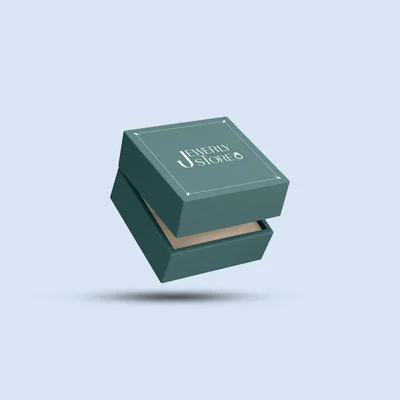
Weight and rigidity carry that impression almost every time a customer picks the box up. A wrapped rigid box uses greyboard between 1,200 and 1,500 micron under a printed paper wrap of 128 to 157 GSM. That board refuses to flex, which is what separates luxury jewelry packaging from a folding carton with the same artwork.
Closure is the second signal and the one that fails most often in transit. A magnetic flap feels the most finished of the options and magnet strength has to match lid weight. Rigid construction is covered on our rigid boxes product and the magnet fitting on custom magnetic closure boxes.
How Does Your Logo Go Onto The Box?
By whichever method the surface accepts, which is why two quotes for custom jewelry boxes with logo come back so far apart. Printed paper accepts full CMYK process alongside Pantone spot colors so a gradient reproduces exactly as drawn. Velvet and suede effect and leatherette accept hot foil stamping and embossing and debossing instead. Foil comes in gold and silver and rose gold and matte black.
Custom jewelry packaging artwork reaches us as vector PDF or AI on our dieline with 3 mm bleed and Pantone colors identified. Brands without a dieline start from our free dieline generator.
What Does A First Order Look Like?
Jewelry packaging for a small business follows the same route as an order ten times the size.
- Step one: send the piece or its measurements and we return a dieline and a price within the week
- Step two: approve the dieline and a plain sample follows in 3 to 5 business days or a printed one in 7 to 10
- Step three: approve the sample and production runs 8 to 10 business days for carton or 10 to 12 for rigid
- Step four: reorder on the same artwork at any time because the die stays with us and remains yours to reuse
Minimum Order, Lead Time And Samples
- Minimum order is 100 units per size and design across every material in this range
- Price breaks arrive at 500 and 1,000 units on one artwork and not across mixed designs
- Production takes 8 to 10 business days for folding carton and 10 to 12 for rigid and wrapped
- A plain sample takes 3 to 5 business days and a printed one takes 7 to 10
- No setup or tooling fees apply because the die and the plates sit inside your unit price
- Shipping is free across the United States on every order we take
Request a Quote
Send your piece measurements, the quantity and the material you have in mind through our quote form and we return a dieline and a price. You do not need a technical drawing because a photograph taken beside a ruler is enough. Brands buying across several lines will find the rest of the catalog under custom packaging boxes.
 The Customized Boxes