



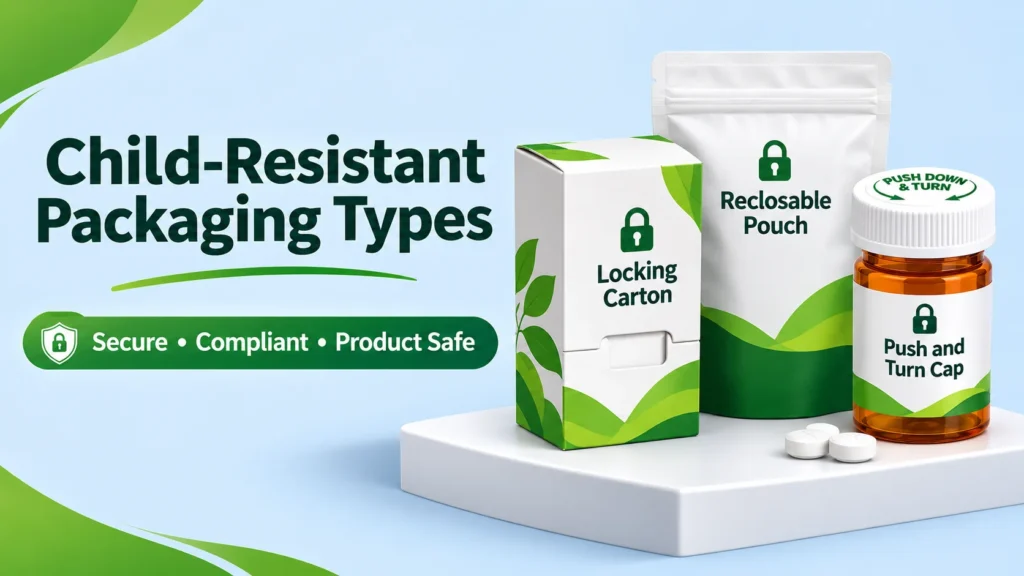
Child resistant packaging is packaging built and tested so that most young children cannot open it within a set time. Most adults can still open it and close it again with ease in the same test.
The rule behind it sits in federal law for medicines, household chemicals and a short list of other substances. State programs then add their own rules for cannabis products on top of that federal base.
This guide explains which products need child resistant packaging and how the child and adult panel tests work. It also covers what a test certificate proves and which package types a brand can choose.
Key takeaways
- Child resistant packaging must be hard for children under five to open and easy for normal adults to use.
- The federal test uses a child panel aged 42 to 51 months and an adult panel aged 50 to 70.
- A certificate covers one exact package, so a new cap, size, material or torque needs a new test.
- Cannabis is not on the federal list, and state programs set its child resistant rules.
- One non complying size is allowed under 16 CFR 1700.5 with a printed household warning.
What Is Child Resistant Packaging?
Child resistant packaging is a closure or package that passes a timed test in which most children under five fail to open it and most adults succeed.
The Poison Prevention Packaging Act sets the standard in plain words that every brand should read once. The package must be “designed or constructed to be significantly difficult for children under 5 years of age to open or obtain a toxic or harmful amount of the substance contained therein within a reasonable time and not difficult for normal adults to use properly.”
Two ideas in that one sentence shape every design decision a brand makes about its pack. The package has to slow a child down for long enough to matter, and it still has to work for the adult who buys it every week.
That second half is the part brands forget, because a package that frustrates older adults fails the test just as surely as one that a toddler opens. The difference between resistant and proof explains why the test is built this way.
Is Child Proof Packaging the Same as Child Resistant Packaging?
Child proof packaging is a common name for child resistant packaging, but no package is truly proof against a determined child, so regulators use the word resistant.
The test openly accepts that some children in every panel will open the package. It only requires that the share who fail stays above a fixed line, which the next sections set out in numbers.
You will also see the short form CR packaging in supplier catalogs and state rules. Childproof packaging, child proof packaging and CR packaging all describe the same tested standard.
Using the right term matters on your label and in your marketing, because a claim of child proof promises more than any test supports. The next question is which products the federal law actually covers by name and amount.
Which Products Must Use Child Resistant Packaging by Law?
Products on the federal list in 16 CFR 1700.14 must use child resistant packaging, which covers most oral medicines and a set of household chemicals.
| Group | Examples on the list | What triggers the rule |
|---|---|---|
| Prescription medicines | Oral prescription drugs and controlled substances | The drug type itself |
| Over the counter pain relief | Aspirin, acetaminophen, ibuprofen and naproxen | Amount per package above the listed limit |
| Other medicines | Diphenhydramine, minoxidil and imidazolines | The ingredient and its amount |
| Iron supplements | Products with 250 mg or more of elemental iron per package | The total iron in the package |
| Mouthwash | Products with 3 grams or more of ethanol per package | The ethanol content |
| Household chemicals | Furniture polish, turpentine, methanol, sulfuric acid and paint solvents | The substance and its form |
Each listed substance has its own trigger, such as a minimum amount per package or a specific form. Read the exact entry for your product before you decide the rule does not apply to it.
Cannabis and hemp products do not appear on this federal list, and a later section explains where their rules come from. For every listed product, the proof that a package complies comes from one standard test.
How Is Child Resistant Packaging Tested?
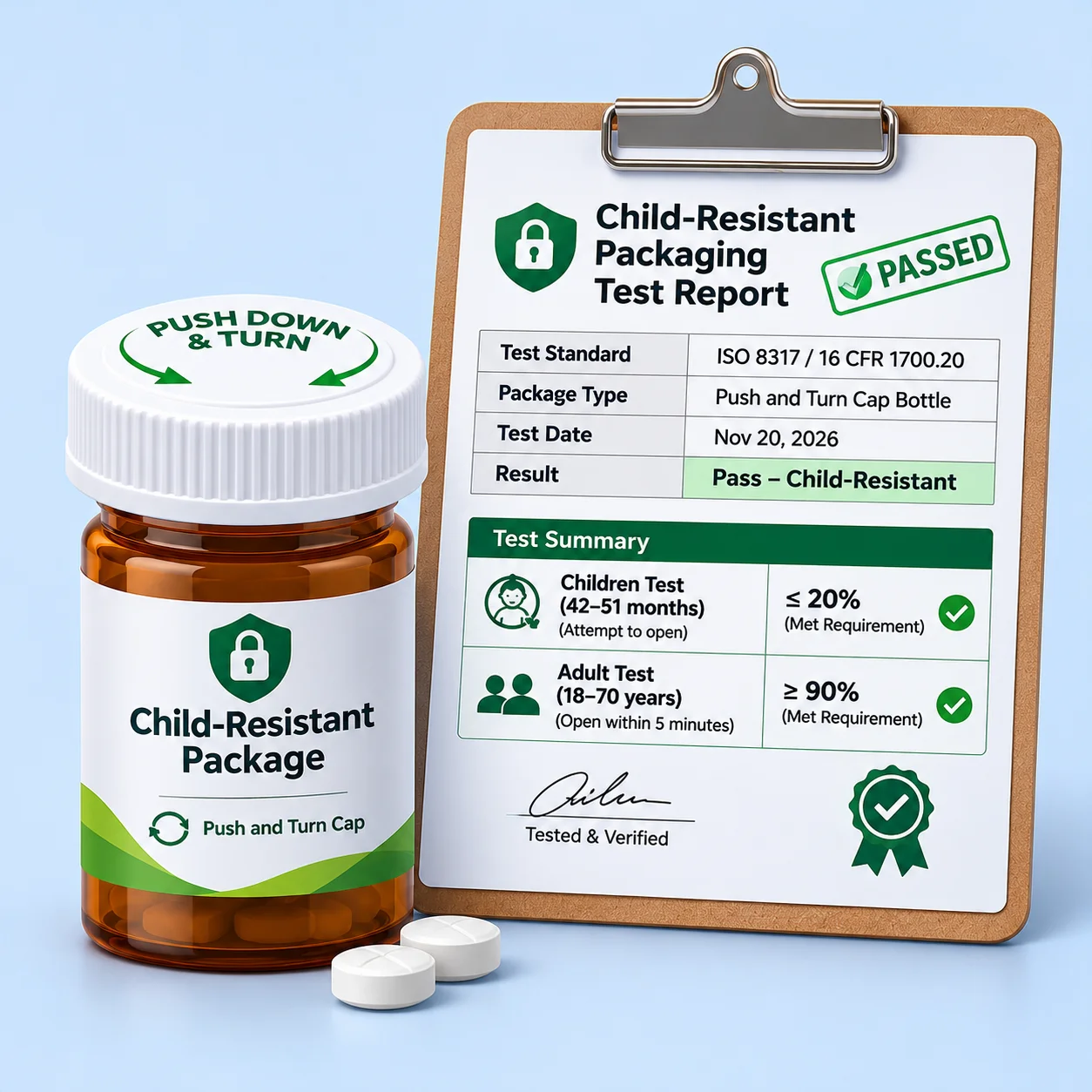
Child resistant packaging is tested under 16 CFR 1700.20 with a panel of young children and a separate panel of adults aged 50 to 70.
| Panel | Who takes part | How the test runs | Pass line |
|---|---|---|---|
| Child panel | 50 children per panel, up to 200 in total, aged 42 to 51 months | Two 5 minute periods with a demonstration between them | 85 percent fail to open before the demonstration and 80 percent across the full test |
| Senior adult panel | 100 adults aged 50 to 70, 70 percent of them women | 5 minutes to open and 1 minute to close again | 90 percent open and close the package correctly |
The children work in pairs in a familiar room and nobody tells them what to do at first. Halfway through, a tester shows them how to open the package without words, then they try again.
The adult panel checks the other half of the rule, which is that normal adults can use the package properly. Many failed designs pass the child panel easily and then fail here because the closure is too hard to work.
A package that passes both panels earns a test report, and that report is what people mean when they call a package certified.
What Makes a Package Certified Child Resistant?
A package is certified child resistant when an accredited lab tests that exact package under the federal protocol and issues a report that names it.
The report covers one specific combination of container, closure, size and material from one supplier. It does not carry over to a similar package from another supplier, even when the two look the same.
- Component change: a different cap, liner or zipper from a new supplier needs a new test
- Size change: a larger pouch has a longer seal and zipper, so it needs its own report
- Torque change: a cap applied tighter or looser behaves differently in a child hand
- Material change: a thicker or softer film changes how the closure grips and tears
- Neck finish change: a cap made for a 38 to 400 neck fits a 38 to 410 neck yet behaves differently under test
When a supplier sends you a report, check five lines before you rely on it. Look for the lab name, the exact package tested, the panel results for children and adults, the test date and a clear pass statement.
Certified child resistant packaging is a property of the whole package, which is why the choice of package type comes next.
Need printed packaging around a child resistant component?
Send us the size of the tested component and tell us what the product is. We return a dieline that fits the tested part, a price and a sample date.
Which Child Resistant Package Types Can a Brand Choose?
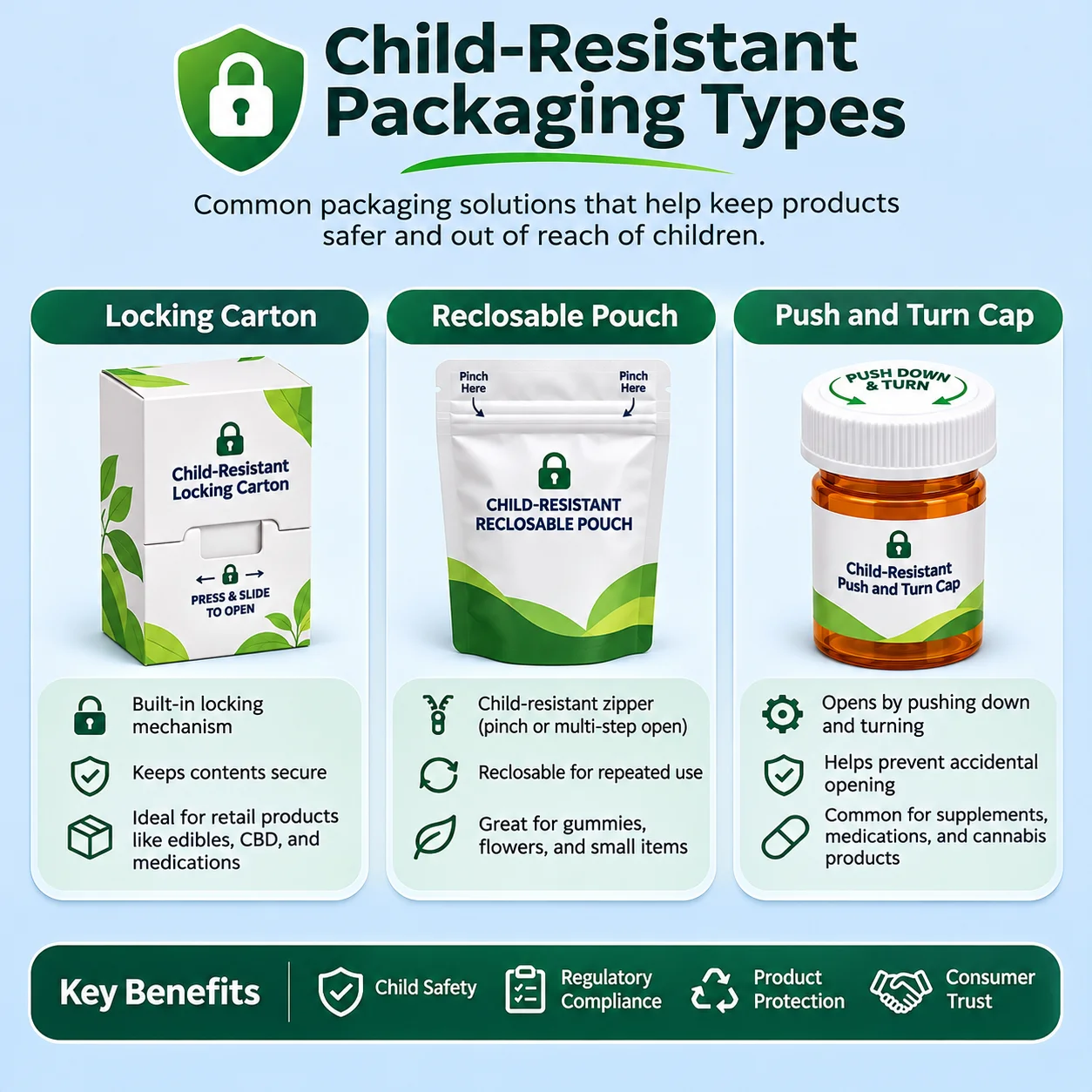
Brands can choose child resistant closures, reclosable pouches, locking cartons, tubes and blister packs, and each type suits a different product form.
| Package type | How it resists a child | Best suited to |
|---|---|---|
| Push and turn cap | Needs downward pressure and a turn at the same time | Bottles of pills, tinctures and liquids |
| Squeeze and turn cap | Needs two side tabs pressed while turning | Bottles and jars for adults with good grip |
| Reclosable child resistant pouch | A zipper that needs a pinch and slide or a press and pull | Gummies, flower and dry goods |
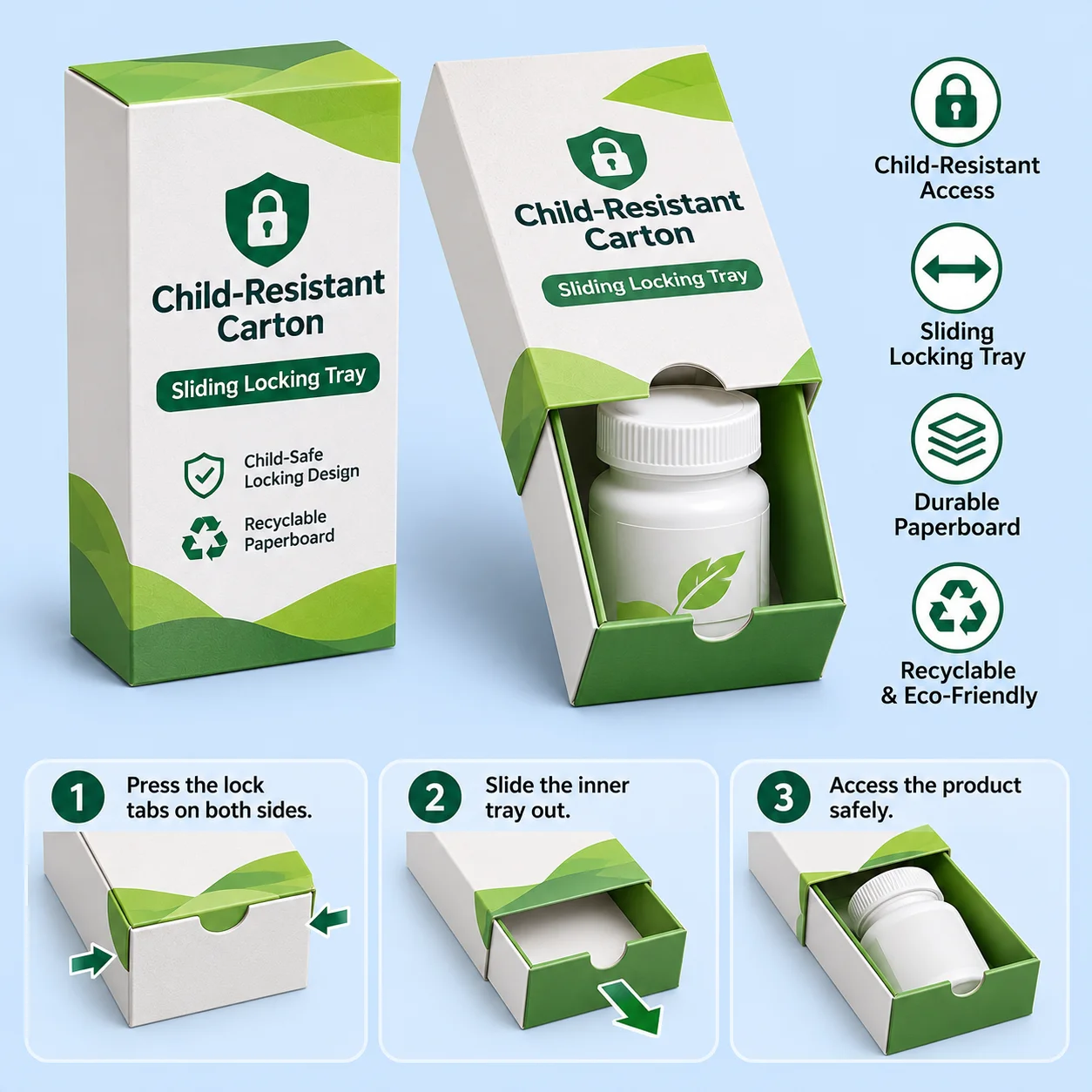
| Child resistant carton | A tray that only slides out when two hidden tabs are pressed | Pre rolls, vape pens and blister cards |
| Child resistant tube | A cap that needs a squeeze or push before it turns | Pre rolls and single items |
| Child resistant blister | Foil that needs peeling before a push opens each cell | Single doses of tablets or capsules |
Reclosable designs have their own international test, ISO 8317, which many suppliers quote beside the federal protocol. Nonreclosable blisters and single use packs follow a different standard in the same family.
The ASTM D3475 classification sorts tested packages into types so buyers can compare like with like. Printed custom mylar bags and locking cartons are the two types we see brands order most for edibles and pre rolls.
Cannabis brands choose from the same list of types, yet the rule that tells them to do it comes from a different place.
Does Cannabis Packaging Fall Under the Federal Child Resistant Rule?
Cannabis packaging does not fall under the federal child resistant list, because the list names no cannabinoid, so state cannabis programs set the requirement.
Every state with a legal cannabis market writes its own packaging rules, and almost all of them require child resistant packaging for edibles, flower, concentrates and vape products. Many states also ban packaging that appeals to children through its colors or images.
Federal agencies have applied the child resistant standard to intoxicating hemp products through recalls. Those recalls named packaging that failed the test and labels with cartoons or candy styling.
The safe approach for any cannabis or hemp brand is to use a tested package and plain adult styling in every state. Our pages for CBD boxes and pre roll boxes show the printed packaging that carries those products.
Federal rules do allow one exception for listed products, and it gives some brands a choice they rarely know about.
Can a Brand Sell One Size Without Child Resistant Packaging?
A brand can sell one size without child resistant packaging under 16 CFR 1700.5, as long as it also sells sizes that comply.
The non complying size must carry the statement “This Package for Households Without Young Children” inside a bordered box. Where the label is too small, the short form “Package Not Child-Resistant” is allowed instead.
The rule also fixes the type size, which scales from one sixteenth of an inch to one quarter of an inch with the size of the label panel. Supplement and over the counter brands use this route for older buyers who struggle with closures.
This exemption covers only one size per product, and it never covers prescription drugs. It gives you a legal option, while the more common goal is a better tested package.
What Is Innovative and Sustainable Child Resistant Packaging?
Innovative child resistant packaging replaces plastic parts with paperboard locks, and sustainable child resistant packaging uses mono material films that can be recycled.
- Paperboard locking cartons: a slide tray with a hidden tab lock replaces a plastic tube for pre rolls and vape pens
- Mono material pouches: a single plastic family in every layer makes the pouch easier to recycle
- Paper based blisters: a board backing with a tear resistant layer cuts the plastic in a blister card
- Refill systems: one tested container that stays in the home with lighter refill packs handled only by adults
Every new design still has to pass the same panel test, so a greener package is only compliant once it has its own report. Ask your supplier for the report before you print the outer packaging around it.
That outer packaging is where most brands start, and it has a clear role beside the tested component.
How Does Printed Packaging Work With a Child Resistant Component?
Printed packaging carries the brand and the warnings, while the tested child resistant component such as the cap, pouch or locking tray does the resisting.
A printed carton around a child resistant bottle does not need its own test, because the bottle already passes. The carton needs room for the required warnings, the ingredient panel and any state symbol.
Keep the design plain for any product that an adult can leave within reach of a child. Avoid cartoon characters, bright candy colors and food styling on weed pen boxes, edibles and vape products.
When you order printed packaging from us for a product that needs child resistance, tell us which component carries the test report. We size the custom packaging boxes around that component so the tested part fits without changes.
The short sections below answer the questions brands ask most when they first meet these rules.
Frequently asked questions
Brands meeting these rules for the first time ask us the same questions about child resistant packaging, and the short answers are below.
The short version
Child resistant packaging has to stop most young children and still work for most adults, and one federal test with two panels proves both halves of that rule.
A certificate covers one exact package, so any change to the cap, size, material or torque needs a new report. Cannabis rules come from each state, while one exempt size is allowed for listed products.
Choose the tested component first and then build the printed packaging around that exact part. Send us the component size and our team will return a dieline that fits it.
Ready to package a regulated product?
We print from a single box with no setup fees, free design support and free shipping across the United States. Folding cartons take 8 to 10 business days to produce after you approve the dieline.
