






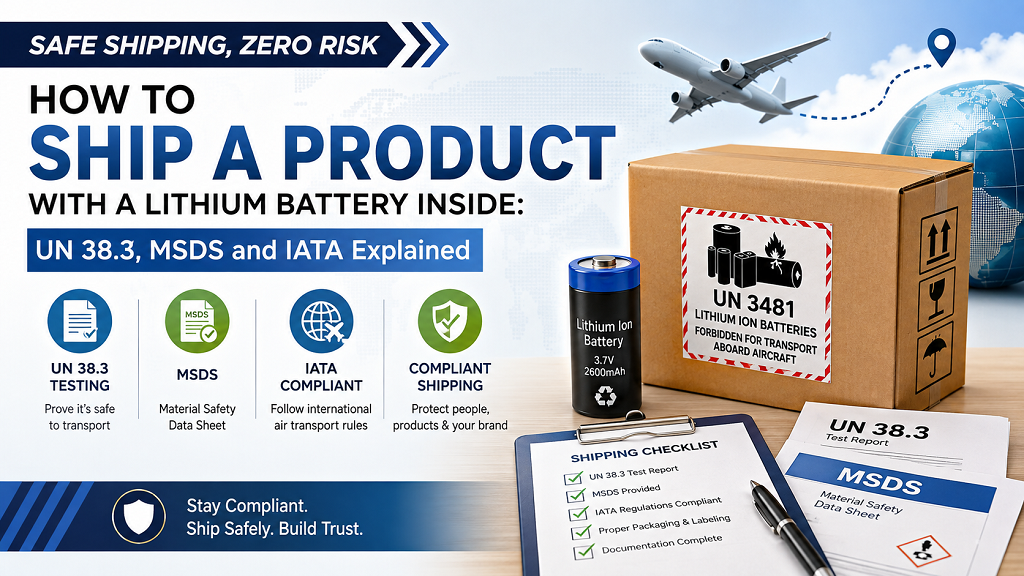
Here is the short answer because you probably came here with a shipment already booked.
If your product has a lithium battery sealed inside it then your shipment is regulated. It travels under UN 3481 and follows Packing Instruction 967. In most cases it qualifies for Section II, which is the lighter set of rules. You will need a UN 38.3 test summary from the battery manufacturer and a lithium battery mark on the outer carton. You also need to keep the net weight of the batteries in each package under 5 kg.
That is the whole answer in one paragraph. The rest of this article explains why each requirement exists and what happens when you get one of them wrong. It also covers the rule that changed on January 1, 2026, which most freight processes have not caught up with yet.
I have seen more product launches delayed by battery paperwork than by artwork. Artwork problems get caught during the proof stage. Battery problems get caught by a freight forwarder four days before the event, and by then there is nothing left to do except pay for a courier who will take the risk.
This article is the whole of lithium battery shipping for a normal branded product, start to finish.
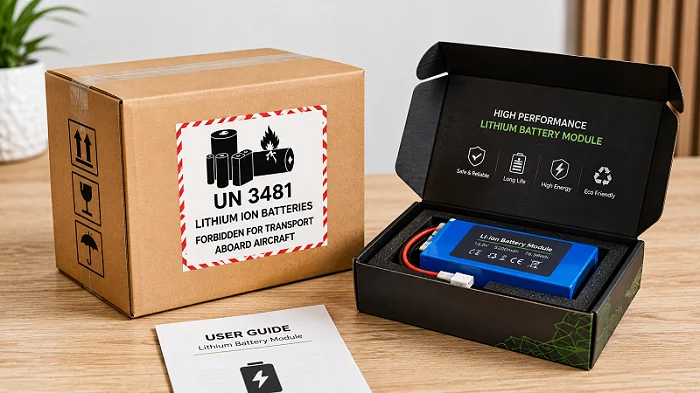
Who This Applies To
You need this information if you ship anything with a rechargeable cell inside it. This covers more products than you might expect.
That includes video boxes and video brochures as well as light-up displays and LED gift packaging. It also covers Bluetooth speakers, power banks, wireless earbuds, electric toothbrushes, digital photo frames, smart tags, e-cigarettes and vapes, heated products, and promotional items with a screen or a sound chip. If it charges, it counts.
The rules apply whether you are the manufacturer, the brand owner, or the agency booking the freight. They follow the goods rather than the company shipping them. That is true of anyone shipping electronics internationally, whether it is 100 units for a launch or a single sample.
The One-Page Version
If you read nothing else, these are the six things that decide whether your shipment moves.
| What You Need | Requirement |
|---|---|
| UN number | UN 3481 for a battery installed in your product |
| Packing Instruction | PI 967 with Section II |
| Watt-hour limit | 20 Wh per cell and 100 Wh per battery |
| Weight limit | 5 kg net battery weight per package |
| Paperwork | UN 38.3 test summary on file and safety data sheet when requested |
| On the carton | Lithium battery mark with a working phone number |
Everything below explains where these requirements come from and what happens when one of them is missed.
Which UN Number Is Yours?
This is the first thing to get right, because the UN number decides everything downstream.
Lithium-ion batteries fall under two UN numbers. The second one splits into two situations, and the difference is simply where the battery is sitting when you hand the package to the courier.
| Situation | UN Number | Packing Instruction |
|---|---|---|
| Batteries shipped on their own with nothing else in the box | UN 3480 | PI 965 |
| Batteries packed with equipment but not installed in it | UN 3481 | PI 966 |
| Batteries installed inside the equipment | UN 3481 | PI 967 |
Most branded products fall into the last category. The battery is soldered or clipped into the device, the device goes in its box, and the box goes in a carton. That means UN 3481 and PI 967, which is the easiest of the three to ship.
The middle category is the one that catches people. If you include a spare battery in the same carton, even as a courtesy, you have moved from PI 967 to PI 966. That is a different rule set with tighter requirements, and it is the one that changed this year.
The practical advice is simple, do not ship spare batteries in the same carton unless you have a specific reason. Ship them separately or leave them out.
What UN 38.3 Actually Is
People talk about UN 38.3 as though it were a certificate you buy. It is not. UN 38.3 is a series of eight physical tests from the United Nations Manual of Tests and Criteria, and a laboratory performs them on sample cells and batteries.
Here is what each test is designed to simulate.
| Test | Name | What It Simulates |
|---|---|---|
| T.1 | Altitude simulation | Low pressure at cruising altitude in an unpressurized cargo hold |
| T.2 | Thermal test | Rapid changes between extreme heat and extreme cold |
| T.3 | Vibration | The constant shaking of transport over hours |
| T.4 | Shock | A sharp jolt, such as a pallet being dropped onto a deck |
| T.5 | External short circuit | A short across the terminals at high temperature |
| T.6 | Impact or crush | A heavy object striking or crushing the cell |
| T.7 | Overcharge | Charging well beyond the rated voltage |
| T.8 | Forced discharge | Being drained past empty by other cells connected in series |
Tests T.1 through T.5 and T.7 run on the same cells in sequence, so a cell has to survive all of them one after another. Tests T.6 and T.8 run on fresh cells.
A battery passes only if it does not leak, vent, disassemble, rupture or catch fire, and if it retains a defined portion of its voltage afterward. There is no partial credit.
The requirement applies to every lithium battery manufactured after June 30, 2003. That date matters, because it means there is no legitimate reason for a modern battery to be missing a test summary. If a supplier cannot produce one, the honest interpretation is that they do not know which cell they are using.
The Test Summary and Exactly What to Ask For
Since January 1, 2020, manufacturers and every subsequent distributor have been required to make the test summary available. That wording is deliberate. The document does not have to be printed and taped to every carton.
IATA confirms the summary does not need to travel with every shipment, and that a URL or QR code is an acceptable way to provide it. In practice, most suppliers email a PDF once and you keep it on file.
A valid test summary contains a specific list of items. When you request one, ask for these by name so you can check the document before you need it:
- Name of the cell or battery manufacturer
- Contact details including address, phone and email
- Name of the testing laboratory and its contact details
- A unique test report identification number
- Date of the test report
- Description of the cell or battery including watt-hour rating, mass, chemistry and physical description
- List of the tests performed and their results
- Reference to the revision of the Manual of Tests and Criteria used
- Signature with the name and title of the person who signed the report
If the document you receive is missing the laboratory name or the report number, it is not a test summary. It is a marketing sheet with the words UN 38.3 printed on it, and I have seen several of those.
One exception is worth knowing. Button cells installed in equipment, including cells soldered onto circuit boards, are excluded from the test summary requirement. That is a narrow exception and it does not cover the rechargeable pouch cells used in video packaging or speakers.
Do You Need a Shipper’s Declaration?
This is the question that decides whether your shipment stays simple or becomes complicated.
Under PI 967 Section II, you do not need a Shipper’s Declaration for Dangerous Goods. That single fact is why most branded electronics move without a specialist agent and without a surcharge.
To stay within Section II, your batteries must sit under both of these limits:
- 20 watt-hours per cell
- 100 watt-hours per battery
Those limits sound restrictive until you calculate what a real product uses.
Watt-hours are easy to work out. Multiply the voltage by the amp-hours. A typical rechargeable cell in a custom video box or a promotional device runs at 3.7 volts with a capacity between 500 and 2,000 mAh, which is 0.5 to 2.0 amp-hours.
| Cell | Calculation | Watt-hours |
|---|---|---|
| 3.7 V, 500 mAh | 3.7 × 0.5 | 1.85 Wh |
| 3.7 V, 1,000 mAh | 3.7 × 1.0 | 3.7 Wh |
| 3.7 V, 2,000 mAh | 3.7 × 2.0 | 7.4 Wh |
| 3.7 V, 5,000 mAh | 3.7 × 5.0 | 18.5 Wh |
Even a 5,000 mAh cell sits under the 20 Wh limit. So for anything smaller than a power bank, Section II is comfortably within reach.
Those two figures are the battery watt hour limit that decides everything else. Stay under them and Section II is yours.
The watt-hour rating should be printed on the cell and it will be stated on the test summary. If your supplier cannot tell you the watt-hour figure, that is the same red flag as a missing test summary.
The 5 kg Rule and the Number Nobody Publishes
This is where a shipment that satisfies every other rule still gets stopped.
Section II of PI 967 limits each package to 5 kg net weight of lithium batteries. That applies to passenger aircraft and cargo aircraft alike. It is not the weight of the carton and it is not the weight of the product. It is the combined weight of the batteries alone.
Almost no supplier mentions this and almost no buyer asks. So let us turn it into a number you can use.
Weigh one battery module. For most small devices it lands somewhere between 15 and 30 grams. Then divide.
| Battery Weight Per Unit | Units Per Package Before Reaching 5 kg |
|---|---|
| 15 g | 333 |
| 20 g | 250 |
| 25 g | 200 |
| 30 g | 166 |
| 50 g | 100 |
Read that table against your order quantity and the picture gets clear fast. An order of 100 units fits in a single package without any thought. An order of 500 units at 25 g per battery has to be split across at least three packages, because 500 batteries weigh 12.5 kg.
That split is not a problem when your supplier knows about it at packing stage. It is a problem when a pallet reaches the airline and one carton is over the limit, because then the whole consignment waits while somebody repacks it.
So before production ends, ask your supplier one question: how many units are you putting in each master carton, and what is the net battery weight of that carton? If the answer is over 5 kg, ask them to split it.
The Rule That Changed on January 1, 2026
This is the part that is genuinely new, and most freight processes have not caught up with it.
From January 1, 2026, lithium-ion batteries packed with equipment under PI 966 must be offered for transport at no more than 30% of rated capacity, or the shipment needs approval under Special Provision A331. This applies to cells and batteries above 2.7 Wh, and it covers both Section I and Section II.
That is a mandatory state-of-charge limit where previously there was none for PI 966.
For batteries contained in equipment under PI 967, there is still no mandatory state-of-charge limit. But IATA now strongly recommends offering them at 30% state of charge or below, or with an indicated capacity of 25% or below. That recommendation is also new in the 2026 guidance.
Here is what this means in plain terms. If your product ships with the battery installed, you are not legally required to reduce the charge. But the guidance is pushing that way, and some carriers apply it as their own policy. Ask your supplier to ship at a partial charge as standard. It costs nothing and it removes an argument.
If your product ships with a loose battery in the same carton, the 30% limit is now mandatory. That is another reason to keep spare batteries out of the carton entirely.
Sodium-ion batteries entered the rules this year as well, under UN 3551 and UN 3552, with IATA recommending the same 30% approach where practical. That will matter more over the next few years as sodium chemistry appears in low-cost devices.
All of this sits inside the IATA lithium battery guidance, which is the document your carrier is working from. It is worth knowing that IATA lithium battery rules are reissued every year, so the edition matters.
Marks and Labels on the Outer Carton
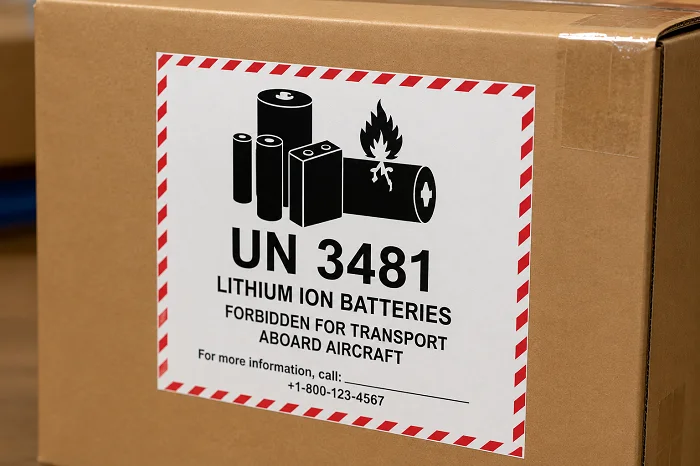
The lithium battery mark goes on the outside of the package. It is the red-bordered rectangle showing the UN number, with a phone number for more information.
There is one exemption worth knowing, and it is narrower than most people assume. The mark can be omitted for consignments of two packages or fewer where each package contains no more than four cells or two batteries installed in equipment.
Read that carefully, because the two halves have to be true at the same time. No more than two packages in the consignment, and no more than four cells or two batteries inside each one. It is not a choice between them. Go to three packages and the exemption is gone, however few cells are in each.
That covers a sample shipment and almost nothing else. Any real production order needs the mark.
The phone number printed on the mark has to reach somebody who can actually provide information about the shipment. Do not use a general switchboard that closes at five.
MSDS, SDS, and the Honest Answer
Your freight forwarder will ask for an MSDS. Here is what is actually going on.
MSDS is the older name. The current term under the Globally Harmonized System is Safety Data Sheet, or SDS. People use both and they mean the same document.
The honest part is this. A lithium battery is legally an article, not a chemical substance or a mixture. Under GHS rules, articles do not strictly require a safety data sheet. So there are cases where a battery has no legally mandated SDS at all.
That does not help you, because your forwarder, your customs broker and your customer’s compliance team will all ask for one anyway. Manufacturers produce them voluntarily for exactly that reason, and any competent battery supplier will have one ready.
The practical position: ask for it, expect to receive it, and do not accept “batteries do not need an SDS” as an answer even though the statement is technically defensible. What you want is the document, because it is what unblocks the shipment.
Ask for the battery safety data sheet by that name, since MSDS lithium battery is the phrase most suppliers still file it under.
Air Freight or Sea Freight?
Air is faster and it is where all the rules above apply. Sea follows the IMDG Code, with its own requirements, and it is generally more permissive on lithium batteries.
The real decision is time against certainty.
| Air Freight | Sea Freight | |
|---|---|---|
| Transit | Days | Weeks |
| Rule set | IATA DGR | IMDG Code |
| Cost per unit | Higher | Lower |
| Risk of a hold | Higher, because more rules apply | Lower |
| Best for | Samples, urgent launches and small runs | Bulk orders with a known delivery date |
For a launch with a fixed date, the mistake is not choosing air. The mistake is choosing it late. A sea shipment booked eight weeks out costs a fraction of an air shipment booked eight days out, and it leaves time to resolve documentation.
Tell your supplier your event date when you request the quotation, not at the artwork stage. The routing decision is made much earlier than most buyers realize.
One more piece of vocabulary. Your forwarder will call all of this dangerous goods packaging, which sounds alarming and simply means the carton has to be marked and the paperwork has to exist. Shipping lithium batteries by air is routine once those two things are in place.
The Checklist to Send Your Supplier
Copy this and send it before you place the order, not after. Every item on it is something you will be asked for eventually.
- The UN 38.3 test summary for the exact cell used in our product, as a PDF
- The watt-hour rating per cell and per battery
- The net weight of one battery module in grams
- The safety data sheet for the cell
- Confirmation of the UN number and packing instruction you will ship under
- The number of units per master carton and the net battery weight of that carton
- Confirmation that the lithium battery mark will be applied to each outer carton
- The state of charge at which the batteries will be shipped
- Confirmation that no spare or loose batteries will be included in the cartons
- The name and phone number that will appear on the lithium battery mark
If a supplier answers all ten without going quiet, they have shipped batteries before. If they go quiet on three or four, plan for delays and involve your freight forwarder early.
What Actually Goes Wrong, in Order
After enough of these projects you start to see the same failures repeat. Here they are ranked by how often they happen.
The carton is over 5 kg of battery. By far the most common. Nobody weighed the batteries, the packing plan was built around box count, and the limit was crossed without anyone noticing.
The test summary arrives late. The supplier has it, but it sits with a production manager on a different continent and a different clock. Ask for it at order stage and you avoid this entirely.
A spare battery was included as a courtesy. Somebody in production added a charging cable and a spare cell to be helpful, and that quietly moved the shipment from PI 967 to PI 966 with its new mandatory charge limit.
The mark is missing because someone applied the sample exemption to a production order. The two-package exemption gets misread constantly, and the misreading is almost always the same one. People treat the conditions as alternatives rather than as a pair.
The courier’s own policy is stricter than the regulation. This one surprises people. Carriers are allowed to apply rules tighter than IATA’s, and several do, particularly on quantity per shipment. Confirm with the specific carrier, not just the regulation.
Returns, Faulty Samples, and the One Thing You Cannot Ship by Air
This section exists because the scenario is common and the answer surprises people.
A sample comes back with a battery that will not hold charge. A retailer returns three units that stopped working. Somebody wants to send a faulty unit back to the factory for inspection.
Lithium batteries identified as damaged or defective, or recalled for safety reasons, are forbidden for transport by air. Not restricted. Not subject to extra paperwork. Forbidden.
The reasoning is straightforward once you see it. A cell that has been crushed, punctured, swollen or internally shorted can enter thermal runaway without warning, and an aircraft cargo hold is the worst place on earth for that to happen. So the regulation removes the judgment call entirely.
Here is what that means in practice:
- Do not put a faulty unit in a courier bag and send it back to the factory
- Do not accept a customer return of a defective battery product and forward it by air
- If a unit needs inspection, send photographs and the batch number first, and let the supplier decide whether the physical unit needs to travel at all
- If the physical unit genuinely must move, it goes by road or sea, and you tell the carrier what it is
A swollen cell is the clearest warning sign. If a battery has visibly expanded and the housing is bulging, that unit does not go on an aircraft under any circumstance.
What It Costs When It Goes Wrong
The failures are rarely dramatic. They are expensive in a quiet way.
A carton over the 5 kg limit gets held at the airline, and the whole consignment waits while somebody repacks it. That is usually two to four days, and it lands on the week you had no slack.
A missing test summary can stop the shipment at customs in the destination country. That is worse, because the goods are now in a warehouse you do not control and storage is charged daily.
A shipment declared incorrectly can void your cargo insurance, because the policy assumed the declared contents. That is the one that hurts, and it only shows up after something has already gone wrong.
None of these come with a fine in most cases. They come with delay, storage fees, and a launch date that moves.
Frequently Asked Questions
Do I Need a Shipper’s Declaration for a Video Box or Small Electronic Gift?
Usually no. Products with the battery installed ship under UN 3481, PI 967 Section II, and Section II does not require a Shipper’s Declaration for Dangerous Goods. You still need the UN 38.3 test summary on file, the lithium battery mark on the carton, and the batteries in each package under 5 kg net.
How Do I Calculate Watt-Hours?
Multiply the voltage by the amp-hours. A 3.7 volt cell rated at 1,000 mAh is 1 amp-hour, so 3.7 × 1 = 3.7 Wh. Section II allows up to 20 Wh per cell and 100 Wh per battery, so most small devices sit far below the limit.
Can I Ship Lithium Batteries by Air at All?
Yes. Batteries installed in equipment move by air routinely and under a relatively light rule set. The restrictions are tighter for batteries shipped on their own, and tighter again since January 2026 for batteries packed alongside equipment rather than inside it.
Does the UN 38.3 Test Summary Have to Travel With the Shipment?
No. IATA confirms the summary does not need to accompany every shipment and can be provided through a URL or a QR code. You should still hold a copy, because customs and your carrier can ask for it at any point.
What Is the Difference Between MSDS and SDS?
They are the same document under two names. MSDS is the older term and SDS is the current one under GHS. A lithium battery is legally an article, so an SDS is not strictly mandated, but suppliers produce one anyway because the whole freight chain asks for it.
How Many Units Can I Put in One Carton?
Divide 5,000 grams by the weight of one battery module. At 25 grams per battery that is 200 units per package. Weigh your own module rather than assuming, because the figure varies with capacity.
Does the 30% State-of-Charge Rule Apply to My Product?
It is mandatory from January 1, 2026 for batteries packed with equipment under PI 966, above 2.7 Wh. For batteries contained inside equipment under PI 967 it is a strong recommendation rather than a requirement. Ask your supplier to ship at partial charge either way.
When Can I Leave the Lithium Battery Mark Off the Carton?
Only when both conditions are met together. The consignment must be two packages or fewer, and each package must contain no more than four cells or two batteries installed in equipment. Three packages removes the exemption no matter how few cells are inside. In practice this covers samples and almost nothing else.
Can I Send a Faulty Unit Back to the Factory by Air?
No. Lithium batteries that are damaged, defective or recalled are forbidden for air transport. Send photographs and the batch number instead, and let your supplier decide whether the unit needs to physically travel. If it does, it moves by road or sea with the carrier informed.
Related Reading
If you are working on a video packaging project, three other articles cover the parts this one does not.
Video box screen sizes sets out the battery weight per screen size, which is what decides how many units fit in one air freight carton.
What happens to the battery covers the other end of the life cycle, including the producer responsibility rules that took effect in several US states in January 2026.
Video box cost breakdown explains where the dangerous goods surcharges and freight decisions sit in the total landed cost.
[IMAGE 4: A shipping desk with the UN 38.3 test summary printed and sitting beside a sealed carton and a courier label. Alt text: UN 38.3 test summary document beside a sealed carton ready for air freight]
One Last Thing About Timing
Battery paperwork is not slow. Discovering you need it is.
A UN 38.3 test summary already exists for any cell legitimately manufactured since 2003. Your supplier either has it on file or can get it from the cell maker in a day or two. The safety data sheet is the same. Neither is a document anybody has to create for you.
What takes time is finding out that your forwarder will not accept the shipment, then finding one who will, then rebooking, then discovering that the new routing adds five days. That sequence is what turns a solved problem into a missed launch.
So ask for the paperwork at the point of order rather than at the point of shipment. It costs one email and it removes the only part of this that has ever cost anybody a date.
Before You Book the Freight
Lithium battery regulations are revised every year and carriers layer their own policies on top of them. Everything in this article reflects IATA’s 2026 guidance, and you should confirm the detail against the current edition and against your specific carrier before you ship.
The pattern that keeps projects on schedule is not expertise. It is timing. Ask for the test summary at order stage. Weigh the batteries before the packing plan is fixed. Keep spares out of the carton, and tell your supplier the destination and the deadline on day one.
Do that and the battery becomes the least interesting part of your shipment, which is exactly what you want.
At The Customized Boxes we produce custom video boxes and printed packaging for electronics, and we supply the UN 38.3 test summary and battery documentation with every order that needs it. If you are planning a launch with a fixed date, tell us the destination early and we will route the order around it.
