






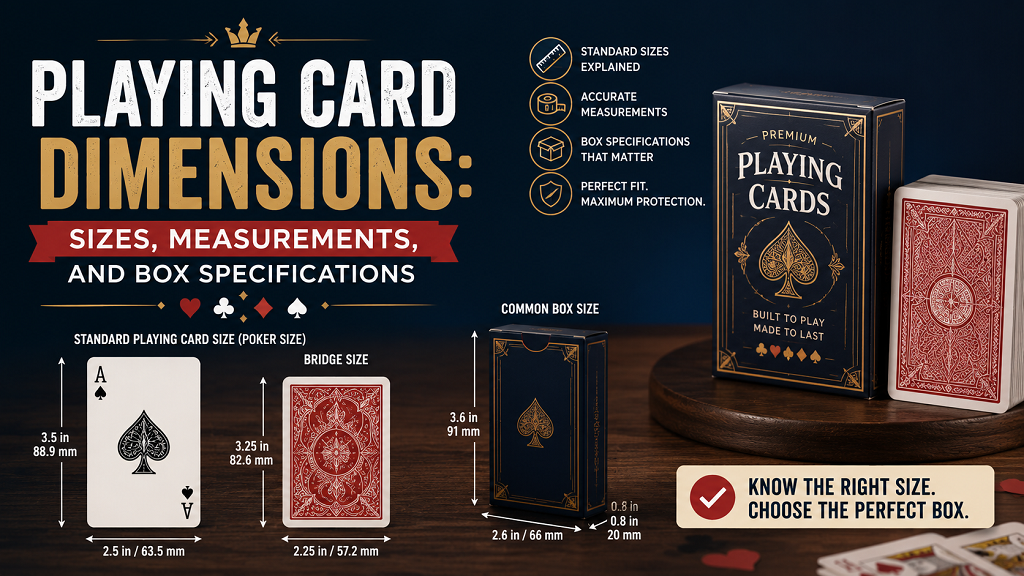
A standard playing card measures 63.5 × 88.9 mm, or 2.5 × 3.5 inches, known as the poker card size and the format you will find in decks sold almost everywhere.
If you are preparing artwork for printing then the finished card dimensions are only part of the calculation. At 300 DPI, a standard poker card measures 750 × 1050 pixels after trimming, while the complete artwork file should measure 822 × 1122 pixels once the required 3 mm bleed is included.
Most guides to the dimensions of a playing card stop after the basics, but there is much more to consider when you are designing, producing, or packaging a deck. This guide covers the major playing card formats, along with their thickness, deck depth, weight, corner radius, bleed requirements, and the box dimensions needed to hold them properly.
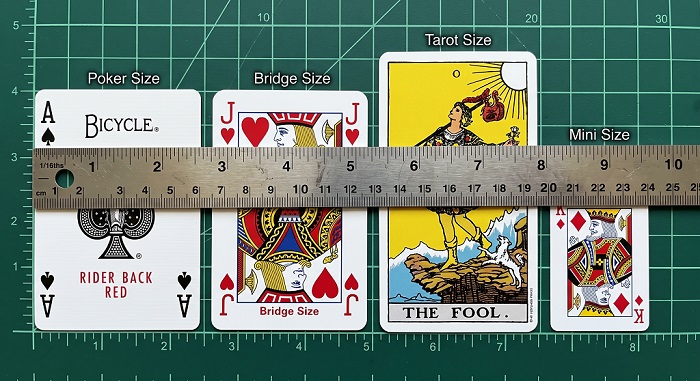
Every Playing Card Size Compared in One Table
The table below gives the finished trim size and the dimensions in inches and the artwork size required at 300 DPI. Both the trimmed figure and the figure with 3 mm bleed are included.
| Format | mm | Inches | Pixels at 300 DPI | Pixels with 3 mm bleed |
|---|---|---|---|---|
| Poker / standard | 63.5 × 88.9 | 2.50 × 3.50 | 750 × 1050 | 822 × 1122 |
| Bridge / slim | 57.15 × 88.9 | 2.25 × 3.50 | 675 × 1050 | 746 × 1122 |
| Tarot | 70 × 120 | 2.76 × 4.72 | 827 × 1417 | 898 × 1488 |
| Mini (1.75 in) | 44.45 × 63.5 | 1.75 × 2.50 | 525 × 750 | 596 × 822 |
| Mini (1.65 in) | 42 × 63.5 | 1.65 × 2.50 | 496 × 750 | 567 × 822 |
| Trading card (MTG, Pokémon) | 63 × 88 | 2.48 × 3.46 | 744 × 1039 | 815 × 1110 |
| Yu-Gi-Oh | 59 × 86 | 2.32 × 3.39 | 697 × 1016 | 768 × 1087 |
| European / continental | 61 × 97 | 2.40 × 3.82 | 720 × 1146 | 791 × 1217 |
| Trump | 62 × 100 | 2.44 × 3.94 | 732 × 1181 | 803 × 1252 |
| Double poker | 88.9 × 127 | 3.50 × 5.00 | 1050 × 1500 | 1122 × 1571 |
| Jumbo / educational | 88.9 × 146 | 3.50 × 5.75 | 1050 × 1724 | 1122 × 1795 |
| Square | 70 × 70 | 2.76 × 2.76 | 827 × 827 | 898 × 898 |
Keep this table handy. It brings the main measurements together in one place, including the pixel dimensions you need when artwork goes to print.
The Two Playing Card Sizes Used Most Often
Many playing card formats exist but two of them account for the overwhelming majority of traditional decks. Those two are poker size and bridge size.
Poker size, 63.5 × 88.9 mm. These are the standard poker playing card dimensions you will encounter most often, whether you are looking at Bicycle and Bee decks or casino cards or custom decks or party games. When someone refers to a “standard playing card size” without specifying a different format, this is the size they mean.
Bridge size, 57.15 × 88.9 mm. Bridge cards have the same height as poker cards but are 6.35 mm narrower. That difference exists for a practical reason. Bridge players hold thirteen cards at once, so reducing the width of every card makes a full hand easier to fan and manage. Across thirteen cards, that reduction adds up to approximately 82 mm of saved space.
For that reason, the choice between poker and bridge size is about how the cards will be used rather than how they look. If players hold up to about seven cards, poker size works comfortably, while games where players hold more than ten cards benefit from the narrower bridge format.
Why Trading Card Sizes Can Create Expensive Problems
The difference between a poker card and a trading card looks insignificant at first because it is only a fraction of a millimeter. It becomes expensive once sleeves and packaging are involved.
A poker card measures 63.5 × 88.9 mm, while a Magic: The Gathering or Pokémon card measures 63 × 88 mm. These are separate standards and they are not interchangeable.
That half-millimeter difference becomes important when the cards are placed inside sleeves because sleeves are manufactured around specific card sizes. A poker-size card in a sleeve cut for a different standard will not fit correctly or will sit proud of the top, which is why the intended use of the deck should be considered before production begins.
Yu-Gi-Oh cards use another standard altogether at 59 × 86 mm, which is why they require their own sleeve size.
The practical rule is simple: if you are producing a collectible or trading card game, use 63 × 88 mm. If you are producing a traditional playing card deck or a party game, 63.5 × 88.9 mm is the right choice. Specify the exact measurements rather than assuming that a printer will know which standard you mean.
Understanding the Difference Between Index Size and Card Size
Another point that causes constant confusion is the difference between the size of a card and the size of its index.
The index refers to the number and suit symbol printed in the corner of the card, while the physical dimensions of the card remain unchanged.
| Index type | What it means |
|---|---|
| Standard index | Small corner numerals with a traditional appearance |
| Jumbo index | Enlarged corner numerals that are easier to read from across a table |
| Large index | A size between standard and jumbo, sometimes called magnum |
For example, a poker card with a jumbo index is still 63.5 × 88.9 mm. The card itself has not become larger; only the printed numbers and symbols have.
The confusion begins when decks are marketed as “jumbo cards,” because some sellers use the term to describe physically oversized cards while others use it to describe a normal-size card with an enlarged index. When placing an order, the safest approach is to specify the exact millimeter dimensions rather than relying on a descriptive term.
How Thick Is a Standard Playing Card?
Playing card thickness is where the numbers get vague in most guides, so it helps to separate the measurements involved.
Playing cards are printed on card stock measured in gsm, or grams per square meter. The finished physical thickness is known as the caliper, and it is measured in millimeters or points, with one point equal to 0.0254 mm.
| Stock | Caliper | Points | Feel |
|---|---|---|---|
| 280 gsm | about 0.28 mm | 11 pt | Light and suitable for promotional decks |
| 300 gsm | about 0.30 mm | 12 pt | A common standard |
| 310 gsm | about 0.31 mm | 12 pt | Casino weight and one of the most commonly used options |
| 330 gsm | about 0.33 mm | 13 pt | Heavy, premium, and suitable for collector decks |
The most useful figure to remember is 0.31 mm per card because most decks land close to that measurement, and the deck-depth calculations throughout this guide are based on it.
At the same time, thickness is not the only factor that affects how a deck feels. A linen finish adds an embossed texture that helps cards slide across one another and resist fingerprints, while a smooth finish gives a cleaner surface for photographic artwork. Both fall within a similar caliper range even though they feel noticeably different in use.
How to Calculate the Thickness of a Complete Deck
Once you know the approximate thickness of one card, calculating the depth of a complete deck becomes straightforward. Multiply the total number of cards by 0.31 mm to estimate the finished stack depth.
| Cards in the deck | Deck depth (mm) | Deck depth (inches) |
|---|---|---|
| 18 | 5.6 | 0.22 |
| 32 | 9.9 | 0.39 |
| 52 | 16.1 | 0.63 |
| 54 (standard with jokers) | 16.7 | 0.66 |
| 60 | 18.6 | 0.73 |
| 80 | 24.8 | 0.98 |
| 100 | 31.0 | 1.22 |
| 110 | 34.1 | 1.34 |
| 200 | 62.0 | 2.44 |
Based on that calculation, the measurements of a standard 54-card deck are approximately 63.5 × 88.9 × 16.7 mm, or 2.5 × 3.5 × 0.66 inches.
You may also see a thickness of 0.75 inches listed for a standard deck. At this caliper that figure describes a deck of about 61 cards, or a 54-card deck on heavier stock with a coating. It works as a general estimate, but if you cut a box from it you will end up with a rattling deck.
That is why it is important to count every card that will go inside the box. A 52-card deck that includes two jokers and an advertising card actually contains 55 cards, and those three extra cards add nearly a millimeter to the total depth. In a tight-fitting tuck box, that small difference can determine whether the flap closes properly.
How Much Does a Standard Deck of Cards Weigh?
Deck weight is not always the first specification people consider, but it becomes useful when you are calculating postage or shipping costs for a large production run.
A poker card measures 6.35 × 8.89 cm, which equals 56.45 square centimeters, or 0.005645 square meters. Multiplying that area by the gsm of the stock gives you the approximate weight of one card.
| Stock | Per card | 54-card deck |
|---|---|---|
| 280 gsm | 1.58 g | about 85 g |
| 300 gsm | 1.69 g | about 91 g |
| 310 gsm | 1.75 g | about 94 g |
| 330 gsm | 1.86 g | about 101 g |
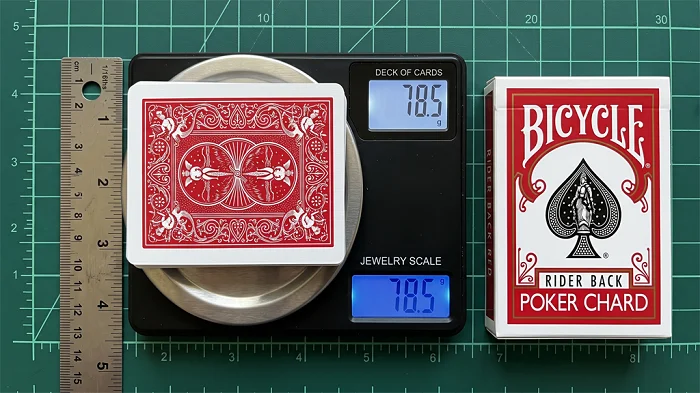
As a result, a standard deck weighs around 90 to 100 grams before the box is added. The tuck box adds 10 to 15 grams depending on the board.
That brings the weight of a boxed deck to roughly 105 grams, which becomes an important number when you are calculating shipping costs for several thousand units and the courier charges according to weight bands.
Corner Radius, Bleed, and Safe Zone Requirements
If you are designing the cards rather than simply purchasing them, these production specifications deserve as much attention as the finished card size, because they are the ones people get wrong.
| Specification | Standard |
|---|---|
| Corner radius | 1/8 inch, approximately 3 to 3.5 mm |
| Bleed | 3 mm on all four sides |
| Safe zone | 3 mm inside the trim line |
| Resolution | 300 DPI minimum |
| Color | CMYK, with any Pantones named separately |
Corner radius refers to the curve on each corner of the card. 3 mm is the industry standard, although larger formats such as tarot sometimes use a bigger radius, so it is worth confirming the requirement with your printer before production.
Bleed is the portion of the artwork that extends beyond the trim line so that small variations during cutting do not leave an unwanted white edge. A 3 mm bleed on every side means that the artwork file for a poker card should measure 69.5 × 94.9 mm, rather than the finished 63.5 × 88.9 mm card size.
Safe zone works in the opposite direction because it keeps important text and design elements away from the cutting edge. Anything you cannot afford to lose should remain at least 3 mm inside the trim line, since a small cutting tolerance makes elements placed too close to the edge look uneven.
One design detail that deserves special attention is a thin border around the card. If the cut shifts by even half a millimeter, one side of the border can appear noticeably thicker than the other. For that reason, it is safer to use a wider border of at least 5 mm or extend the artwork fully to the edge with no border.
Will Your Playing Cards Fit Standard Sleeves?
If the deck is intended to be played rather than simply displayed, there is a good chance that players will want to use sleeves. Because sleeves are manufactured for specific card standards, this should be considered during the design stage rather than treated as an afterthought.
| Sleeve type | Sleeve size | Fits cards up to | Used for |
|---|---|---|---|
| Standard / poker | 66 × 91 mm | 63.5 × 88.9 mm | Magic, Pokémon, Lorcana, and most custom decks |
| Japanese / small | 62 × 89 mm | about 59 × 86 mm | Yu-Gi-Oh and Cardfight Vanguard |
| Inner sleeve | 63 × 88 mm | Goes under an outer sleeve | Double-sleeving for protection |
A standard 66 × 91 mm sleeve accommodates both a 63.5 × 88.9 mm poker card and a 63 × 88 mm trading card, which is why those two formats coexist without creating a major sleeve problem.
The situation becomes more difficult when you choose an unusual format. A 61 × 97 mm European card does not have the same mainstream sleeve availability, and a 70 × 70 mm square card presents a similar challenge. If your game is likely to be sleeved by players, particularly if it has a collectible element, choosing a size the sleeve market already serves makes the deck easier to live with.
There is also an important packaging consideration because sleeved cards are thicker than bare cards. Custom playing card packaging should account for the additional depth if the deck is expected to remain sleeved inside the box. A standard sleeve adds roughly 0.1 mm per card, so a 54-card deck grows about 5 mm once sleeved. If the cards are expected to remain in the box while sleeved, the box should be sized around the sleeved depth rather than the bare stack.
How Different Card Finishes Affect the Feel of a Deck
Two decks can have the same dimensions and caliper while still feeling completely different in the hand, largely because of the finish applied to the cards.
Linen. This finish uses an embossed texture pressed into the surface, creating microscopic air channels between the cards. As a result, linen decks fan and shuffle more easily while also resisting fingerprints. It is commonly associated with casino-style cards and is the feel many players expect from a traditional deck.
Smooth. A smooth finish has no embossed texture. That makes it a better choice for photographic artwork because no surface pattern interrupts the image. It slides less freely than linen, although some players prefer that.
Plastic-coated. A coating goes over the card stock to improve durability and moisture resistance. It extends the usable life of the deck.
Fully plastic. These cards are not made from standard card stock and are designed for heavy, repeated use. They are washable and highly durable but considerably more expensive.
| Finish | Shuffles | Photographic artwork | Durability |
|---|---|---|---|
| Linen | Best | Good, with visible texture | Good |
| Smooth | Adequate | Best | Good |
| Plastic-coated | Good | Good | Better |
| Fully plastic | Good | Adequate | Best |
Finish can also affect the total thickness of a deck slightly. A linen deck sits a fraction taller than a smooth deck with the same card count and stock weight because the embossed surface creates small spaces between the cards. Across a full 54-card deck, that difference becomes visible, which is another reason measuring an actual stack is more reliable than relying entirely on a calculated caliper.
What Size Box Does Each Type of Card Deck Need?
Once the card dimensions and deck depth are established, the next step is determining the appropriate Custom Playing Card Boxes size.
The box needs to be slightly larger than the finished deck to allow the cards to fit comfortably, with approximately 1 mm of clearance on the width and height and around 0.5 mm on the depth.
| Deck | Card size | Deck depth | Internal box size |
|---|---|---|---|
| 54 poker cards | 63.5 × 88.9 | 16.7 mm | about 64.5 × 90 × 17.5 mm |
| 54 bridge cards | 57.15 × 88.9 | 16.7 mm | about 58 × 90 × 17.5 mm |
| 78 tarot cards | 70 × 120 | 24.2 mm | about 71 × 121 × 25 mm |
| 110 game cards, poker size | 63.5 × 88.9 | 34.1 mm | about 64.5 × 90 × 35 mm |
If the box is too tight then the tuck flap will not close properly and the cards scuff on the way out. A box with too much empty space lets the deck rattle, which reads as cheap the moment somebody picks it up.
If you are having a custom box produced, sending five sample cards is more useful than relying on a written specification sheet. Card caliper varies with the stock, coating and finish, and a linen deck sits taller than a smooth deck at the same card count. Measuring the actual stack is more reliable than calculating the dimensions from a general table.
How to Measure a Deck You Already Own
If you are reordering an existing deck or trying to match one, it is better to measure the cards directly rather than relying on an assumed standard.
- Card width and height. Use a digital caliper if you have one and a steel ruler if you do not. Measure the same card three times and use the measurement that appears consistently.
- Deck depth. Square the entire deck on a flat surface and press it lightly and measure the complete stack. Measuring one card and multiplying the result can introduce small errors that become larger across the entire deck.
- Card caliper. Measure ten cards together and divide the total thickness by ten because a single card is too thin to measure accurately with most tools.
- Corner radius. Compare the corner with a printed radius gauge, or photograph it next to a ruler and measure it on screen.
Once you have those four measurements, you will have everything a printer or box manufacturer needs to work from.
Common Playing Card Sizes Used in Different Regions
Poker and bridge sizes are widely used around the world, but they are not the only formats that exist.
European or continental cards at 61 × 97 mm are taller and narrower than standard poker cards. They are used in games such as Skat, Piquet, and several other Central European card games.
Trump cards at 62 × 100 mm are used for German and Austrian card games as well as some collectible card sets.
Square cards at 70 × 70 mm appear in modern board games and party games where the format itself is part of the overall design.
If you are producing a deck for a specific regional market, it is worth checking what players in that market already use because people replace decks with decks that feel like the ones they know.
The Most Common Problems That Occur During Production
Most playing card production problems trace back to measurements rather than to the artwork itself. The following five issues account for many of the mistakes that lead to reprints.
The box was designed for 52 cards, but the finished deck contains 55. Jokers and advertising cards get forgotten at dieline stage, and three extra cards add nearly a millimeter to the deck depth. That is enough to stop the tuck flap closing.
A thin border was placed 2 mm from the trim edge. Cutting tolerance shifts it, so one side of the border appears thicker than the other and the finished deck looks misregistered even when the original artwork was correct. A wider border of 5 mm or more, or a full-bleed design, reduces this problem.
The artwork was supplied at trim size without bleed. In that situation, the printer enlarges the artwork slightly and crops part of the design, or the finished card develops an unwanted white edge.
The deck was designed to be sleeved, but the box was not sized for sleeved cards. Sleeves add about 0.1 mm per card, so the difference across a full deck is significant.
The wrong trading card standard was selected. A deck produced at 63.5 × 88.9 mm for a game designed around 63 × 88 mm cards will not fit the sleeves players expect to use.
None of these problems are unusual, and confirming the essential measurements before production avoids all of them.
These measurements are especially important when ordering printed playing card boxes, as the finished packaging needs to accommodate the actual card count, thickness, and any sleeves used with the deck.
Your Complete Print-Ready Playing Card Checklist
Before sending your files to a printer or box manufacturer, make sure both parties receive the same measurements and specifications.
- Card trim size in millimeters, stated explicitly rather than only by name.
- Artwork size with bleed, calculated as the trim size plus 3 mm on every side.
- Total card count, including jokers, rule cards, and advertising cards.
- Card stock in gsm, along with the selected finish.
- Deck depth, measured from an actual stack whenever possible.
- Corner radius, usually 3 mm.
- Whether the deck will normally be sleeved during use.
- Artwork files supplied as vector PDF or 300 DPI CMYK, with fonts outlined and Pantones named.
The total card count is the specification that gets left out, and it decides whether the finished box closes.
Frequently Asked Questions About Playing Card Dimensions
Which Playing Card Size Should I Choose for My Game?
The right size depends largely on how many cards players will need to hold at one time. For hands containing up to about seven cards, poker size at 63.5 × 88.9 mm works comfortably. When players regularly hold more than ten cards, the narrower bridge size of 57.15 × 88.9 mm is easier to fan. If the deck is collectible and likely to be sleeved, the 63 × 88 mm trading card standard is more practical because it fits the sleeves people already use. If the artwork itself is the main focus, such as with tarot or an art deck, a larger format such as 70 × 120 mm suits it better.
What Are the Dimensions of a Standard Playing Card?
A standard playing card measures 63.5 × 88.9 mm, or 2.5 × 3.5 inches. This is the standard poker size and is widely used around the world. At 300 DPI, the trimmed artwork measures 750 × 1050 pixels, while the file measures 822 × 1122 pixels when 3 mm of bleed is included.
How Big Are Playing Cards Compared to Each Other?
Poker cards measure 63.5 × 88.9 mm, while bridge cards measure 57.15 × 88.9 mm, making bridge cards 6.35 mm narrower at the same height. Tarot cards are considerably larger at 70 × 120 mm, while mini cards are around 44 × 63.5 mm. Trading cards sit slightly below poker size at 63 × 88 mm.
What Is the Standard Poker Card Size in Inches?
The standard poker card size is 2.5 × 3.5 inches, which is exactly equivalent to 63.5 × 88.9 mm rather than simply being a rounded approximation.
What Are the Measurements of a Deck of Cards?
A 54-card deck printed on 310 gsm stock measures approximately 63.5 × 88.9 × 16.7 mm, or 2.5 × 3.5 × 0.66 inches. For a different card count, you can estimate the deck depth by multiplying the total number of cards by 0.31 mm.
Are All Playing Cards the Same Size?
No. Poker and bridge are the two most common traditional formats, but they differ in width. Trading card games, tarot decks, and regional European decks also use their own dimensions, and sleeves are manufactured for specific sizes rather than one universal standard.
How Thick Is a Standard Playing Card?
A playing card printed on 310 gsm stock is approximately 0.31 mm thick, or roughly 12 points. Lighter promotional decks run around 0.28 mm and heavy premium decks reach 0.33 mm.
What Size Should My Playing Card Artwork File Be?
The artwork should include 3 mm of bleed on every side of the finished trim size. For a standard poker card, that produces an artwork file measuring 69.5 × 94.9 mm, or 822 × 1122 pixels at 300 DPI. Important text and design elements should remain at least 3 mm inside the trim line.
What Is the Difference Between Jumbo Index and Jumbo Card Size?
A jumbo index refers to enlarged numbers and suit symbols printed on a standard 63.5 × 88.9 mm card. A jumbo-size card, on the other hand, is physically larger. Because sellers use the word “jumbo” for either feature, confirming the exact dimensions in millimeters is the safest approach.
How Much Does a Standard Deck of Cards Weigh?
A 54-card poker deck weighs around 90 to 100 grams depending on the stock. A tuck box adds another 10 to 15 grams, bringing the finished boxed deck to approximately 105 grams.
Playing Cards Sizes at a Glance
For a quick comparison, the table below summarizes each size of playing cards covered above, arranged from smallest to largest by area.
| Rank | Format | mm |
|---|---|---|
| 1 | Mini | 42 to 44.45 × 63.5 |
| 2 | Yu-Gi-Oh | 59 × 86 |
| 3 | Trading card | 63 × 88 |
| 4 | Bridge | 57.15 × 88.9 |
| 5 | Poker | 63.5 × 88.9 |
| 6 | European | 61 × 97 |
| 7 | Trump | 62 × 100 |
| 8 | Square | 70 × 70 |
| 9 | Tarot | 70 × 120 |
| 10 | Double poker | 88.9 × 127 |
| 11 | Jumbo | 88.9 × 146 |
The trading card, bridge, and poker formats are particularly close to one another, which is why they get confused. Even though the differences are only a few millimeters, stating the exact dimensions rather than relying on the format name can prevent many ordering and production mistakes.
The Four Most Important Playing Card Measurements to Remember
If you only remember four numbers from this guide, these are the ones that matter most.
63.5 × 88.9 mm is the standard poker card size, unless you are producing a trading card game, in which case the standard is 63 × 88 mm.
0.31 mm is the approximate thickness of one standard card, which you can multiply by your total card count to estimate the depth of the deck.
3 mm is the standard bleed and safe-zone margin used throughout this guide, while the corner radius is also commonly around the same measurement.
822 × 1122 pixels is the artwork size at 300 DPI for a standard poker card with 3 mm of bleed.
Once those four measurements are correct, everything that follows becomes much easier to calculate and coordinate. That covers preparing the artwork, printing the cards and producing the box around the finished deck.
