








Why Does Card Stock Thickness Decide the Box?
A tuck box has three internal dimensions and only two of them are easy to find. Width and height come from the card format and both are published numbers you can look up. Depth comes from the card count multiplied by the caliper of one card, and caliper is the one number that almost nobody in the trade publishes.
Card printers quote stock in grams per square meter and they rarely quote it in millimeters at all. Two stocks at the same 300 gsm can measure differently because the core inside them is different. So gsm on its own never gives you a depth you can cut a die against.
| Stock type | Typical range | What the core does | Where it is used |
|---|---|---|---|
| Art paper, no core | 300 to 400 gsm | No hidden layer, least opaque | Promotional decks and low cost runs |
| Blue core | 280 to 330 gsm | Good opacity at lower cost | The mainstream choice for board and card games |
| Black core | 300 to 350 gsm | Blocks light so the face cannot be read from the back | Poker, tournament play, magic and cardistry |
| PVC plastic | 0.30 to 0.35 mm | Not paper, waterproof and far more durable | Casino, pool and outdoor use |
The core is a hidden layer laminated between the two printed faces and its whole job is opacity. Black core is the standard anywhere that show through would matter during play. Blue core is where most game decks sit because it balances opacity against cost.
How Deep Is Your Deck?
Published caliper for cored playing card stock runs roughly 0.31 to 0.40 mm depending on the core and the finish. That spread sounds small until you multiply it by the number of cards in a real deck.
| Cards in the deck | Deck depth at 0.31 mm | Deck depth at 0.40 mm | Spread |
|---|---|---|---|
| 18 cards | about 5.6 mm | about 7.2 mm | 1.6 mm |
| 54 cards | about 16.7 mm | about 21.6 mm | 4.9 mm |
| 80 cards | about 24.8 mm | about 32.0 mm | 7.2 mm |
| 110 cards | about 34.1 mm | about 44.0 mm | 9.9 mm |
| 200 cards | about 62.0 mm | about 80.0 mm | 18.0 mm |
Read the right hand column rather than either of the two beside it. At 54 cards the two stocks differ by nearly 5 mm, which is the difference between a box that closes and one that bulges. At 200 cards they differ by 18 mm and that is simply not the same box at all.
So we do not calculate your depth from a formula and neither should your printer. Send us five loose cards off the actual press run and we measure the stack. Then we add roughly 1 mm of clearance so the deck slides out rather than jams.
Count every single card that ends up inside the finished box before you send us a number. A deck sold as 52 cards usually ships as 52 plus two jokers plus a rules or advertising card, which makes 55. Three extra cards add about a millimeter and a millimeter is exactly what a tuck flap does not have spare.
What Card Format Are You Printing?
Format is what sets both the internal width and the internal height of the box. These four formats between them cover almost everything we cut in this category.
| Format | Card size | Internal box size | Typically used for |
|---|---|---|---|
| Poker | 63.5 x 88.9 mm | about 64.5 x 90 mm | Standard decks, magic and casino games |
| Bridge | 57 x 88.9 mm | about 58 x 90 mm | Bridge and games dealt to larger hands |
| Tarot | 70 x 120 mm | about 71 x 121 mm | Tarot and oracle decks |
| Mini | 44 x 63 mm | about 45 x 64 mm | Promotional and novelty decks |
Poker is 2.5 by 3.5 inches and bridge is 2.25 by 3.5 inches, so the two share a height and differ only across the face. Allow about 1 mm of clearance on the width and the same again on the height.
Rounded corners and coatings and press tolerances all move the finished card slightly. The figures in that table are where we start a dieline rather than where we finish it.
Which Tuck Box Style Do You Need?
| Style | How it works | Best for |
|---|---|---|
| Straight tuck end | Both flaps fold the same way | Retail decks where the front panel has to stay clean |
| Reverse tuck end | Flaps fold in opposite directions | Lower cost runs, because the shape nests tighter on the press sheet |
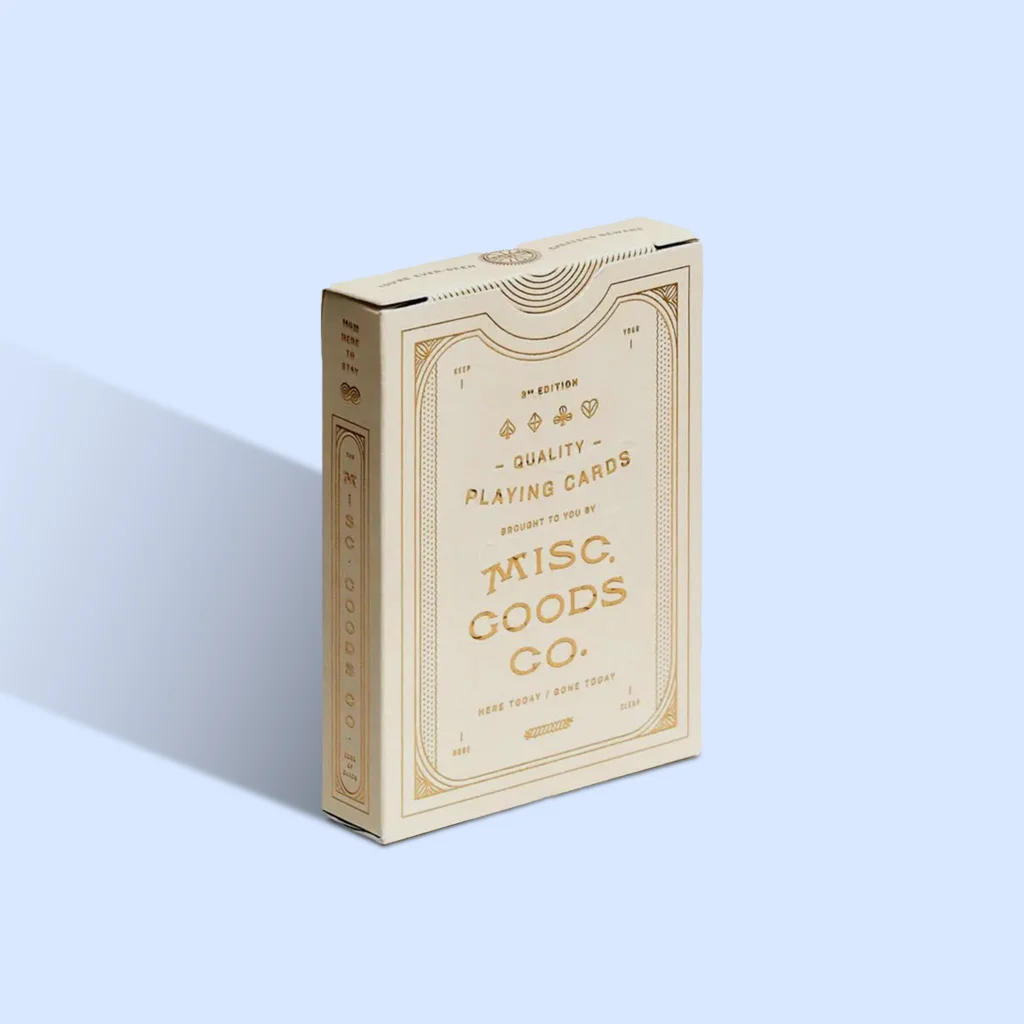
| Tuck with a thumb notch | A half moon cut in the panel | Decks that get opened daily |
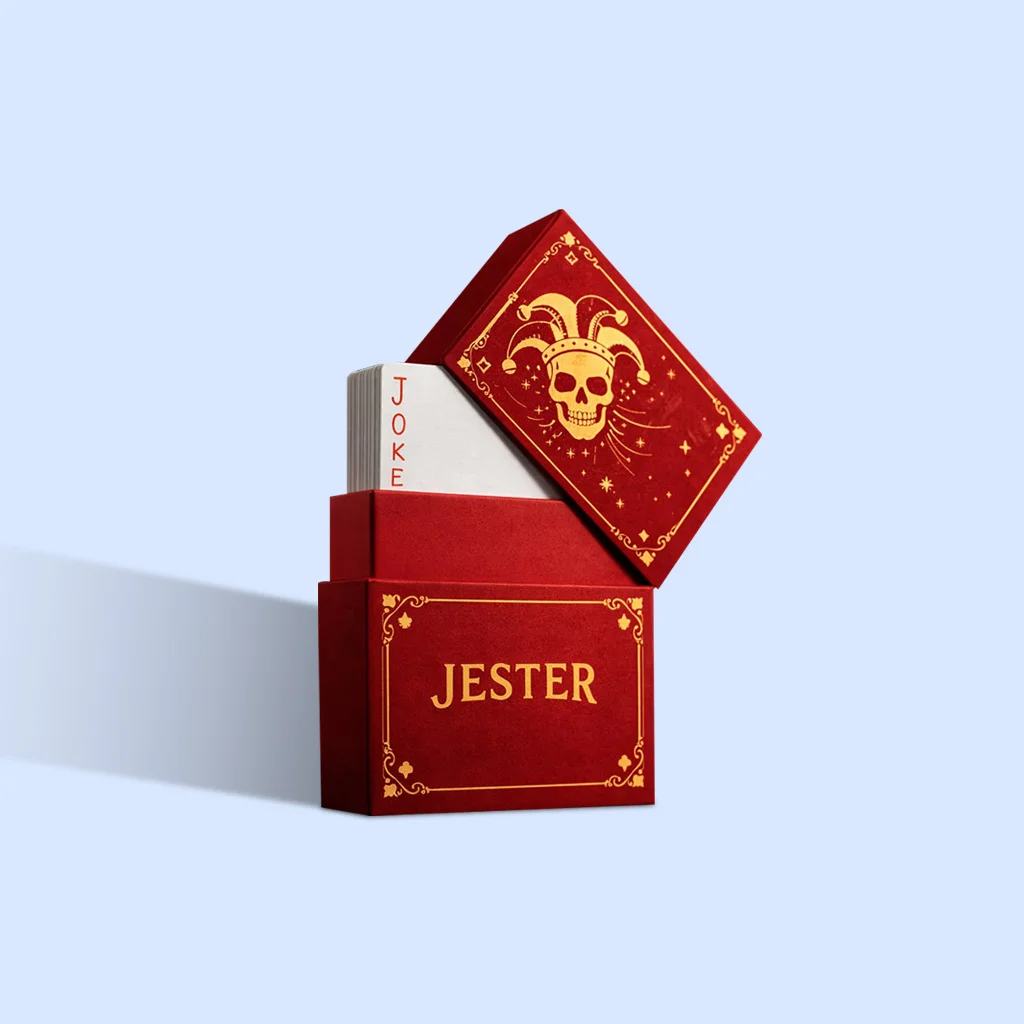
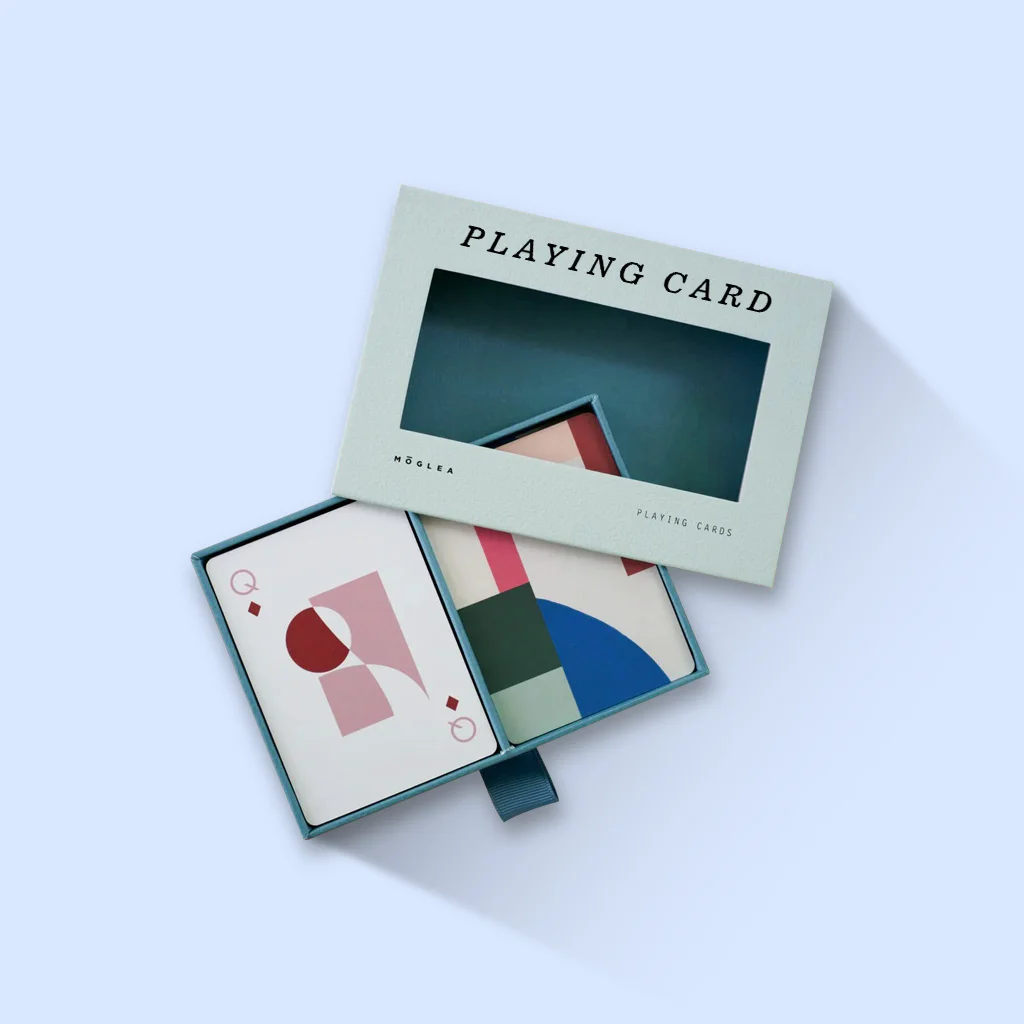
| Two piece box | A separate lid lifts off a base | Collector editions and gift sets |
| Rigid box with a magnetic flap | A magnet holds the lid shut | Limited editions and high end releases |
Straight tuck and reverse tuck cost differently for one purely structural reason on the press. A reverse tuck nests more tightly when the dielines are stepped across the press sheet so you get more boxes from one sheet. On a short run the saving is small and on a long run it is worth asking about.
The thumb notch earns its place on any deck that actually gets used regularly. Without one the customer tips the box and shakes it until the flap wears out at the crease. The notch is a cut in the die rather than an added part so it costs nothing extra once the die exists.
If you want the same construction without the card specific dieline, our custom tuck boxes page covers the general format.
Does Your Deck Count as a Children’s Product?
This is the question that catches game publishers and it has nothing to do with packaging design.
A product designed or primarily intended for children under 12 is a children’s product under United States law. A card game aimed at that age group counts as one of them, while a standard poker deck sold to adults does not.
If your deck is a children’s product then the tracking label requirement applies. It comes from section 14(a)(5) of the Consumer Product Safety Act and was added by the Consumer Product Safety Improvement Act of 2008. The label itself has to carry four separate pieces of information about the run.
- The name of the manufacturer or private labeler so the responsible party can be identified
- The location and date of production rather than a general year
- Batch or run number or another detail that pins down the specific production
- Anything else needed to determine the source of that particular unit
The label generally has to appear on the product and on the packaging both. Where marking the product is impractical, the packaging still has to carry it. On a card game the tuck box is usually the only surface that can, which makes this a panel space decision rather than a compliance afterthought.
None of that is legal advice and your own compliance adviser should confirm your position. What all of it means for the box is simple enough to plan around. Design that space in before the die is cut rather than finding room for it afterward.
Which Board and Finish Suits a Tuck Box?
A playing card box runs on folding carton board rather than corrugated, because a deck needs a smooth print surface and a score line that folds crisply. Our custom folding cartons page covers the same board running across a range of other products.
| Board | Caliper | Where it fits |
|---|---|---|
| 300 GSM coated | 0.30 to 0.38 mm | Mini decks and light card counts |
| 350 GSM coated | 0.35 to 0.46 mm | The working weight for most tuck boxes |
| 400 GSM coated | 0.42 to 0.55 mm | Deep decks above about 60 mm and tarot |
Note that 300 gsm board and 300 gsm card stock are not the same thickness. Card stock is calendered harder and runs thinner at the same weight, which is why the two numbers on this page do not match. Ask any supplier for the caliper rather than the gsm whenever the fit is what matters.
Board weight matters a great deal more as the deck gets deeper. A 350 gsm tuck box holding 55 cards keeps its shape indefinitely. The same board holding 200 cards bows at the long panel because that panel is unsupported across its length.
What Prints Well on a Playing Card Box?
Offset litho is the volume route and it is where both color consistency and unit cost come from. Digital printing skips the plates entirely which makes short runs and prototypes workable. It also handles artwork that changes from one box to the next.
- Gloss or matte lamination sets the surface feel and protects the print from handling
- Spot UV lifts a logo or a back pattern against the surrounding finish
- Foil stamping in gold, silver, copper or holographic reads as premium on a dark ground
- Embossing or debossing gives a raised or recessed logo that survives a shelf
- Cellophane wrap with a tear strip keeps the deck sealed for retail sale
Pick one or two of those finishes rather than all five of them. A tuck box is a small surface and finishes compete with each other on it.
Keep artwork clear of the tuck flaps and the glue seam. Those areas fold or overlap or disappear when the box is assembled. A logo placed across a seam ends up cut in half. Send vector PDF or AI on our dieline with 3 mm bleed, fonts outlined and Pantone numbers named.
What Should You Send Us Before We Quote?
| What you send us | What we build from it |
|---|---|
| Five loose cards from the real press run | The measured caliper and the internal depth |
| The exact card count including jokers and rules cards | Depth again, this time against the final deck |
| The card format | Internal width and height |
| Whether the deck is aimed at children under 12 | Whether a tracking label needs panel space |
| Whether it sells at retail or ships direct | Cellophane wrap, thumb notch and board weight |
| Your annual volume across all decks | Board grade, print route and price breaks |
Five actual cards beat a printed spec sheet every single time. A printer quoting you 310 gsm has not told you the caliper and the caliper is what sets the box.
Minimum Order, Lead Time, and Samples
- Minimum order: 100 boxes per size because each size needs its own cutting die
- Plain structural sample: 3 to 5 business days from your card dimensions
- Printed pre production sample: 7 to 10 business days from approved artwork
- Production: 8 to 10 business days after you approve the dieline
- Price breaks: at 500 units and again at 1,000 units on the same artwork
- Setup and tooling: no charge on the first order or on any reorder after it
- Artwork: vector PDF or AI on our dieline with 3 mm bleed and fonts outlined
- Shipping: free across the United States
Lock the card count down before the die is cut. We do not charge for tooling at any stage. A deck that grows from 54 cards to 66 after approval is a different box with a different depth. That means a new dieline and a new production slot rather than a change to the existing one.
Request a Quote
Send us five loose cards from the real press run, the exact card count including jokers and inserts, your card format and your artwork. We will measure the stack, build a dieline against it and come back with a board specification, a 3D mock up and a unit price. You can also start on our quote page if you already have measured cards.
 The Customized Boxes