





Aqueous coating is the clear finish on most of the printed cartons you pick up in a store. Printers call it AQ coating and lay it down in the same pass as the ink to protect the print from scuffs and fingerprints.
This guide explains what aqueous coating is made of and how a press applies it. It covers the finishes you can order and how AQ compares with UV coating and varnish and lamination. It also answers the questions buyers ask before they approve a proof, from writing on the coating to recycling the box.
Key takeaways
- Aqueous coating is a clear water based polymer coating that a press lays over wet ink so the sheet dries fast and resists scuffs.
- It comes in gloss, satin, matte and soft touch and even gloss reads well below UV coating on a gloss meter.
- AQ is the lowest cost coating along with machine varnish, while UV costs more and film lamination costs the most.
- Aqueous coating is water resistant but not waterproof and most laser toner and water based inkjet do not hold on it.
- Food contact depends on each component of the coating having FDA status for paper and paperboard, such as 21 CFR 176.170.
What Is Aqueous Coating?
Aqueous coating is a clear protective coating made with water as its carrier rather than a solvent. The word aqueous simply means water based and AQ coating is the short form you will see on a print quote. A press applies it over the printed sheet while the ink is still wet and then hot air drives the water out.
What stays behind is a thin plastic film that seals the ink and gives the sheet its final look. That film is why an aqueous coated box feels smooth and why the colors on it look a little richer than on the bare sheet. It also stops ink rubbing off onto the next sheet in the delivery pile.
Brands that order custom packaging boxes meet aqueous coating on almost every folding carton quote without always noticing it. It is the default finish for a good reason and that reason starts with what the coating is made of.
What Is Aqueous Coating Made Of?
An aqueous coating is a water based dispersion of polymer resin with a few additives that control how it flows and how it feels once dry. FUJIFILM lists the main parts in its published coating guide as a resin and a wax or silicone with surfactants and small amounts of other additives.
| Component | What it does |
|---|---|
| Polymer resin | Forms the clear film and decides gloss and hardness, usually styrenated acrylic, acrylic or polyester |
| Wax or silicone | Adds slip and rub resistance so sheets and cartons slide without scuffing |
| Surfactants | Help the coating flow out evenly and wet the ink film |
| Water and ammonia | Carry the resin onto the sheet and leave during drying |
| Additives | Small amounts of defoamer, solvent or optical brightener for press behavior |
The resin decides the gloss and the hardness of the film. The wax decides how slippery the surface feels and how well it resists rubbing in a shipping carton. Changing that balance is how a supplier turns the same base into a high gloss or a satin or a matte coating.
The coating dries by losing its water and a little ammonia, which leaves the resin to form the film. That drying step happens on the press itself, which raises the question of how the coating gets onto the sheet.
How Is Aqueous Coating Applied on a Press?
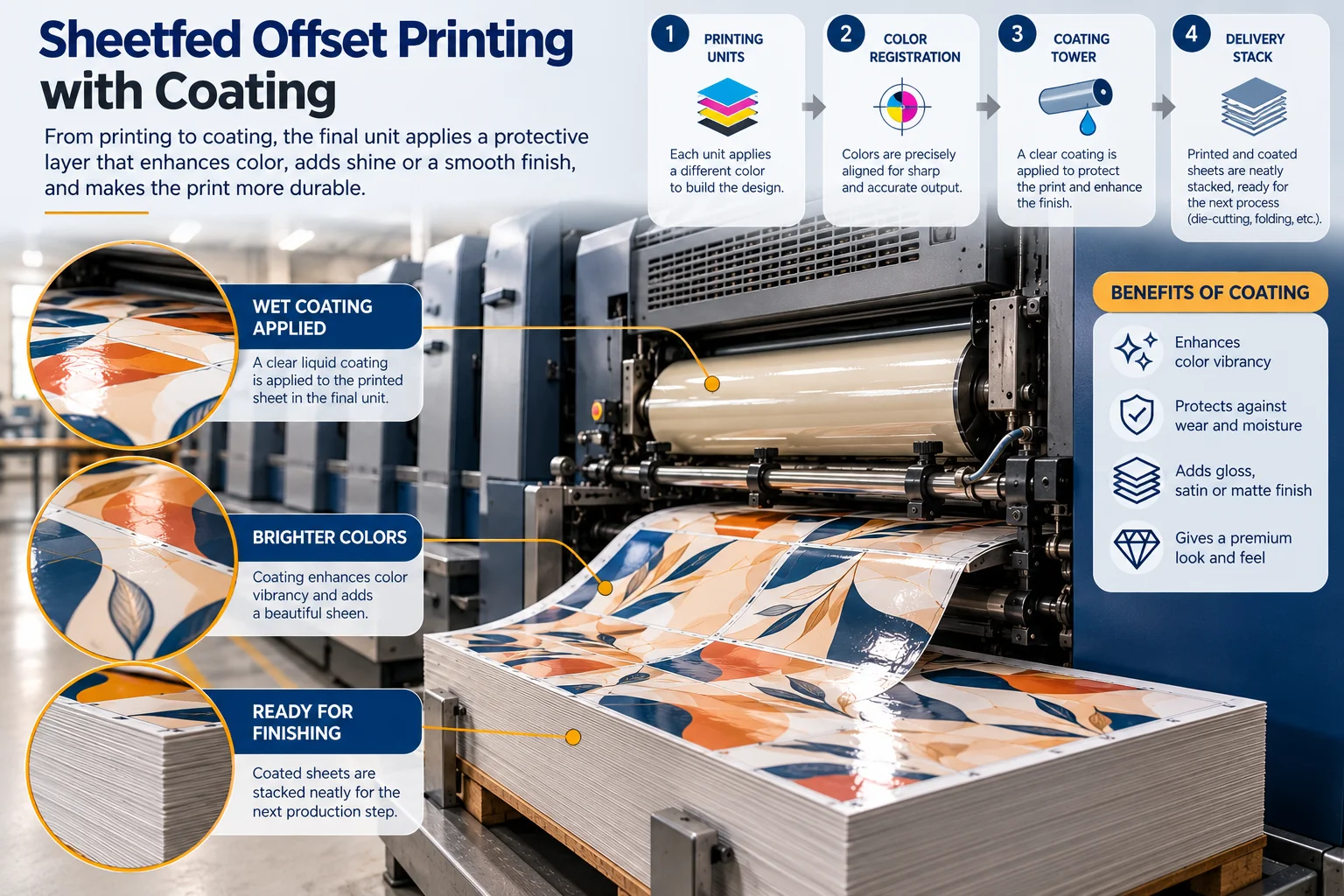
Most aqueous coating goes on inline, which means the press prints and coats the sheet in one pass. A sheetfed offset press usually carries a dedicated coating tower after the last ink unit. FUJIFILM calls the tower coater the industry standard because no printing unit is lost to the coating.
| Method | Where it sits | What to know |
|---|---|---|
| Tower coater | Its own unit after the last ink unit | Industry standard on sheetfed presses, no printing unit lost |
| Coater dampener | The last printing unit | Coating replaces fountain solution, costs one color unit |
| Blanket coater | The last printing unit | Rollers transfer coating to the blanket, allows a cut blanket for spots |
| Offline coater | A separate machine after printing | Used after digital printing or when the press has no coater |
Hot air knives and infrared dryers in the delivery remove the water before the sheets stack. The ink and coating keep hardening after that and the same guide puts full hardness and rub resistance at 24 to 48 hours. That is why printers let coated sheets rest before they die cut and fold them.
Digital presses can take aqueous coating too through an inline coating unit or on an offline coater after printing. The method you get depends on the press that runs your job and it also decides whether only part of the sheet can be coated.
Can You Spot Coat With Aqueous Coating?
You can spot coat with aqueous coating, but only when the press carries a plate or a cut blanket for the coating. A flood coat from a tower covers the whole sheet and needs no plate. A spot coat needs an image carrier that lays coating only where the artwork asks for it.
Most printers still leave spot effects to UV coating because a spot of AQ gives a soft contrast that buyers often miss. A gloss UV spot over a matte AQ flood is the common build when a logo has to shine against a quiet background. Foil stamping is the other route when the spot has to look metallic.
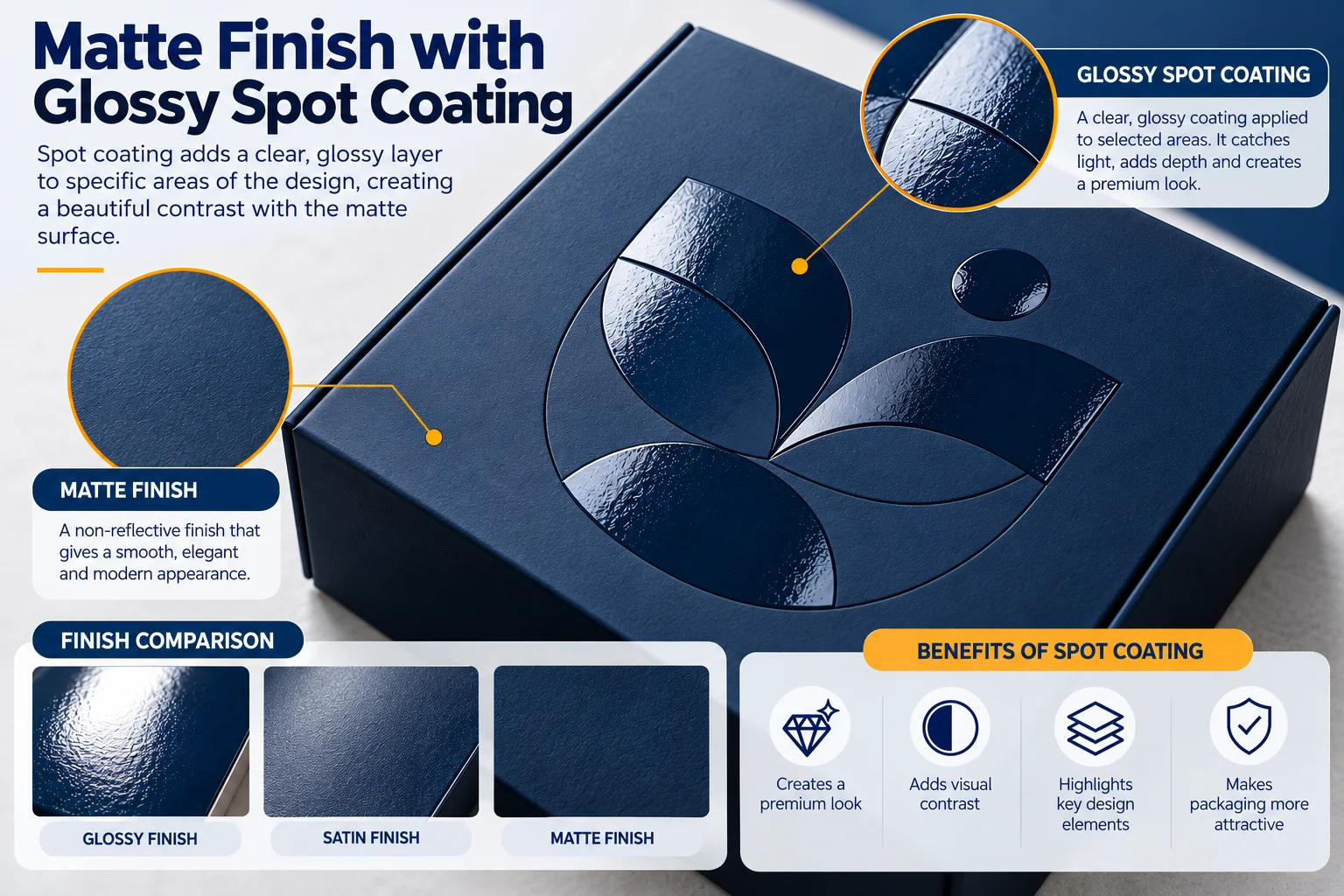
A spot AQ means one extra plate in the setup and a softer effect than most buyers picture. For most boxes the more useful choice is which finish the flood coat should have.
What Finishes Does Aqueous Coating Come In?
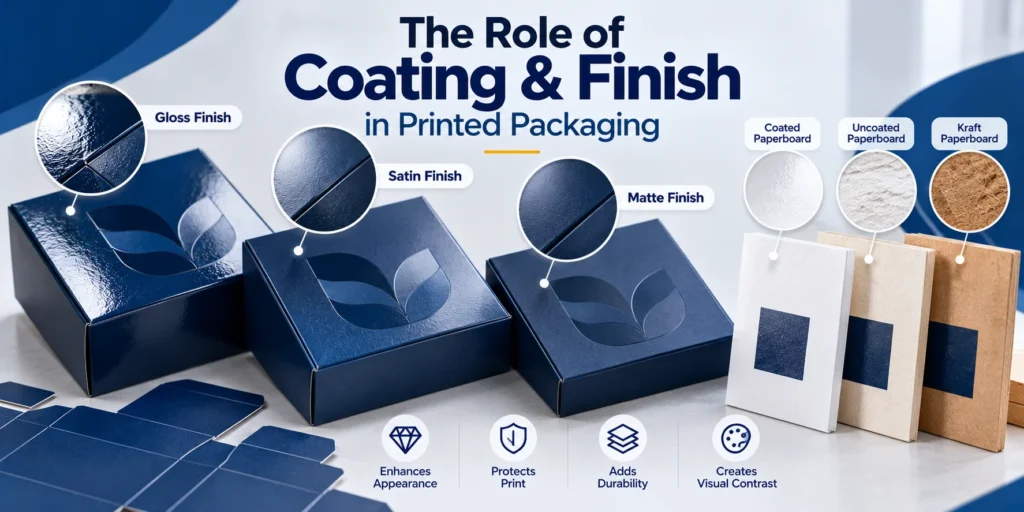
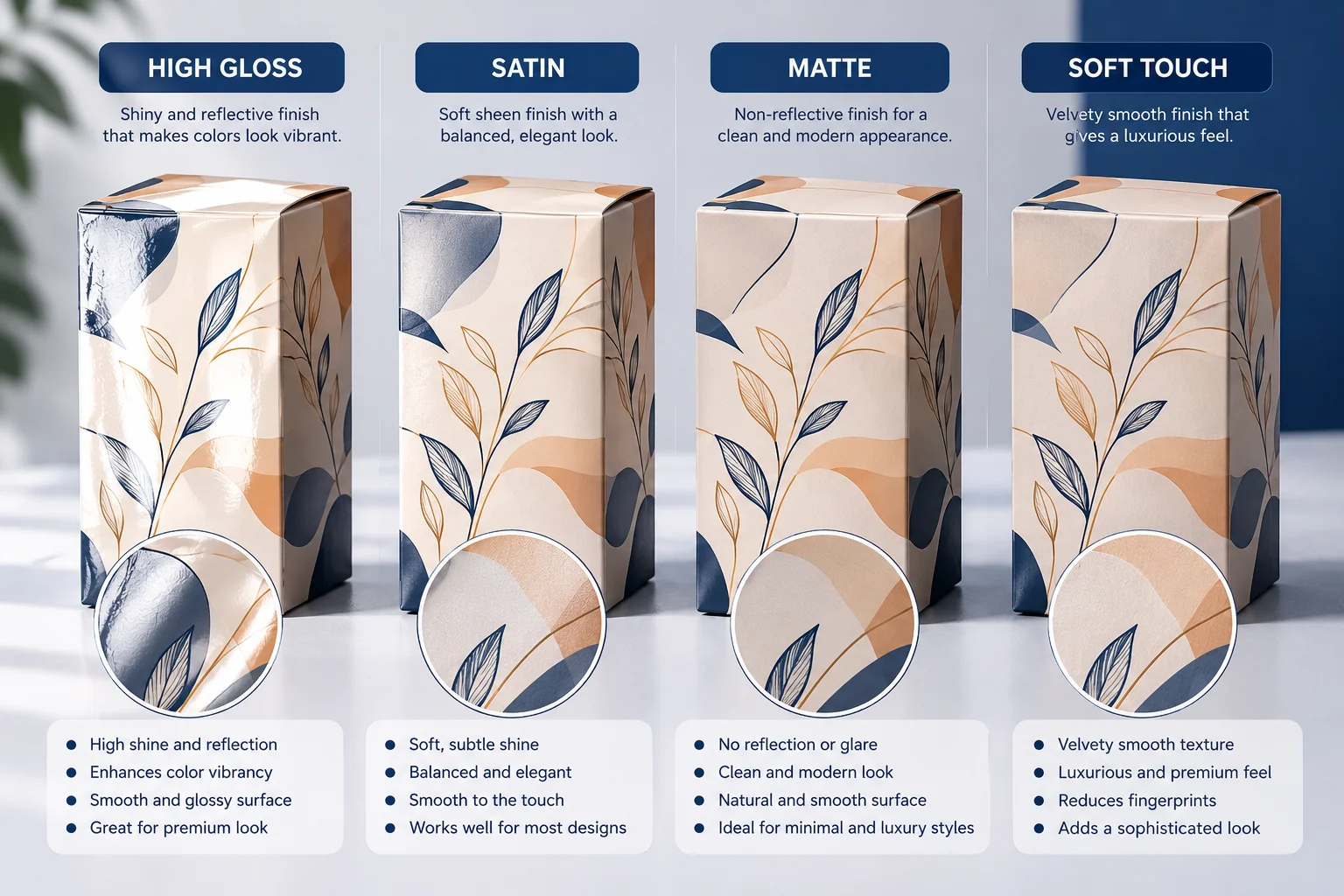
Aqueous coating comes in gloss, satin and matte finishes plus soft touch and a few working grades for special jobs. Gloss is the default on most cartons. Satin aqueous coating sits between gloss and matte and keeps colors bright without a strong reflection.
Matte AQ coating gives a flat look that suits premium cosmetics and food brands. Soft touch adds a velvet feel that buyers notice the moment they pick up the box. FUJIFILM also lists anti skid grades for stacking and primer grades that prepare the sheet for UV coating on top.
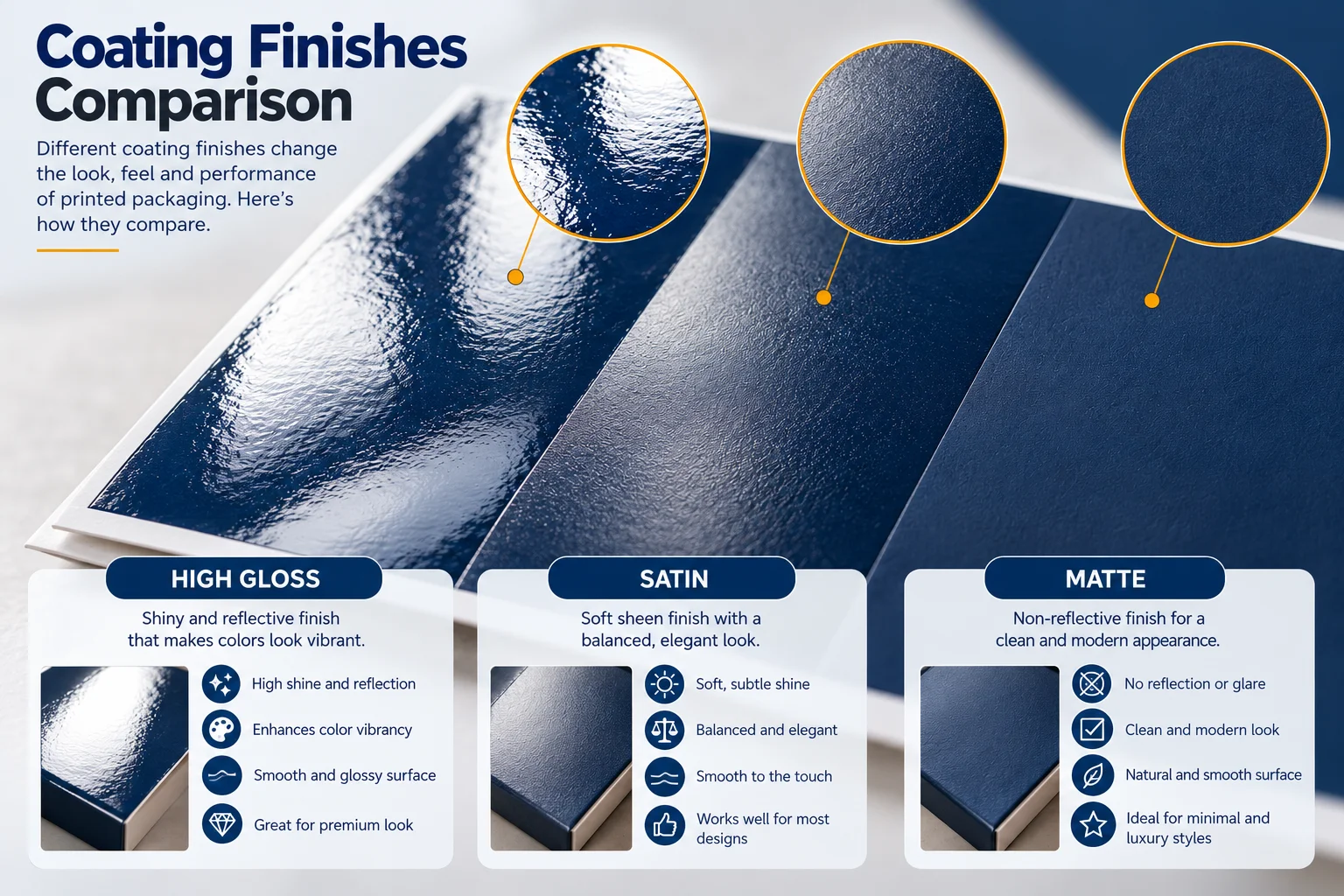
| Finish | Look on the sheet | Gloss reading at 60 degrees | Best use |
|---|---|---|---|
| Gloss AQ | Bright and reflective | About 60 to 80 on coated text paper | Everyday cartons and photo heavy artwork |
| Satin AQ | Soft sheen | Between gloss and matte | Cosmetics and premium retail |
| Matte AQ | Flat with no glare | About 10 to 30 | Readable text and a quiet premium look |
| Soft touch AQ | Flat with a velvet feel | Low | Gift and luxury boxes |
| UV coating, for comparison | Mirror shine | 90 and above | Spots and maximum gloss |
The gloss figures in that table come from a 60 degree gloss meter, which is the instrument printers use to measure shine. Even a high gloss aqueous coating stays well below UV coating, so a buyer who wants mirror shine has to look past AQ. Soft touch is the finish that causes the most surprises after delivery.
What Goes Wrong With Soft Touch Aqueous Coating?
Soft touch aqueous coating marks more easily than gloss or satin and the marks show more because the surface is so even. A fingernail or a rough shipping carton can leave a shiny line that does not rub out. Oily fingers leave prints that stand out against the flat finish.
Soft touch also makes gluing and foil stamping harder, because the same surface that feels soft resists the adhesive and the foil. Tell us early if the box needs a glued side seam or a foil logo so the glue flap and the foil area can stay uncoated.
The fix for most soft touch problems is protection in transit rather than a different coating. A sleeve or a shipping carton with dividers keeps soft touch boxes from rubbing together on the way to you. When the box has to survive rough handling, the comparison with UV coating becomes the real decision.
Choosing a finish for your next box?
Tell us the box style, the quantity and what the box will face. We return a dieline, a finish recommendation and a price within the week.
Aqueous Coating vs UV Coating: Which Should You Choose?
In the aqueous coating vs UV coating choice, pick AQ for everyday cartons and UV when the box needs maximum gloss or a spot effect. UV coating is a liquid that cures in a fraction of a second under ultraviolet lamps instead of drying with air. It goes on thicker and harder, which is where its extra shine comes from.
| Point | Aqueous coating | UV coating |
|---|---|---|
| How it sets | Dries as the water leaves with hot air | Cures under ultraviolet lamps |
| Gloss | Medium to high | Highest of any print coating |
| Protection | Good against scuffs and fingerprints | Harder surface with more scratch resistance |
| Folding | Flexible on score lines | Can crack on folds unless kept off the score |
| Spot coating | Possible but subtle | Common and sharp |
| Cost | Lowest along with machine varnish | Higher, needs its own coater and lamps |
| Writing on it | Matte and satin take a pen | Hard to write on |
UV coating can crack along a fold because the cured film is harder and less flexible than AQ. Printers handle that by keeping UV off the score lines, which takes a little planning on the dieline. Aqueous coating bends with the board and rarely needs that step.
Both finishes go into the paper stream on a printed carton. UV boxes are sometimes mistaken for laminated board at a sorting line because of their shine. That is one more reason most brands keep UV for spots. Varnish and lamination complete the comparison.
Aqueous Coating vs Varnish vs Lamination: What Is the Difference?
A varnish is an oil based coating printed from an ink unit, while lamination is a plastic film glued over the whole sheet. Aqueous coating sits between them with more protection than varnish and far less than a film. The table puts the four finishes side by side.
| Finish | What it is | Protection | Relative cost |
|---|---|---|---|
| Machine varnish | Oil based coating printed from an ink unit | Light | Lowest |
| Aqueous coating | Water based polymer coating, usually from a tower | Good | Lowest |
| UV coating | Liquid cured instantly by ultraviolet light | Very good | Medium |
| Film lamination | Plastic film glued over the sheet | Best | Highest |
Aqueous coating and machine varnish are the two lowest cost options because both go on inline at full press speed. UV costs more because it needs its own coater and lamps. Film lamination costs the most because it is a second process on a separate machine with a film that has to be bought.
Lamination earns its price on rigid boxes and on cartons that face real wear because nothing else stops scuffs and tears as well. It also has to be separated from the fiber when the board is recycled. The other half of the decision is the paper or board under the coating.
Which Papers and Boards Work With Aqueous Coating?
Aqueous coating works best on coated paper and coated board and gloss coated stock is the most common match. The coating maker Magnum Inks puts gloss and matte and silk coated papers at the top of its compatibility list. Coated recycled board accepts AQ too with slight changes in texture or color.
| Stock | How AQ performs | Our view |
|---|---|---|
| Gloss coated paper and board | Holds on the surface with an even film | Best match for gloss AQ |
| Matte and silk coated stock | Even film with a softer sheen | Good match for satin and matte AQ |
| Coated recycled board | Accepts AQ with slight texture or color shifts | Fine for most cartons |
| Uncoated paper | Soaks in unevenly and looks closer to matte | Little gain from coating |
| Kraft board | Absorbs coating, adds protection without shine | Use it for scuff protection only |
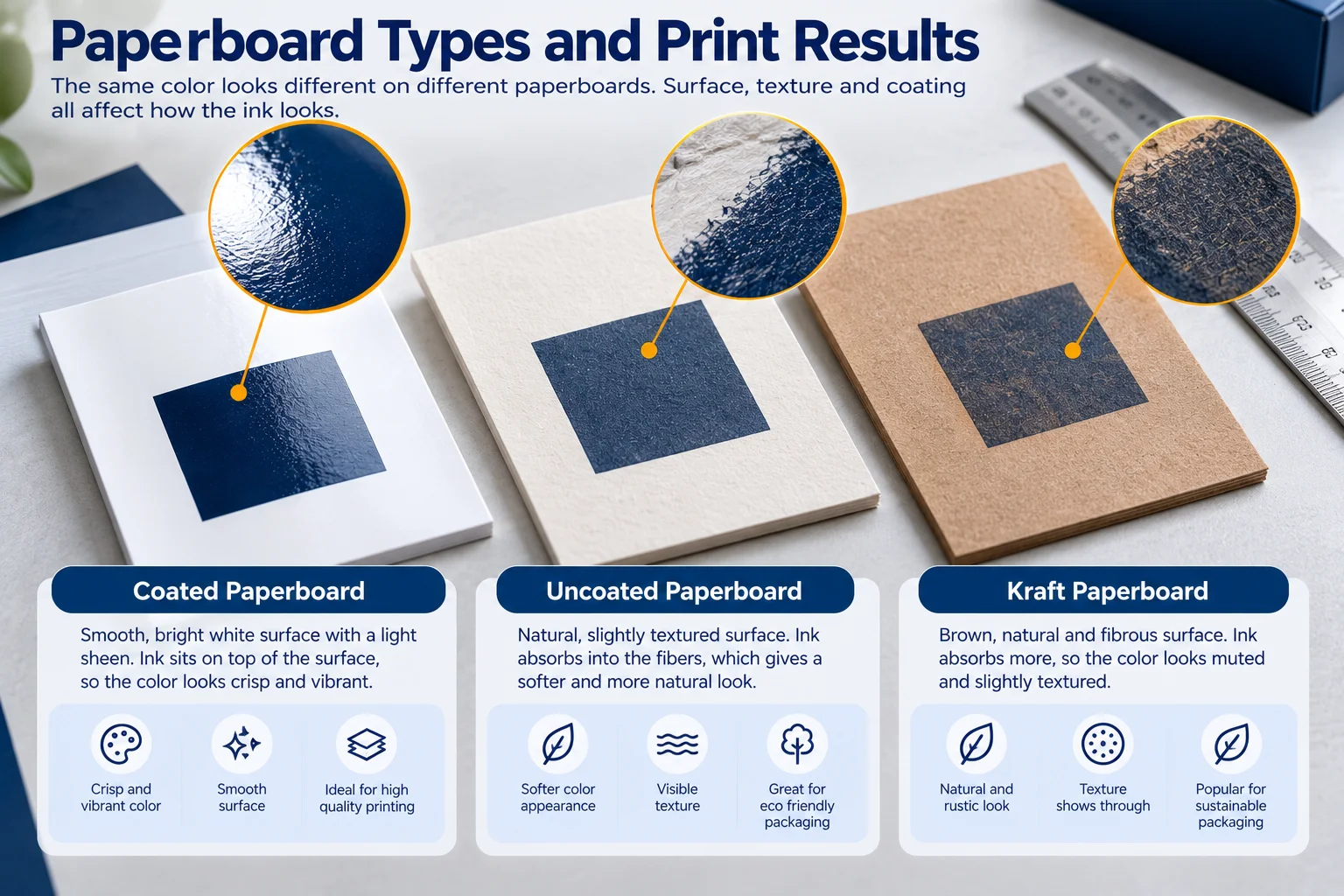
Uncoated paper is the hard case, because it soaks the coating into its fibers instead of holding it on top. The result is uneven and closer to matte and it gives much less protection. A buyer who asks for gloss AQ on uncoated paper will not see gloss.
Kraft board sits in the same group because AQ on kraft boxes protects the print without adding much shine. Business cards are the other common place where the stock decides the result.
What Is Aqueous Coating on Business Cards?
Aqueous coating on business cards is the same clear water based film applied to a heavy coated card stock so the card resists scuffs in a wallet. A 16 point coated card with a satin or matte AQ finish is a common build in commercial printing.
Gloss AQ makes photos on a card look sharp and bright but it also makes the card hard to write on. Matte and satin AQ take a pen far better, which matters when a sales team adds notes by hand. A 100 lb gloss cover with aqueous coating is the usual choice for postcards and inserts that travel inside a box.
The same writing question comes up on packaging from shipping labels to the signature on a gift box. That is the next question buyers ask.
Can You Write, Sign or Print Over Aqueous Coating?
You can write on matte and satin aqueous coating with a ballpoint pen and sign it with a permanent marker. Gloss AQ is harder, because the slick film makes ink bead up and smear before it dries.
| Tool | Gloss AQ | Satin or matte AQ |
|---|---|---|
| Ballpoint pen | Smears before it dries | Writes cleanly |
| Permanent marker | Works | Works |
| Pencil | Skips | Works lightly |
| Water based inkjet | Tends to smudge | Tends to smudge |
| Laser toner | Can flake off | Can flake off |
Printing over aqueous coating is the bigger risk. FUJIFILM notes that water based inkjet tends to smudge on AQ while alcohol based inkjet holds better. It also notes that most aqueous coatings do not soften under laser printing and that laser toner can flake off later.
Tell us before printing if you plan to add lot codes or addresses to the box after it ships. We can leave a small panel uncoated so the code sits on bare board. Water is the next worry for food brands and anything kept in cold storage.
Is Aqueous Coating Waterproof?
Aqueous coating is water resistant but not waterproof. A coated carton shrugs off a light splash or a damp hand and you can wipe it with a dry cloth. Soaking is a different story, because water works through the cut edges and the board swells from the inside.
The film itself is thin and the edges of every die cut box are raw fiber. That is why a carton that stands in water fails even when its printed face still looks clean. Condensation in a cold room causes the same damage more slowly.
A box that has to survive real moisture needs a barrier coating or lamination. Another answer is a corrugated shipper such as our mailer boxes around the retail carton. Folding is the next stress the coating has to survive.
Will Aqueous Coating Crack When a Box Is Folded?
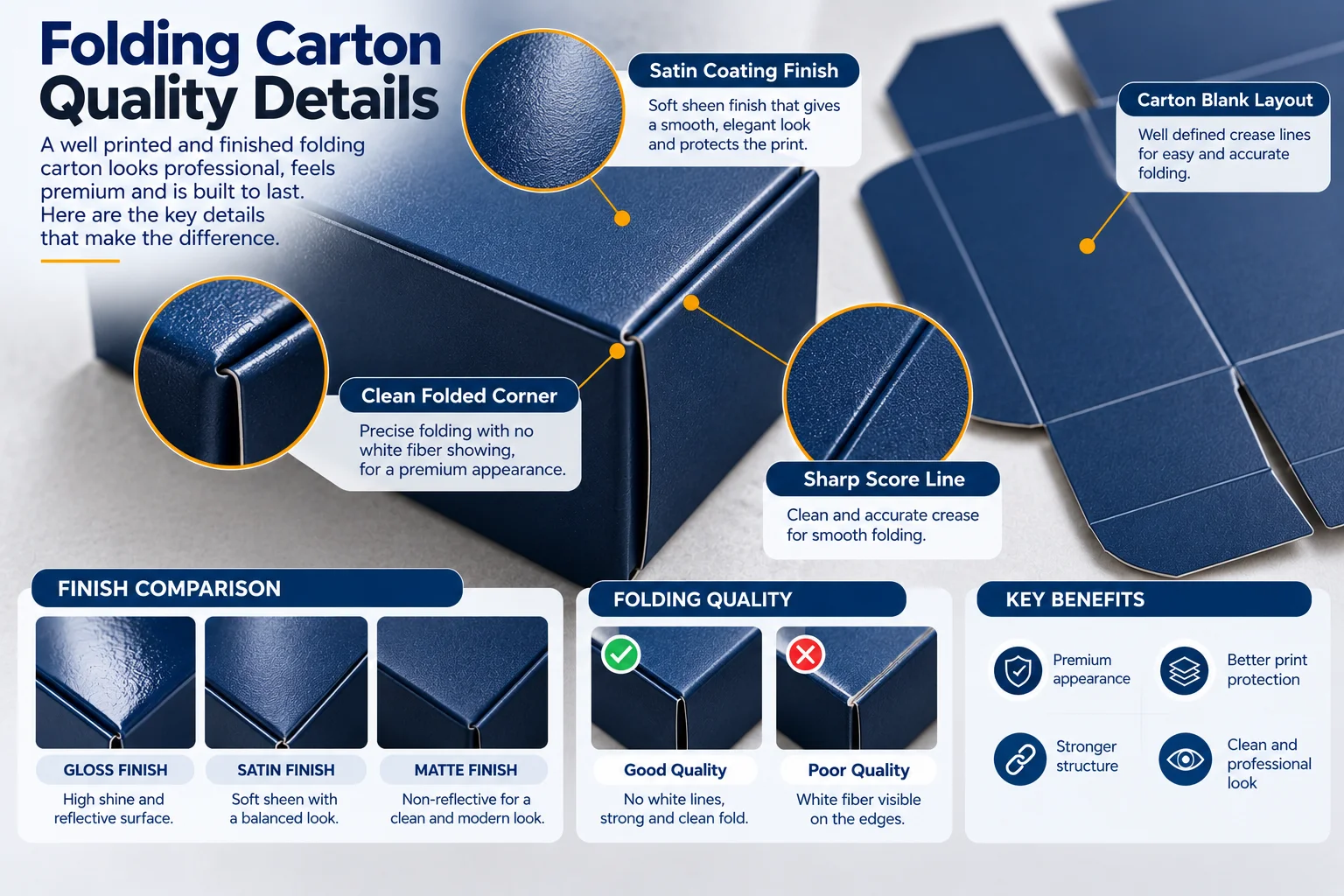
Aqueous coating rarely cracks when a box is folded, because the film bends with the board. When a fold does crack, the cause is almost always the board or a heavy ink layer rather than the coating.
Board cracks most when it is folded across the grain or scored too shallow. A dark solid color across a fold shows every crack because the white fiber breaks through. We set the grain direction and the score depth on the dieline for that reason.
Ask for a sample before the run if your design carries a dark solid across the folds of folding cartons. A plain sample shows the fold quality in a few days. The surface can show two more problems over time, which are yellowing and fingerprints.
Does Aqueous Coating Yellow or Show Fingerprints?
Aqueous coating does not yellow the way an oil based varnish can and FUJIFILM lists non yellowing among its advantages. A white carton with AQ keeps its white for the shelf life of the product under normal store lighting.
Fingerprints are a finish question rather than a coating question. Gloss hides prints best because its shine breaks up the mark. Matte and soft touch show them most, because the flat surface makes any oil look darker.
| Finish | Fingerprint visibility |
|---|---|
| Gloss AQ | Lowest, the shine breaks up the mark |
| Satin AQ | Low to medium |
| Matte AQ | Medium to high |
| Soft touch AQ | Highest, oil darkens the flat surface |
Scuffing is the related problem and our guide to scuff marks on boxes covers how packing and transit cause most of it. Food brands have one more question before they choose a coating.
Is Aqueous Coating Food Safe for Packaging and Paper Cups?
Aqueous coating can be used on food packaging when every component in it has the right FDA status for that use. A law firm that advises packaging companies explains that each component of the coating must be cleared for the proposed use on a case by case basis.
The main rule for paper and board is 21 CFR 176.170, which lists substances allowed on the food contact surface of paper and paperboard. The aqueous in that rule refers to watery foods, not to the coating. Dry foods fall under a separate section of the same part called 176.180.
Paper cups use a related idea called an aqueous barrier coating, which replaces the plastic lining inside the cup. That coating is built to hold liquid in a way the print coating on the outside of a carton never does.
For a food carton, ask for the coating supplier letter that confirms the FDA status for your food type. The other question brands ask about any coating is what it does to recycling.
Is Aqueous Coating Environmentally Friendly?
AQ coating is one of the more environmentally friendly print finishes, because it uses water as its carrier and releases very little solvent when it dries. That makes the pressroom safer and keeps the coating free of the solvent smell that varnish can carry.
An aqueous coated carton goes into the paper stream with the rest of your board. The coating is a thin film that breaks up with the fiber when the board is pulped. A laminated carton is harder, because the plastic film has to be separated from the fiber first.
Uncoated board is still the simplest material to recycle, so skip the coating on boxes that never face wear. For every other box the last question is how to order the finish you want.
How Do You Order Boxes With Aqueous Coating?
Ask for aqueous coating by name on your quote and say which finish you want from gloss, satin, matte and soft touch. Then tell us what the box will face, from rough handling and moisture to handwriting or direct food contact. Those answers decide whether AQ is enough or whether the box needs UV or lamination.
Send your dimensions through our quote form and we return a dieline and a price within the week. You can also draw the flat yourself in our free dieline generator and send it with the request. Our artwork guidelines show where to mark uncoated areas for glue flaps, codes and foil.
- Minimum order is 100 boxes per size and design and it comes down on rigid, corrugated and larger sizes
- Price breaks arrive at 500 and 1,000 units on one artwork and not across mixed designs
- Production takes 8 to 10 business days for folding carton and 10 to 12 for rigid and wrapped
- A plain sample takes 3 to 5 business days and a printed one takes 7 to 10
- No setup or tooling fees apply because the die and the plates sit inside your unit price
- Shipping is free across the United States on every order we take
Order a plain sample if you want to check the fit before the printed run. The related guides below cover the finishes buyers usually compare with aqueous coating.
Frequently asked questions
The short version
Aqueous coating is a clear water based polymer film that a press lays over wet ink to protect the print. It comes in gloss, satin, matte and soft touch. It costs the least of any protective finish and goes into the paper stream with the board.
Choose AQ for everyday cartons and move to UV or lamination when the box needs maximum gloss, a sharp spot or real wear resistance. Tell your printer what the box will face and the right finish follows from that answer.
Ready to order boxes with aqueous coating?
At The Customized Boxes we print folding cartons, kraft boxes and rigid boxes with gloss, satin, matte or soft touch AQ, from 100 boxes per size and design with free shipping across the United States.
