





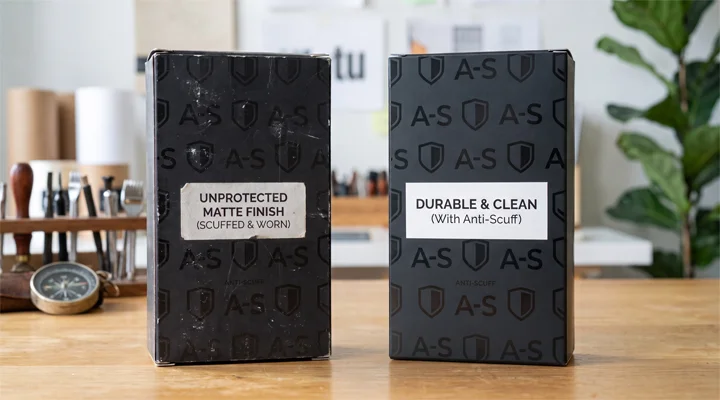
You’ve spent time getting the box design right. The matte black finish looks exactly the way you wanted it to in the proof. Then the order arrives and the boxes have faint rub marks across the surface — lighter streaks cutting across the dark finish that weren’t there when they left the printer.
This is one of the most common complaints about dark packaging finishes, and it’s almost entirely preventable. Anti-scuff coating is the fix — but most buyers don’t know to ask for it until after they’ve seen the problem on a real order. This post explains what it is, how it works, and when it’s worth including.
Table of Contents
- What is anti-scuff coating?
- Why dark finishes are more vulnerable
- When does scuffing actually happen?
- What finishes are most at risk
- Does it affect the look or feel of the box?
- When should you ask for anti-scuff coating?
- How much does it add to the cost?
- Anti-scuff vs other protective coatings
- A practical note before you order
What is anti-scuff coating?
Anti-scuff coating is a thin protective layer applied over the surface of a printed box — typically over a matte lamination or matte coating — that reduces friction between packaging surfaces during handling, stacking, and transit. It doesn’t change how the box looks or feels in any meaningful way. What it does is create a barrier that prevents boxes rubbing against each other from leaving visible marks on the surface.
It’s sometimes called anti-scratch coating or rub-resistant coating — different names for the same functional result.
Why dark finishes are more vulnerable
This is the part that surprises most buyers. Scuff marks don’t discriminate by color — but they show up dramatically more on dark surfaces than light ones.
Think about it this way: a faint rub mark on a white or cream-colored box blends into the surface. The same mark on a matte black box shows up as a visible lighter streak — sometimes looking almost silver or grey against the deep finish. On dark navy, forest green, or deep burgundy, the effect is similar.
The issue isn’t the color itself — it’s the contrast between the mark and the background. Dark finishes make that contrast impossible to ignore.
When does scuffing actually happen?
Most scuff marks happen during transit, not production. The sequence is fairly predictable:
- Boxes are packed into shipping cartons and stacked on top of each other
- During transit, cartons shift with road vibration, loading and unloading, and general movement
- The surfaces of individual boxes rub against each other, against tissue paper, against the inside of the carton
- Over a long shipping route — especially international freight — this friction accumulates
By the time the order reaches you, boxes that looked perfect coming off the production line have surface marks that weren’t there before. The longer the transit and the rougher the handling, the more visible the damage.
What finishes are most at risk
Not all finishes need anti-scuff protection equally. The risk is highest on:
- Matte lamination on dark colors — the most common combination that causes problems. Matte surfaces have slightly more friction than gloss, and dark colors show marks immediately.
- Soft-touch lamination — the velvety feel comes from a surface texture that, while luxurious to touch, is slightly more prone to showing contact marks than standard matte.
- Uncoated or minimally coated dark boards — no protective layer at all means direct surface-to-surface contact.
Without anti-scuff coating
With anti-scuff coating
Does it affect the look or feel of the box?
This is what most people ask first — and the honest answer is: not in any way you’d notice. Anti-scuff coating is thin enough that it doesn’t change the visual appearance of matte or soft-touch finishes. The surface still looks matte. The soft-touch still feels soft. What changes is the durability of that surface during the journey from production to end user.
Some buyers describe a very slight increase in surface smoothness — essentially less tactile friction — but this is subtle enough that most people wouldn’t detect it without a direct before-and-after comparison.
When should you ask for anti-scuff coating?
The clearest cases where it’s worth including:
- Any dark solid color — matte black, deep navy, dark green, charcoal, burgundy. If the background is dark and the finish is matte or soft-touch, ask for it.
- Retail packaging that needs to look perfect on shelf. If boxes go directly onto retail display after shipping — without any quality sorting — scuff marks become a customer-facing problem.
- Long-distance or international shipping. More transit time means more opportunity for friction damage. The cost of anti-scuff coating is a fraction of the cost of reprinting an order.
- Luxury or premium packaging. Soft-touch with foil or embossing is positioning itself as premium — a scuffed surface undermines that immediately.
- Gift packaging and unboxing-focused products. If the box is part of the experience — subscription boxes, PR mailers, gift sets — it needs to arrive looking the way it was designed to look.
Simple rule: dark color plus matte or soft-touch finish equals anti-scuff coating. It’s a small addition that eliminates a problem that’s genuinely frustrating to deal with after the fact.
How much does it add to the cost?
Anti-scuff coating is not a significant cost addition — it’s typically a minor per-unit uplift rather than a meaningful percentage of the overall order. Exact pricing depends on box size, order quantity, and your current finishing spec. In most cases, buyers who’ve experienced scuffing on a previous order don’t think twice about including it on the next one. The cost of reprinting or writing off a portion of a scuffed order is considerably higher.
Anti-scuff vs other protective coatings — what’s the difference?
Anti-scuff coating vs gloss lamination
Gloss lamination is naturally more resistant to scuffing than matte because the slicker surface reduces friction. If you switch from matte to gloss, scuffing becomes much less of a concern — but you lose the visual quality that matte finishes offer. Anti-scuff coating lets you keep the matte finish and add the protection.
Anti-scuff coating vs soft-touch lamination
Soft-touch lamination is a finish choice, not a protective treatment. It creates the velvety surface texture — but that texture is also what makes it slightly more prone to showing contact marks. Anti-scuff coating can be applied over soft-touch to protect the surface without changing the feel in any significant way.
Anti-scuff coating vs UV coating
UV coating adds a hard, shiny protective layer — effective for protection but it changes the surface to gloss. Spot UV is applied selectively, not over the full surface. Neither is the same as anti-scuff coating, which is specifically formulated to reduce friction damage while preserving a matte or soft surface finish.
A practical note before you order
Anti-scuff coating is one of those things that’s easy to overlook in the spec conversation — it’s not as visible as a finish choice or as obvious as a structural decision. But if your packaging uses a dark color on a matte or soft-touch finish, and it’s going through any meaningful amount of transit, it’s worth asking about before production rather than after delivery.
If you’re ordering custom hair oil boxes, cream boxes, or any dark cosmetic packaging and you’re not sure whether your finish spec needs it — ask. The answer takes about 30 seconds and could save a significant amount of frustration on the back end.
