
Home Custom Bakery Boxes Custom Patisserie Boxes
Patisserie Boxes Packaging
Patisserie Box
Patisserie Boxes Wholesale
Custom Patisserie Boxes

Custom Patisserie Boxes

Most bakery packaging is specified for a dry counter. Patisserie does not live on a dry counter. Cream, mousse, ganache and fresh fruit go into a refrigerated display case, and a box that stacks four high on the bench behaves very differently at four degrees.

That single fact decides more about a patisserie box than the printing does. It changes the board, the barrier, and whether your window fogs over the moment the case door closes.

At The Customized Boxes we make custom patisserie boxes and patisserie packaging for patisseries, bakeries, cafes, dessert brands and catering kitchens. Our minimum is 100 boxes per size. Production runs 8 to 10 business days after dieline approval. We ship FCA or EXW as standard, with DDP quoted to the US and the EU.

Google review logo
Overall Rating
10 reviews

Get Custom Quote


  • Custom Sizes Built around your product
  • MOQ 100 Boxes Per size, per style
  • Free Design Support Every file checked
  • No Setup Charges No die or plate fees
  • 8 to 10 Day Turnaround After dieline approval
  • Free US Shipping Across the US

Which Patisserie Box Size Do You Need?

Sizes get called small, medium and large across most of this industry, which tells a buyer nothing. Here are the formats we quote, with what each one actually holds.

Format External Holds
5 inch long 127 x 89 x 75 mm 2 to 3 individual pastries or one eclair
7 inch long 178 x 89 x 75 mm 4 eclairs, or 3 to 4 small tarts
9 inch square 229 x 229 x 75 mm 4 to 6 individual gateaux or petit fours
9 inch deep square 229 x 229 x 110 mm Tall entremets, choux stacks, layered desserts
11 inch square 279 x 279 x 75 mm 8 to 9 individual pastries
Single serve window 102 x 102 x 51 mm One pastry, retail grab and go

Two things set the height, and people usually only think about one of them.

The obvious one is the product. The one that catches people is the lid clearance over a piped or glazed top. A mirror glaze, a chocolate garnish, or a piped crown needs headroom, and a lid resting on a finished dessert is a returned order. Measure your tallest garnish, not your tallest cake.

What Size Macaron Boxes Do You Need?

Macarons get their own sizes because the layout is fixed by the product rather than by the box.

A standard macaron runs about 50 mm across and 8 to 12 grams, with minis at roughly 38 mm and jumbos up to 100 mm. Those numbers set everything below.

Count External Layout
6 macarons 152 x 76 x 51 mm One row
12 macarons 203 x 102 x 51 mm Two rows of 6
24 macarons 254 x 152 x 51 mm Four rows of 6

The detail that decides the box. Macarons can lie flat or stand on edge. Lying flat, the footprint is set by the diameter and the box stays shallow. Standing on edge, the box needs internal height equal to the macaron diameter, and the length is set by the shell thickness rather than the width.

Standing on edge fits more into less board and it holds them steady in transit. Lying flat photographs better when the lid comes off. Tell us which presentation you want before the dieline is drawn, because the two boxes are not the same box.

What Board and Grease Barrier Does Patisserie Packaging Need?

This is where most bakery packaging pages say food safe and stop. Food safe is not a specification. Here is one.

Board Caliper Suits
300 GSM folding carton About 0.38 mm Single serve and macaron boxes
350 GSM folding carton About 0.45 mm Standard patisserie boxes up to 9 inch
400 to 450 GSM folding carton 0.50 to 0.55 mm 11 inch, deep boxes, anything carried by a handle
E-flute kraft corrugated About 1.6 mm Catering trays, transport, stacked delivery
Kraft-wrapped grayboard 1.5 to 2.0 mm Rigid gift and seasonal collections

Grease is the other half of any patisserie packaging specification, and it is measured rather than claimed. The Kit test under TAPPI T 559 rates resistance to oil and grease on a scale of 1 to 12, where a higher number holds out more.

Product Kit rating we specify
Dry biscuits, meringue, macarons 4 to 6
Buttercream, ganache, mousse 6 to 8
Laminated pastry. Croissants, palmiers, kouign-amann 8 or higher
Fried. Beignets, doughnuts, churros 8 or higher

Laminated pastry is the one that surprises bakers. A croissant sitting in a warm van releases far more butter than a slice of cake does. A box rated for cake will show through by the time it arrives.

What Replaced PFAS in Grease Barriers for Bakery Packaging?

If you last bought bakery packaging a few years ago, this changed underneath you.

The FDA announced in February 2024 that substances containing PFAS were no longer being sold into the US market for use as grease-proofing agents on paper food packaging. By January 2025 the agency had determined that 35 food contact notifications covering PFAS-treated paper and paperboard were no longer effective.

So the question is no longer whether a box is PFAS free. It is what is doing the work instead.

  • Clay coated board. A mineral coating that resists grease and prints well. The common choice for patisserie.
  • PFAS-free chemical treatments. Applied at the mill, and rated by Kit test like any other barrier.
  • Greaseproof paper liners. A separate sheet between product and board. Cheap, effective, and it lets you use an uncoated kraft box.
  • Laminated or extrusion coated board. The strongest barrier and the hardest to recycle. Worth it for anything wet as well as greasy.

Ask for the Kit rating and the barrier type on your quote. We put both on ours.

Will the Box Hold Up in a Display Chiller?

Here is the part almost nobody covers, and it is the reason patisserie boxes fail.

A refrigerated display case runs cold and very humid. Board absorbs moisture from that air, and it loses strength as it does.

Published testing across 30 to 90 percent relative humidity found that edge crush strength is the most humidity-sensitive property of corrugated board. At low temperature combined with high humidity, edge crush values fell to as little as 22 to 34 percent of their reference value. Shear and torsional stiffness dropped to between 40 and 50 percent.

Translated into a bakery: a box that stacks four high on your bench can lose most of that stacking strength inside a chiller. That is why boxes sag, why lids sink onto the product, and why a stack that was fine at closing has slumped by morning.

There are four things you can do about it, and none of them are expensive.

  1. Go up a board weight for anything that lives in a chiller. 400 GSM instead of 350 is the single most effective change.
  2. Use a coated or laminated surface, which slows moisture pickup as well as resisting grease.
  3. Do not stack chilled boxes as high as you stack dry ones. Two high in the case, not four.
  4. Choose a two piece or tray and sleeve style, where the base carries the load rather than a folded lid.

If you tell us the box goes into a chiller, we specify the patisserie packaging differently. Most suppliers will not ask.

Do You Need a Window, and Will It Fog?

A window sells the product, and in a chilled case a plain window fogs. Warm humid air meets a cold film and condenses on it, and the customer sees a blurred rectangle instead of your dessert.

Film Use it for Note
Plain PET Ambient counter and takeaway Clear, cheap, fogs when chilled
Anti-fog PET Refrigerated display and transport Treated so condensation spreads into a clear sheet
RPET Ambient, where recycled content matters Same clarity, recycled feedstock
No window, printed lid instead Delivery and gifting More print area and no film to fog

Anti-fog film costs a little more and it is the correct answer for anything that goes into a case. If you have ever wondered why a competitor’s window stays clear and yours does not, that is the reason.

Window shape matters as well. A large window weakens a folded lid. On a 9 inch or 11 inch box we usually recommend a smaller window placed off center rather than a full panel.

Which Box Style Suits Your Product?

Different desserts need different constructions, especially once refrigeration, presentation and transport are all part of the job.

Style How it works Best for
Roll end tuck top One piece, ships flat, folds up with a hinged lid Everyday patisserie and takeaway
Two piece, base and lid Separate lid lifts off Gateaux, chilled products, gifting
Tray and sleeve Printed sleeve slides over a tray Macarons, petit fours, retail shelf
Drawer or slide box Inner tray pulls out of an outer shell Premium gifting and seasonal collections
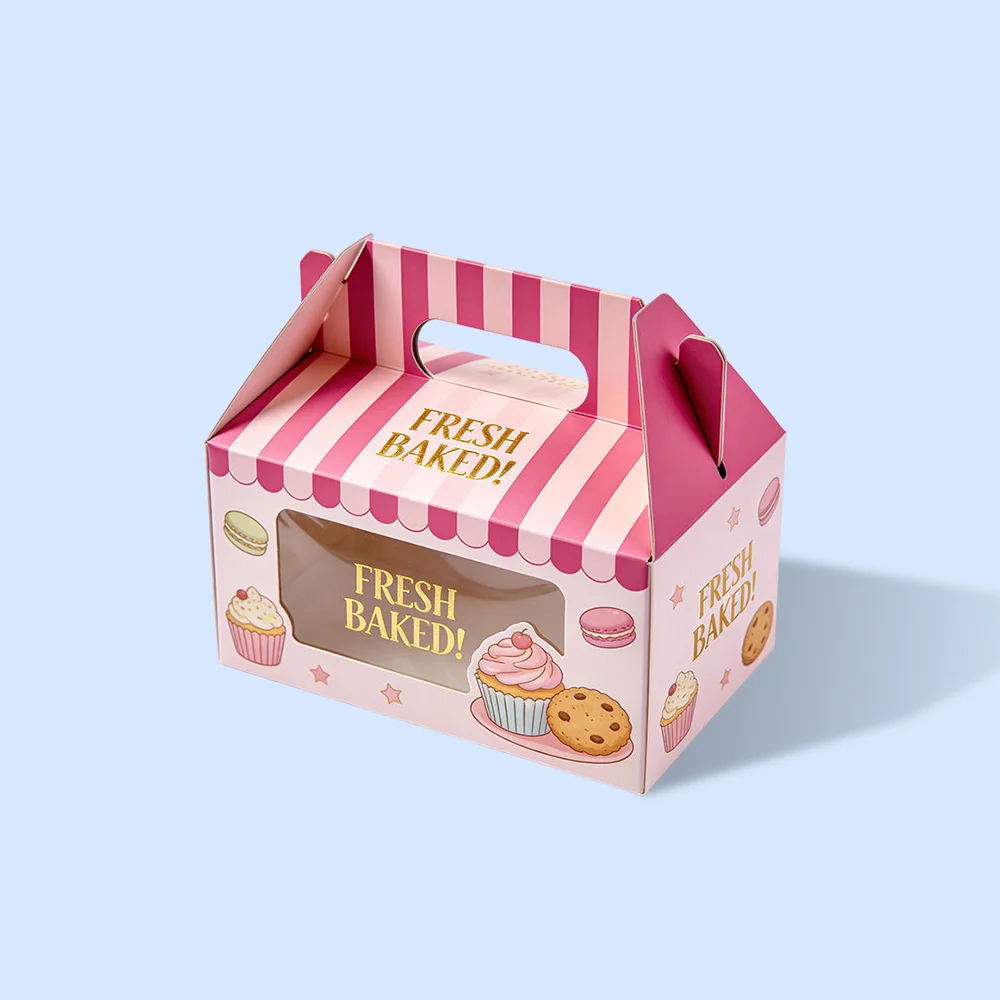
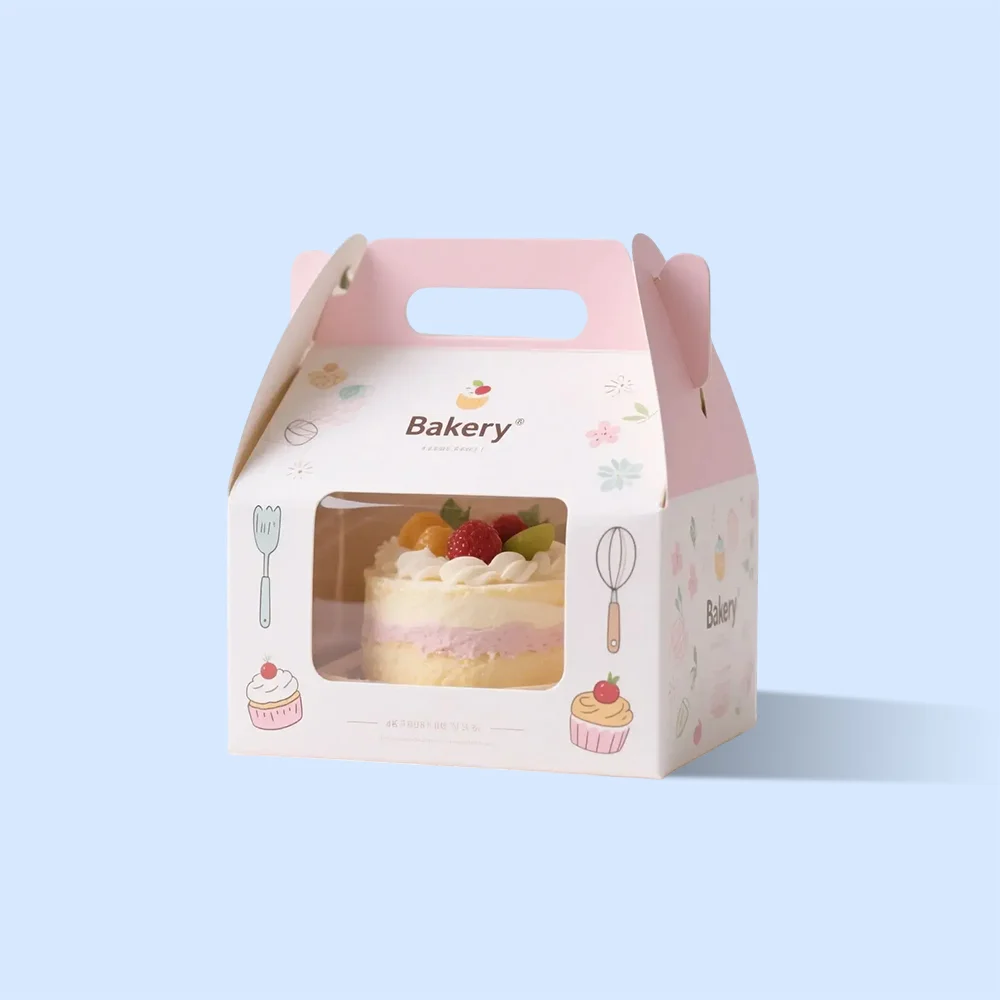
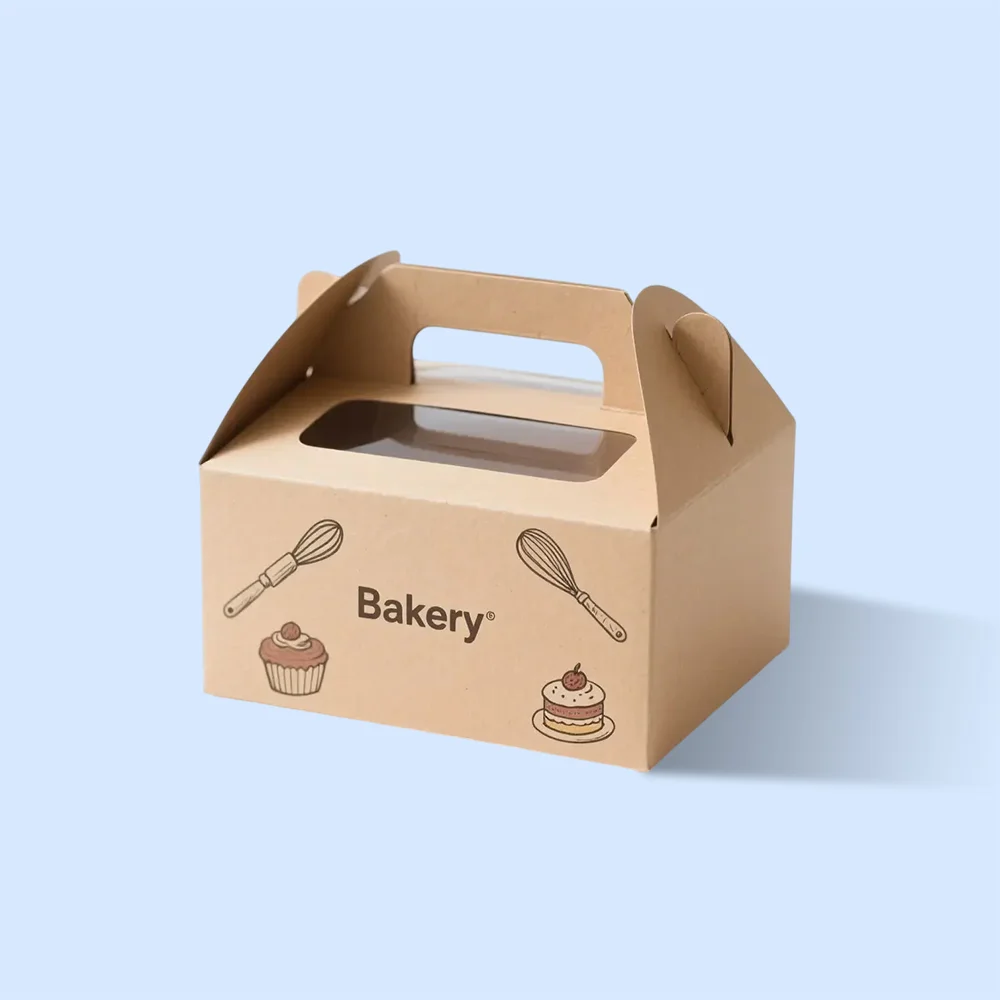
Gable box Folded handle built into the top Takeaway, events, catering
Auto bottom with window Pops open, locks flat at the base High volume counter service

For chilled products the two piece and the tray and sleeve hold up best, because the load sits on the base rather than on a folded lid.

Which Bakery Box Do You Need?

This page covers patisserie packaging specifically. If you are packing something else, these are the right pages.

Box type Best suited for What we usually quote
Cake boxes Whole cakes, 6 to 12 inch 400 GSM or E-flute with a window
Cupcake boxes Cupcakes with inserts 350 GSM with a die cut cupcake tray
Macaron boxes Macarons and petit fours 300 GSM tray and sleeve
Cookie boxes Cookies and biscuits 350 GSM with a greaseproof liner
Donut boxes Donuts and fried pastries Kit 8 or higher, E-flute for volume
Pastry boxes Mixed daily bakery and takeaway 350 GSM roll end tuck top
Bakery mailer boxes Shipping desserts to customers E-flute with an insert and a liner

Ordering several of these together is usually cheaper than adding them one at a time, because tooling is charged per size rather than per order.

What Can You Print on a Patisserie Box?

Custom printed patisserie boxes take every process below, with one constraint that applies to all of them.

Print does not go on the food contact surface. Ink stays on the outside, and the inside stays plain board, a coated liner, or a greaseproof sheet. If you want a printed interior, it is printed with food-safe ink on the surface that does not touch the product, or the product sits on a liner.

  • Digital printing. Best under 1,000 units, and it handles short seasonal runs and variable artwork.
  • Offset litho. Best above 1,000 units, with the sharpest photographic reproduction.
  • Foil stamping. Strong against kraft and against dark board.
  • Embossing and debossing. Works on 350 GSM and above. Lighter board loses the impression.
  • Matte, gloss, and soft touch lamination. Adds a moisture barrier as well as a finish, which matters for chilled products.
  • Spot UV. Best used on a matte base so it reads as a detail.

On kraft, remember that white and pale inks print over a brown base and come out muted. A flood white underprint fixes it, or design with one or two strong colors and let the kraft show through.

Minimum Order, Lead Time, and Samples

  • Minimum order: 100 boxes per size. Each size needs its own die.
  • Production: 8 to 10 business days after dieline approval. 10 to 12 for rigid and wrapped constructions.
  • Plain samples: 3 to 5 business days.
  • Printed pre-production samples: 7 to 10 business days.
  • Artwork: vector PDF or AI on our dieline with 3 mm bleed, and any Pantone colors identified.
  • Shipping terms: FCA and EXW as standard, with DDP quoted to the US and the EU.

For patisserie boxes wholesale, pricing steps down at 500 units and again at 1,000 units on the same artwork. Tooling is a one time cost, so a repeat order in the same size and style does not pay for the die again.

Send us the product dimensions including the tallest garnish, the quantity, whether it goes into a chiller, and your destination. We will specify the board and the barrier around that rather than around a standard.

Request a Quote for Custom Patisserie Boxes

Send us the product dimensions including your tallest garnish, the quantity, your destination, and whether the box goes into a chiller. If you have artwork or an existing box to match, send that too.

We will come back with a dieline sized around your product, a board and barrier specification with the Kit rating, a 3D mock-up, and a firm price.

Size Custom sizes with format of (length x width x height / depth). Standard formats: 5 inch long 127 x 89 x 75 mm, 7 inch long 178 x 89 x 75 mm, 9 inch square 229 x 229 x 75 mm, 9 inch deep square 229 x 229 x 110 mm, 11 inch square 279 x 279 x 75 mm, single serve window 102 x 102 x 51 mm
Macaron Sizes 6 macarons 152 x 76 x 51 mm, 12 macarons 203 x 102 x 51 mm, 24 macarons 254 x 152 x 51 mm. Layout changes if macarons stand on edge rather than lying flat
Material Folding carton in clay coated, white or brown kraft. E-flute kraft corrugated for catering and transport. Kraft-wrapped grayboard for rigid gift boxes
Material Thickness 300 GSM (about 0.38 mm), 350 GSM (about 0.45 mm), 400 to 450 GSM (0.50 to 0.55 mm), E-flute (about 1.6 mm), B-flute, grayboard 1.5 to 2.0 mm
Grease Barrier Kit rated under TAPPI T 559. Kit 4 to 6 for dry bakery and macarons, 6 to 8 for buttercream and ganache, Kit 8 or higher for laminated and fried pastry. Clay coat, PFAS-free treatment, greaseproof liner or lamination
Food Contact Food grade board with the barrier stated on the quote. Printing never on the food contact surface. Interior is plain board, coated liner or a greaseproof sheet
Chilled Use Specify at order stage. Board loses compression strength in a cold humid display case, so chilled boxes are quoted a heavier board, a coated surface, a two piece or tray and sleeve style, and a lower stack height
Box Structure Roll End Tuck Top (RETT), Roll End Tuck Front with Dust Flaps (RETF), Two Piece base and lid, Tray and Sleeve, Drawer or Slide, Gable, Auto Bottom with window
Window Die-cut window with plain PET film for ambient use or anti-fog PET film for refrigerated display and transport. RPET available. Smaller off center windows recommended on 9 and 11 inch lids
Color Scheme CMYK, Pantone
Printing Digital printing economical at 100 to 1,000 units. Offset lithography more economical above 1,000 units
Coatings Varnish, Lamination, Aqueous coating
Finishing options Matte, Gloss, Soft Touch, Spot UV, Embossing, Debossing, Foil Stamping. Emboss and deboss hold best on 350 GSM and above
Add-ons Die-cut inserts, cupcake trays, macaron dividers, greaseproof liners, cake boards, ribbon, printed sleeve, corrugated outer mailer
Box Sample Flat View, 3D Mock-up, Physical Sampling (On Demand). Plain sample 3 to 5 business days, printed pre-production sample 7 to 10 business days
Minimum Order 100 boxes per size. Each size requires its own die. Price steps down at 500 and again at 1,000 units on the same artwork
Artwork Vector PDF or AI on our dieline with 3 mm bleed and Pantone colors identified. Send the height of your tallest garnish, not the cake
Turnaround Time It takes 8 to 10 Business Days after dieline approval for folding carton. 10 to 12 Business Days for rigid and wrapped constructions
Shipping FCA or EXW as standard, with DDP available to the US and the EU on request. Transit time depends on mode and destination and is quoted with your order

Paper Material

white material

White Paper

Brown Kraft

Brown Kraft

Black Kraft

Black Kraft

Holographic Material

Holographic

Corrugation

E-Flute

E-Flute

B-Flute

B-Flute

Coatings

Aqueous Coating

Aqueous Coating

Varnish

Varnish

Lamination

Lamination

Finishes

Spot UV

Spot UV

Gloss

Gloss

Satin

Satin

Matte

Matte

Soft Touch

Soft Touch

Emboss

Emboss

Deboss

Deboss

Inserts and Window Patching

Packaging Insert

Packaging Insert

Window Patching

Window Patching

Colors Printing Options

CMYK

CMYK

Pantone

Pantone

Frequently Asked Questions

What is the minimum order for custom patisserie boxes?

One hundred boxes per size, because each size requires its own die. A 7 inch box, a 9 inch box, and a 12 macaron box count as three sizes and three minimums. Ordering them in one run is more efficient than adding them separately through the year.

Are your custom patisserie boxes food safe?

Yes, and the useful answer is more specific than that. We supply food grade board with a stated grease barrier and a Kit rating under TAPPI T 559, and we confirm the barrier type on your quote. Ask any supplier for those two numbers rather than for the words food safe.

Are the patisserie boxes PFAS free?

Yes, Since the FDA phase-out completed, PFAS grease-proofing agents are no longer sold into the US market for paper food packaging. Our grease resistance comes from clay coating, PFAS-free treatments, greaseproof liners, or lamination depending on the product.

Will the box perform well in a refrigerated display case?

It will if it is specified for one. Board loses a large share of its compression strength in cold, humid air. A chilled box wants a heavier board, a coated surface, a two piece or tray and sleeve style, and a lower stack height. Tell us it goes into a case and we will build it for that.

Can you add inserts and dividers to patisserie boxes?

Yes, Die cut paperboard inserts, cupcake trays, macaron dividers, and greaseproof liners are all available. An insert also helps in transit, because a dessert that cannot slide does not arrive against the side of the box.

How long does it take to produce custom patisserie boxes?

Eight to ten business days after dieline approval for folding carton, and ten to twelve for rigid constructions. Add three to five business days for a plain sample or seven to ten for a printed pre-production sample before that.

Can I get patisserie boxes with logo printing on a small order?

Yes, Digital printing makes 100 to 1,000 units economical, so a small bakery can order patisserie boxes with logo printing without committing to a litho run. Above 1,000 units offset becomes the cheaper route.