
Home Custom Cosmetic Boxes Custom Eyewear Boxes
Main Product

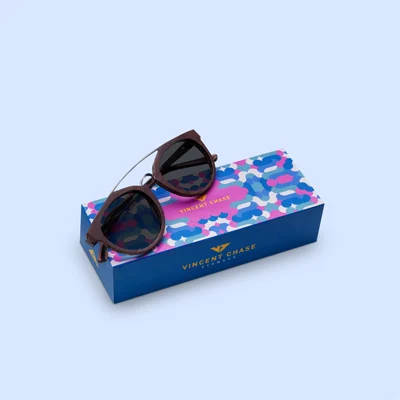
Custom Eyewear Boxes

An eyewear carton gets sized from the case with the frame inside it rather than from the frame alone. The case is the thing that actually goes into the box and it sets every internal dimension. A classic hard glasses case is published at 160 by 65 by 30 mm and an extra large one at 160 by 75 by 36 mm.

We make custom eyewear boxes at The Customized Boxes for optical brands and private label sellers and independent opticians. Eyewear packaging boxes get built from the closed case rather than from a frame width off a spec sheet. The second decider is the federal lens rule, which reaches the paperwork sitting behind the carton. The minimum order is 100 boxes per size and design and shipping is free across the United States. We charge no setup or tooling fee on any order.

Get Custom Quote


  • Custom Sizes Built around your product
  • MOQ 100 Boxes Per size, per style
  • Free Design Support Every file checked
  • No Setup Charges No die or plate fees
  • 8 to 10 Day Turnaround After dieline approval
  • Free US Shipping Across the US

Why Do You Size the Box From the Case Rather Than the Frame?

Frame dimensions describe the frame itself and they stop at its outer edge. Adult frames run roughly 121 to 145 mm across, with a lens width of about 40 to 60 mm. A case built around that frame adds hinge clearance and shell thickness on every side of it.

Published case sizes give you a starting point rather than a finished dieline. One hardshell case is marketed with internal dimensions of 6.4 by 3.0 by 2.1 inches, which describes the cavity and not the outside. Send us the case with a frame seated inside and we measure the closed unit here.

Published glasses case sizes and frame widths
Reference figure Published dimension
Classic hard glasses case 160 by 65 by 30 mm
Extra large hard case 160 by 75 by 36 mm
Hardshell case interior 6.4 by 3.0 by 2.1 inches
Adult frame width Roughly 121 to 145 mm

What Does the Impact Resistant Lens Rule Mean for Your Carton?

Eyeglasses and sunglasses sold in the United States must be fitted with impact resistant lenses under 21 CFR 801.410. The test drops a five eighths inch steel ball weighing about 0.56 ounce from 50 inches onto the lens. A lens that fractures under that ball fails and the finished pair does not ship.

The record trail matters more to the carton than the test itself does. The manufacturer keeps invoices, shipping documents and lens test records for three years. A lot field and a batch field on the panel are what tie a finished pair back to those records. The carton makes no claim about the lens unless your own test data supports the wording.

What the impact resistant lens rule covers
Rule element What 21 CFR 801.410 states
Who it covers Eyeglasses and sunglasses sold in the United States
The test A five eighths inch steel ball dropped from 50 inches
Pass condition The lens must not fracture under the drop
Records Invoices, shipping documents and test records kept three years

Which Board and Insert Does a Box That Ships on Its Own Need?

Plenty of eyewear now goes direct to the wearer and the retail carton becomes the shipper. A 300 to 350 GSM folding carton handles an optical shelf but not a delivery network on its own. E flute board takes that load and still prints a full color outer panel.

The insert does the rest of the work inside the box. A case that slides around arrives with scuffed corners and a hinge worked loose, so a die cut card cradle or a foam bed holds it still. That is the whole job of a box insert in this category. Our guide to measuring a box covers the gap between inside and outside dimensions.

Which Structure Suits Optical Retail and Direct Shipping?

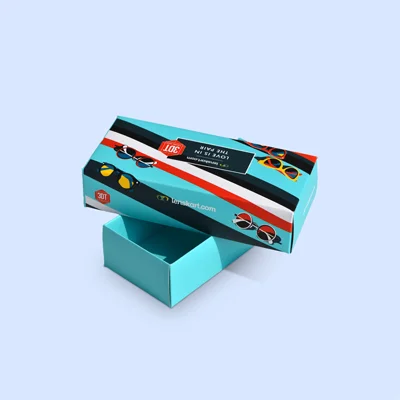
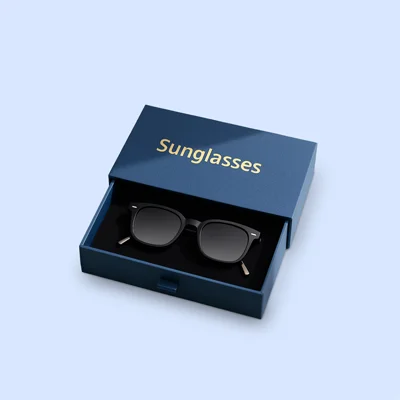
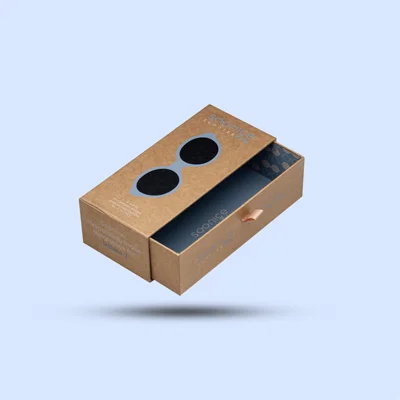
Four structures cover nearly every eyewear program that comes through our floor. A straight tuck end is the cheapest route for a cased frame going onto a shelf. A sleeve and tray turns the long panel into the face, which suits a narrow shelf position. A drawer box reads as a gift and a two piece rigid box reads as a designer line.

Foil stamping on a wrapped lid is how an optical house signals a premium frame at retail. We build those as rigid boxes with a wrapped shell and a fitted tray inside.

Should an Eyewear Box Carry a Window?

A window shows the case rather than the frame and that is the trouble with it. A shopper looking at a closed case learns nothing new through the plastic. Optical retail sells on the frame instead, which is why most display sits open on a tray.

A branded case changes that answer, because the case itself carries a designer mark worth showing. A frame packed without a case also has something worth showing through a window. A printed counter tray holds a row of cartons upright beside the till in either situation.

Minimum Order, Lead Time, and Samples

  • The minimum order is 100 boxes per size and design, so one case size starts at 100 cartons
  • Folding cartons run 8 to 10 business days after you approve the dieline
  • Rigid and magnetic frame boxes run 10 to 12 business days after dieline approval
  • A plain sample takes 3 to 5 business days and a printed sample takes 7 to 10
  • Price breaks land at 500 and 1,000 units on the same artwork

Request a Quote

Send one case with a frame seated inside and your run quantity to our quote form. We measure the closed case here and quote a tuck end and a rigid option on one dieline.

Size Built from your case with the frame inside, not from the frame alone
Reference Cases A classic hard case runs 160 by 65 by 30 mm and an extra large one 160 by 75 by 36 mm
Frame Width Adult frames run roughly 121 to 145 mm, with lens width around 40 to 60 mm
Material White SBS folding carton board, kraft board, E flute, or wrapped rigid
Board Weight 300 to 400 GSM for retail cartons, E flute where the box ships on its own
Box Structure Straight tuck end, sleeve and tray, drawer box, two piece rigid
Insert Die cut card cradle or foam bed so the case cannot slide inside the carton
Lens Rule Eyeglasses and sunglasses need impact resistant lenses under 21 CFR 801.410
Records Invoices, shipping documents and lens test records are kept for three years
Color Scheme CMYK process, Pantone spot colors. Kraft needs a white undercoat for pale colors
Coatings Matte or gloss lamination, soft touch, aqueous coating
Finishing Options Foil stamping, embossing, debossing, spot UV
Artwork Vector PDF or AI on our dieline, 3 mm bleed, Pantone identified
Minimum Order 100 boxes per size and design
Price Breaks 500 and 1,000 units on the same artwork
Estimated Price Range $0.60 to $5.00 per box for a printed folding carton. The range moves with size, board and finish
Box Sample Flat View, 3D Mock-up, Physical Sampling (On Demand)
Setup and Tooling We do not charge setup or tooling fees. The die and the printing plates are included in your unit price, on the first order and on every one after it
Turnaround Time 8 to 10 business days after you approve the dieline
Shipping Free across the United States
How To Order

How To Order Custom Boxes

Four steps from your first message to boxes on your dock. There are no setup or tooling fees at any stage, and delivery is free across the contiguous US.

  1. Tell Us About Your Product

    Send your product size, the packed weight and the quantity you need. We recommend the board grade and box style that fit, then quote a unit price with no setup fee.

  2. Approve Your Dieline

    Upload artwork as a vector PDF or AI file and we check it against our artwork guidelines for bleed, resolution and Pantone colors. If you have no artwork yet, our team draws it on our dieline for you.

  3. Check a Real Sample

    A plain structural sample takes 3 to 5 business days and a printed sample takes 7 to 10. You hold the actual box before the full run starts.

  4. Production and Free Delivery

    Production runs 8 to 10 business days after you approve the dieline. We pack your boxes and deliver them free across the contiguous US, with export orders quoted separately.

Start Your Quote

Minimum order is 100 boxes per size. Price breaks at 500 and 1,000 units.
Or build your own dieline first on our free dieline generator.

Build Your Dieline Free, Before You Order

Most suppliers send a dieline after you place an order. Ours is a live tool on this site. Pick a box style, type your own dimensions and download the file in a few seconds, with no account and no charge.

The Customized Boxes Download
Reverse Tuck End
reverse tuck · dust flaps Unit
mm cm in
Size
120120–200 6030–60 160100–550
Material Cardstock SBS (White) Generate
Details Ready to download. inside119.4 × 59.4 × 158.9 mm outside120.4 × 60.4 × 160.9 mm sheet375.5 × 309 mm boardSBS · 0.5 mm
CutCreaseBleed
Reverse tuck end dieline, 120 x 60 x 160 mm, from our generatorRed lines are cut, blue dashed lines are crease and the green outline is the bleed edge.
Sheet 375.5 × 309 mm Die 120 × 60 × 160 mm

Open the Dieline Generator

Every box style we make is in the tool, at any size you type. Exports to AI, PDF and SVG, and our design team checks your artwork on that dieline free of charge.

Eyewear Box Questions Buyers Ask

The answers below cover sizing around a case and the federal lens rule and board choice. Send us one case with a frame inside if your question is not answered here.

What size should a custom eyewear box be?

It comes from the closed case with the frame seated inside rather than from the frame alone. A classic hard case is published at 160 by 65 by 30 mm and an extra large one at 160 by 75 by 36 mm.

Does the impact resistant lens rule change the carton?

That rule changes the paperwork behind the box more than it changes the panel. Eyeglasses and sunglasses sold in the United States need impact resistant lenses under 21 CFR 801.410. The carton makes no claim your test data does not support. A lot field and a batch field tie each pair to its records.

Which board holds up when the box ships on its own?

E flute board is the answer once the retail carton doubles as the shipper. A 300 to 350 GSM folding carton suits a shelf and a shipper needs the flute behind it. E flute still prints a full color panel and takes a laminate over the top.

Should an eyewear box have a clear window in it?

Usually not, because the window shows a closed case rather than the frame a shopper wants. A branded case with a designer mark is the exception worth cutting a window for. A frame packed loose without a case also has something worth showing through the panel.

Which structure suits a premium optical frame?

A two piece rigid box with a wrapped shell and a fitted tray does that job. Foil stamping on the lid is the usual signal for a designer range at retail. A drawer box sits one step below rigid and still reads as a gift at retail.

How long does the lens test paperwork have to be kept?

The manufacturer keeps invoices, shipping documents and lens test records for three years under 21 CFR 801.410. That trail is why a lot field and a batch field belong on the carton. A pair with no batch on the box has nothing tying it back to a record.

Free of charge

Hold the Box Before You Commit

A quote is easy to compare on a screen. A sample is the only thing that tells you how the board feels in the hand and whether your product sits the way you expect. We send samples free, and you can pick the one that answers your question.

  • Plain Sample Unprinted, so you can judge the structure, the board and the fit around your product. 3 to 5 business days
  • Random Sample A box from recent production, so you can see our print quality and finishes in the hand. Ships from stock
  • Printed Pre-Production Sample Your own artwork on your own board, exactly as the run will be printed. 7 to 10 business days

Order a Sample Box

A flat view and a 3D mock-up come free before anything prints. Already know what you need? Get a quote instead.