





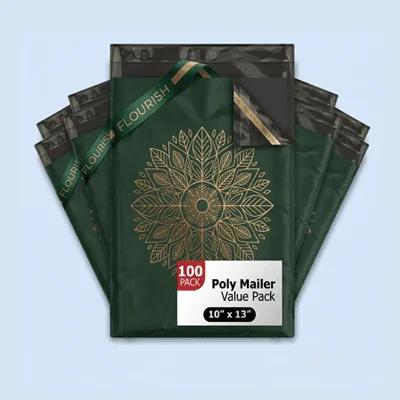


Why Does 10 x 13 Miss the Cheapest USPS Tier?
USPS prices a soft pack by adding the length and the width of the empty mailer laid flat. The height of the packed mailer plays no part in that calculation at all. That single rule decides what a 10 x 13 costs you every day.
USPS changed these tiers on 12 July 2026 and cut Ground Advantage soft pack cubic from ten tiers down to five bands. The new bands and the mailer sizes that land in each one look like this.
| Soft pack tier | Length plus width | Where a mailer lands |
|---|---|---|
| 0.10 cubic foot | Up to 21 inches | 9 x 12 sits exactly on the line at 21 inches |
| 0.20 cubic foot | More than 21 up to 27 inches | 10 x 13 lands here at 23 inches |
| 0.30 cubic foot | More than 27 up to 31 inches | 12 x 15.5 lands here at 27.5 inches |
| 0.40 cubic foot | More than 31 up to 34 inches | 14.5 x 19 lands here at 33.5 inches |
| 0.50 cubic foot | More than 34 up to 36 inches | The largest soft pack that still prices cubic |
A 10 x 13 adds up to 23 inches and sits in the 0.20 band. A 9 x 12 adds up to 21 inches and sits on the top edge of the 0.10 band. The two mailers hold almost the same folded garment but they do not price the same.
None of this changes anything about what we charge you for the mailers themselves. Our mailers ship to you free across the United States. It changes what USPS charges you when the mailer goes out to your customer, which is the cost that repeats on every order.
Should You Drop to 9 x 12 Instead?
Not always. The honest answer depends entirely on what you are folding into it.
A 9 x 12 gives you 108 square inches of face and a 10 x 13 gives you 130. That is about 20 percent more room for the same postage class but a tier higher on cubic pricing. A single folded tee fits comfortably in either one of them. A lightweight hoodie usually does not fit 9 x 12 without forcing it.
| If you ship | Try first | Why |
|---|---|---|
| One folded t-shirt | 9 x 12 | Sits on the 21 inch line and holds the cheapest tier |
| Two folded t-shirts | 10 x 13 | The extra inch each way stops the seal straining |
| A lightweight hoodie at 8 to 12 oz | 10 x 13 | This is the size that garment is built around |
| A midweight hoodie at 12 to 16 oz | 12 x 15.5 | Covers most hoodie shipments in the market |
| Leggings, socks or underwear multipacks | 9 x 12 | Small folded volume, no reason to pay the higher tier |
Leave at least one inch of clearance around the folded garment on every side. A mailer stuffed to its seams splits at the corner seal rather than at the adhesive, and that failure happens in the sorter rather than at your bench.
Is the Stated Size the Usable Space or Does It Include the Flap?
It is the usable space and the flap sits on top of that as extra film. This detail trips up more first time buyers than anything else in the category.
A poly mailer is always measured flat and empty rather than packed. You measure straight across the opening for the width and from the bottom seam up to where the flap begins for the height. So a 10 x 13 gives you 10 inches across and 13 inches of usable depth. The adhesive lip sits above that 13 inches and is never counted.
That convention matters for two separate reasons. Your product has to fit inside the stated 13 inches rather than inside the total length of the film. And USPS measures the mailer the same way we do, so the 23 inch tier figure holds.
What Mil Thickness Do You Actually Need?
A mil is one thousandth of an inch. One mil equals 0.0254 millimeters, which is 25.4 microns, so a supplier quoting microns is describing the same film in different units.
| Mil | Microns | Where it belongs |
|---|---|---|
| 2.0 mil | about 51 microns | The ecommerce standard for folded apparel |
| 2.5 mil | about 64 microns | Heavier garments and anything with a zipper or hardware |
| 3.0 mil | about 76 microns | Books, boxed items and products with corners |
| 4.0 mil | about 102 microns | Industrial use, where puncture is the real risk |
Two mil is the right answer for most apparel and it is where the volume sits. Move to 2.5 when the garment carries a zip pull, a button or a metal snap. Those press against the film inside a sorter and a 2 mil wall gives way at exactly that point.
Going to 3 mil for a soft garment is money spent on nothing the customer notices. Going to 2 mil for a hardback book is a return waiting to happen.
What Is the Film Actually Made Of?
Standard mailers run coextruded polyethylene. Coextruded means the film is made in layers rather than as one sheet. That layering is what lets a thin wall stay opaque and still tear cleanly along a seal.
Most stock is low density polyethylene, which carries resin code 4. That code matters for what your customer can do with the mailer afterward, and it is the reason a poly mailer is not a curbside item.
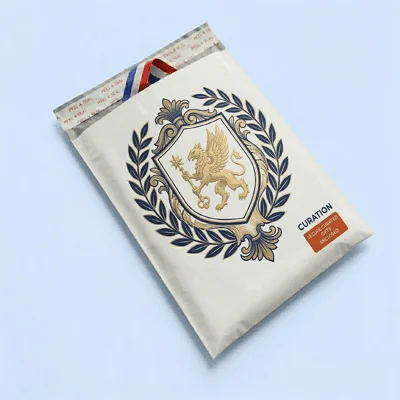
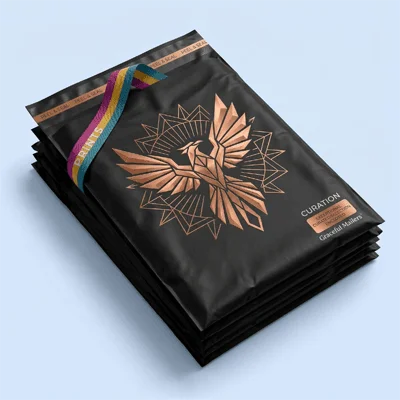
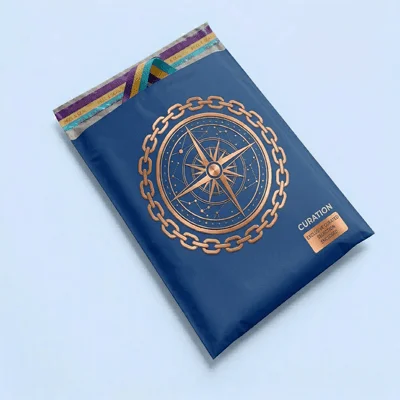
Opacity is worth specifying rather than assuming. A white outer with a gray or black inner layer stops anyone reading a garment color or a branded box through the film. If you ship anything where the contents should not be visible on a doorstep, say so when you send the artwork.
Can Your Customer Recycle a Poly Mailer?
Not in the curbside bin. This is where a great deal of packaging artwork is now out of date.
Plastic bags, wraps and films are not accepted in most curbside programs in the United States. The route for polyethylene film is store drop off, where the material is collected in bins at participating retailers and has to be clean and dry.
Two things changed recently and both affect what you print.
- The How2Recycle Store Drop-off label was redesigned and it no longer carries the chasing arrows symbol. If your current artwork shows the old label, it is out of date
- California SB 343 restricts which products may display a recycling label or the chasing arrows symbol at all. A blanket recyclable claim on a mailer sold into California is a compliance question rather than a design choice
The federal picture has not moved. The FTC Green Guides are still the 2012 edition and the promised revision remains pending. State law is therefore what actually sets the rules on recyclability claims right now.
There is also a claim we get asked about that we will not make for you. Minimum recycled content laws in the United States mainly cover PET beverage containers and trash bags. No federal or state minimum currently applies to ecommerce poly mailers. A recycled content figure on your mailer is therefore a voluntary claim you have to be able to substantiate.
What About Recycled Content and Padded Options?
Post consumer recycled film is available and it is the most requested sustainability option in this category. It runs slightly less consistent in color than virgin film and a printed white on a recycled ground reads a touch warmer.
| Option | What changes | Worth it when |
|---|---|---|
| Post consumer recycled film | Slightly less color consistency, same strength at the same mil | Your brand makes a material claim you can back |
| Bubble lined poly | A bubble layer bonded inside the mailer | The product has hard edges but does not warrant a box |
| Padded paper mailer | Paper outer with a paper or bubble lining | You want a curbside recyclable route instead of store drop off |
| Rigid mailer box | A printed corrugated box rather than a film mailer | The unboxing itself is part of the product |
If protection is the reason you are considering a bubble lining, look at a custom mailer box before you commit. A film mailer with bubble inside costs more than plain film and still cannot do what a corrugated wall does.
How Do You Print a Poly Mailer?
Film printing is not board printing and the differences are worth knowing before you send artwork.
Flexographic printing is the volume route. Each color needs its own plate, so a one or two color design is dramatically cheaper per unit than a four color one. Most brands in this category run one color on a colored film rather than four colors on white.
- One color flexo is the standard and it suits a logo, a wordmark and a simple pattern
- Two color flexo gives you a logo plus an accent without moving to process printing
- Full coverage flood color with a knocked out logo reads strongly and still runs as one color
- Digital print makes short runs workable because there is no plate to pay for
- Solid dark films hide the seam and the seal line better than a pale film does
Keep fine detail away from the seal areas. The bottom seam and the adhesive lip both get heat and pressure, and thin lines close to either one distort. Set your safe area at least half an inch inside every edge.
Which Closure and Return Options Do You Need?
| Feature | What it does | Best for |
|---|---|---|
| Single self seal strip | One peel and press adhesive lip | Standard outbound, lowest cost |
| Double strip for returns | A second adhesive strip below the first | Apparel, where returns are routine |
| Tear strip | A pull line that opens the mailer cleanly | Brands where opening is part of the experience |
| Tamper evident seal | The seal shows if it has been opened | Higher value goods and dispute protection |
| Reinforced bottom seam | A wider heat seal at the base | Heavier fills near the top of the mil range |
The return strip is the one that pays for itself in apparel. Fit rates being what they are, a customer who can reseal the mailer they received sends the item back in the packaging you already paid for.
What Should You Send Us Before We Quote?
| What you send us | What we build from it |
|---|---|
| Your product folded as you actually ship it | Whether 9 x 12, 10 x 13 or 12 x 15.5 is the right size |
| The heaviest item that will go in this mailer | Mil thickness and whether the base seam needs reinforcing |
| How many colors your artwork runs | Flexo or digital, and the plate count |
| Whether you take returns in the same mailer | Single or double adhesive strip |
| Any recyclability or recycled content wording | Whether the claim can go on the print as written |
| Your annual volume across all sizes | Price breaks and how many designs share a run |
Send us the garment folded rather than a flat measurement. Apparel takes up more depth than people estimate and the fold is what decides the size.
Minimum Order, Lead Time, and Samples
- Minimum order: 500 mailers per design because film runs need a minimum web length
- Plain unprinted sample: 3 to 5 business days in your chosen mil
- Printed pre production sample: 7 to 10 business days from approved artwork
- Production: 10 to 12 business days after you approve the print proof
- Price breaks: at 2,500 units and again at 10,000 units on the same artwork
- Setup and tooling: no charge on the first order or on any reorder after it
- Artwork: vector PDF or AI at 100 percent scale with a half inch safe area
- Shipping: free across the United States
Request a Quote
Send us your product folded as you ship it, the heaviest item that will go in this mailer and your artwork. We will come back with a size recommendation against the USPS tiers, a mil specification, a print route and a unit price. You can also start on our quote page if you already have your sizes.
 The Customized Boxes